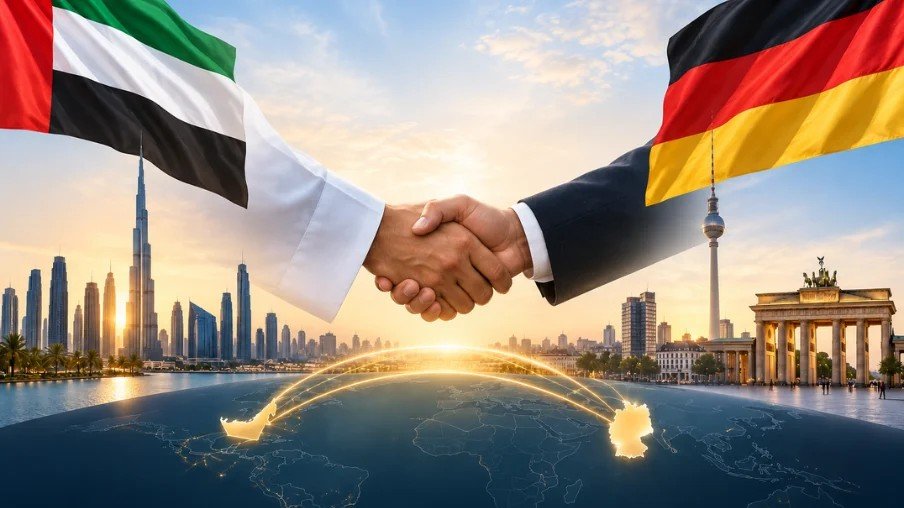
Berlin Rolls Out the Red Carpet as UAE Deepens Its European Partnerships
UAE President Sheikh Mohamed bin Zayed Al Nahyan wrapped up a closely watched state visit to Germany this week, one that Emirati officials say will produce multibillion-euro agreements spanning artificial intelligence, energy and technology — a haul significant enough to underscore just how central Germany has become to the UAE’s strategy of diversifying its international partnerships.
The president’s aircraft was escorted into German airspace by military aircraft in a gesture of welcome, and he was received in Berlin with a 21-gun salute and a full guard of honour, a level of ceremony reflecting the weight both countries have placed on the visit. President Frank-Walter Steinmeier hosted Sheikh Mohamed at Villa Borsig, with Chancellor Friedrich Merz also meeting the UAE leader as part of a tightly choreographed two-day programme that saw flag-lined streets cordoned off and heavy police deployment across central Berlin.
What’s Actually Being Signed
Ahead of the visit, senior Emirati diplomat Lana Nusseibeh told reporters at a briefing that the UAE and Germany would use the visit to make “a number of key announcements and multibillion-euro agreements across investment, business, technology, AI and energy” — language that signals a deliberately broad and substantial package rather than a single headline deal. While full details of individual agreements were still emerging as the visit concluded, the emphasis on AI and energy in particular reflects two sectors where the UAE has been aggressively building international partnerships over the past several years.
The energy dimension builds on an already active relationship. Abu Dhabi’s Masdar holds a 49 percent stake, valued at €488 million, in Germany’s 476-megawatt Baltic Eagle offshore wind farm, which became fully operational in July 2025 and now supplies electricity to roughly 475,000 homes while preventing an estimated 800,000 tonnes of CO2 emissions annually. That project has served as something of a template for the kind of large-scale, capital-intensive clean energy partnership both governments appear keen to replicate.
A Relationship With Deep Roots
Diplomatic ties between the UAE and Germany date back to 1972, and the relationship has grown steadily since a strategic partnership was formalised in 2004. Bilateral trade between the two countries exceeded $15.5 billion in 2025, and Germany has cemented its position as the UAE’s most important partner within the Gulf region. Roughly 2,000 German businesses now maintain offices in the UAE, including major names such as BMW, Siemens and ThyssenKrupp, alongside rail operator Deutsche Bahn, which played a significant role in helping establish Etihad Rail’s first freight services.
During his visit to the Bundestag, Sheikh Mohamed was received by Julia Klöckner, President of the German parliament, along with a number of members of parliament, who welcomed him and expressed appreciation for the visit as a reflection of the strength of bilateral relations. Discussions there focused specifically on parliamentary cooperation as a pillar of the broader relationship, with Sheikh Mohamed emphasising the shared human values connecting the two nations and the role of parliamentary institutions in advancing peaceful coexistence and cultural exchange. He was accompanied throughout by a senior UAE delegation including Saqr Ghobash, Speaker of the Federal National Council, and Dr Sultan bin Ahmed Al Jaber, Minister of Industry and Advanced Technology — whose presence alongside Al Jaber in particular reinforces the technology and industrial dimension of the visit’s agenda.
Why the Timing Matters
The visit’s timing carries its own significance. It comes as the US-Iran conflict continues to roil the wider Gulf region, creating uncertainty that has pushed a number of midsize powers, the UAE among them, to actively diversify their strategic and economic partnerships rather than depend on any single set of alliances. Strengthening ties with a major European economy like Germany fits squarely within that broader hedging strategy, giving the UAE additional economic and diplomatic ballast at a moment when regional dynamics remain genuinely unpredictable.
For Germany, the calculus runs in a complementary direction: deepening ties with a capital-rich Gulf partner like the UAE offers access to sovereign wealth investment and energy cooperation at a time when European economies are themselves navigating a complex mix of energy security concerns and efforts to accelerate their own clean energy transitions.
What Comes Next
With the formal state visit now concluded, attention turns to the practical follow-through on the agreements announced — how quickly the promised AI, energy and technology deals translate into signed contracts, operational projects and measurable investment flows. Given the scale of ambition signalled ahead of the visit, both governments are likely to face expectations of delivering visible, near-term progress on at least some of the announced initiatives in the months ahead, particularly in the energy sector where the Baltic Eagle partnership has already demonstrated what a successful UAE-Germany collaboration can look like in practice.


Comments 1