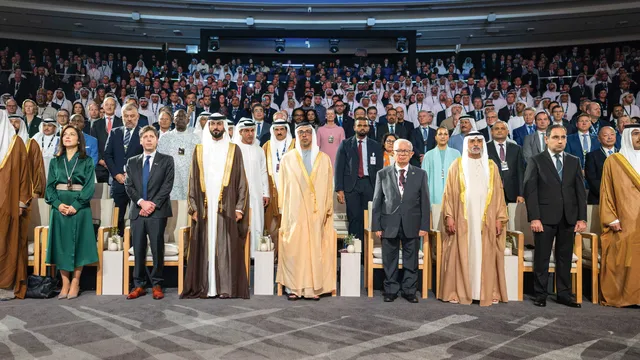
ABU DHABI — One of Abu Dhabi’s biggest industrial projects has secured its funding. TA’ZIZ announced at ADIPEC 2026 that it has reached the financial close of AED 5.1 billion for two strategic projects in Ruwais.
The company said both transactions were oversubscribed. In project finance, that means lenders offered more money than was needed. It is generally read as a sign of confidence in a project and in its sponsor.
What was financed
The financing covers two projects in Ruwais, in Abu Dhabi’s Al Dhafra region, that sit at the centre of TA’ZIZ’s portfolio: an ammonia project and a terminal. The company described the financing as reinforcing international investor confidence in TA’ZIZ, in Abu Dhabi’s industrial growth strategy and in the UAE’s position as a leading destination for long-term infrastructure investment.
The coverage reviewed for this report did not list the banks and institutions involved, the breakdown between the two projects, the loan tenors or the interest terms. Those details would normally come in a later statement from the lenders.
Construction is well advanced
The financial close comes late in the build, which is unusual. In many projects, financing is arranged before work starts. Here, construction was already far along. TA’ZIZ said engineering, procurement and construction (EPC) works on the ammonia project, awarded to Tecnimont, are more than 90 per cent complete. EPC works on the terminal, awarded to Rotary Engineering, are around 70 per cent complete.
That progress matters for lenders. A project that is almost built carries less construction risk than one that has yet to break ground. It also suggests the debt may replace earlier funding and give the company a longer-term capital structure.
Why Ruwais matters
Ruwais is among the UAE’s principal industrial sites. The coastal area in Al Dhafra already hosts a major refining and petrochemicals complex, and Abu Dhabi has been building out the surrounding Al Ruwais Industrial City to attract manufacturing, chemicals and energy-related investment. Last year, TA’ZIZ was reported to have awarded more than $2 billion of contracts for infrastructure there.
Projects such as these are intended to turn the UAE’s gas and hydrocarbon resources into higher-value products. Ammonia, for example, is used in fertilisers and is increasingly discussed as a carrier for hydrogen. A terminal gives producers the means to store and ship those products to customers abroad.
A market test during a tense period
The announcement carries weight because of the setting. The Gulf is dealing with disruption to shipping and a US-Iran standoff, yet lenders still oversubscribed the transactions. That does not remove the risks of the region, but it suggests investors see long-term demand for the UAE’s industrial products and confidence in its finances.
It also fits a wider pattern at ADIPEC. Organisers reported that last year’s event logged tens of thousands of agreements worth tens of billions of dollars. This year’s edition, which closes today, has featured partnerships on artificial intelligence in energy, LNG supply and new gas developments. Financing news adds a different dimension, because it shows that money is being committed, not just agreed in principle.
Questions that remain
Several details have yet to emerge. When will the ammonia plant and the terminal begin operations? Who will buy their output? How will exports be routed if shipping through the Strait of Hormuz remains uncertain? The company has not addressed those points in the announcement reviewed here.
Observers will also watch how the financing is structured, and whether it sets a model for other industrial projects in Al Dhafra.
What this means for Abu Dhabi
For Abu Dhabi, the immediate meaning is practical. A fully funded project reduces the risk that construction will stall for lack of capital, and it supports jobs and contractors in the region. In the longer term, it adds to the emirate’s effort to build an industrial base that does not depend only on selling crude oil.
The result for TA’ZIZ is a stronger balance sheet and a clearer path to completion. The next test will be whether the two projects are delivered on schedule and whether they find buyers.


Comments 1