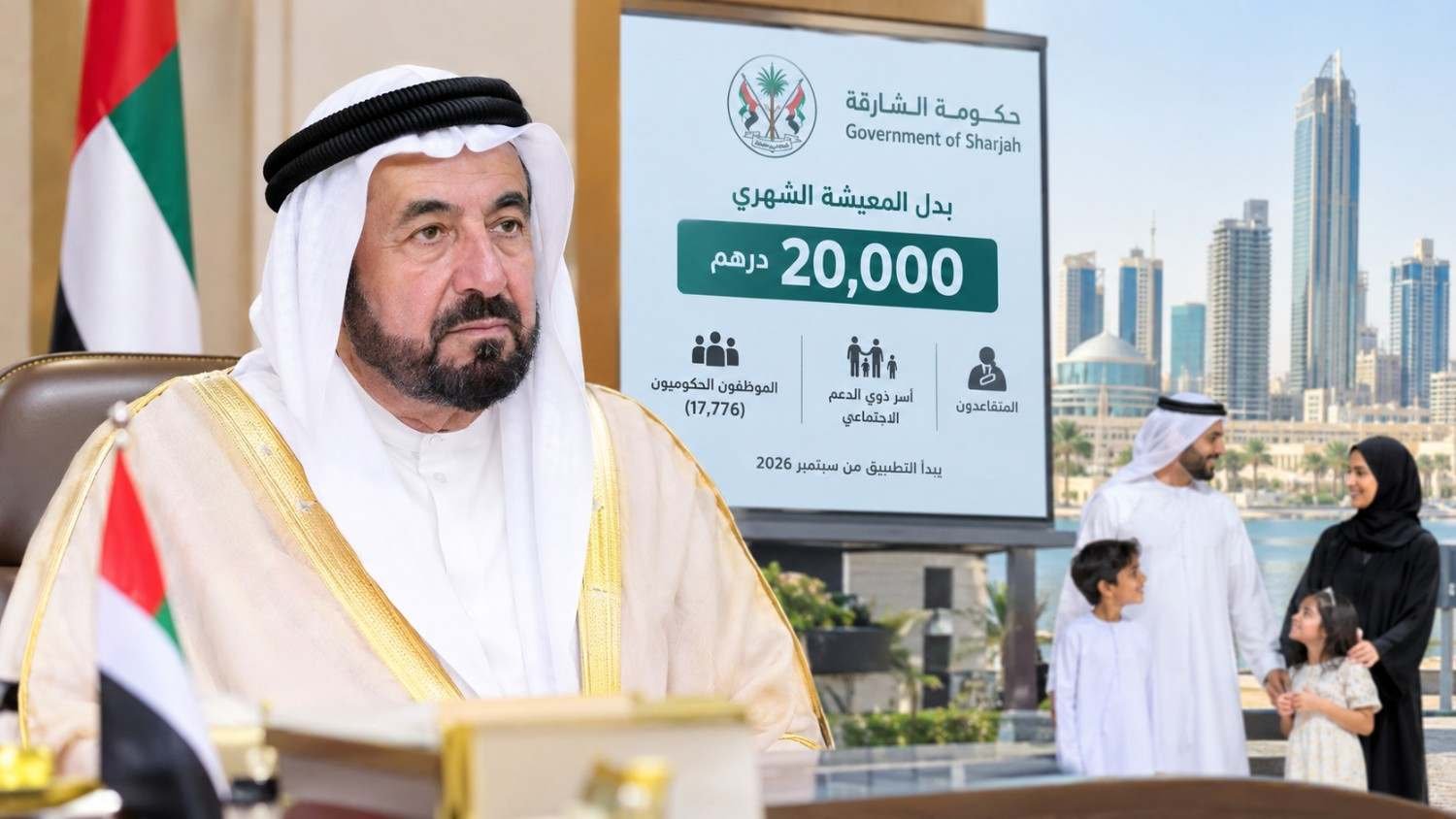
A Major Financial Boost for Sharjah Households
In one of the most consequential domestic policy announcements to come out of the UAE this month, Sharjah’s Ruler, His Highness Sheikh Dr Sultan bin Muhammad Al Qasimi, has approved a significant increase to the emirate’s “dignified living allowance,” raising it to AED 20,000 a month for a wide cross-section of government employees, retirees and families receiving social support.
The decision, effective from September, is one of the largest single welfare adjustments seen in Sharjah in recent years, and it reflects a broader push by the emirate’s leadership to address the rising cost of living faced by Emirati households, particularly as inflationary pressures and regional economic uncertainty have made household budgeting more difficult for many families across the UAE.
Who Benefits, and By How Much
According to figures released alongside the announcement, the change touches several distinct groups. The largest is Sharjah’s own government workforce: 17,776 employees will see their minimum monthly income floor lifted to AED 20,000, a move the emirate says will cost more than AED 720 million annually.
Beyond current staff, the policy extends to those who have already left government service. Some 2,251 retirees from Sharjah’s government will have their pensions topped up to the new AED 20,000 threshold, at an annual cost of just over AED 113 million. A further 5,300 retirees who never worked directly for the Sharjah government, but who receive supplementary grants through other channels, will also see their monthly income raised to the same level, adding roughly AED 159 million a year to the programme’s overall cost.
Families receiving social assistance from the Sharjah government form the fourth and final group covered by the decision. Around 6,652 households will see their monthly support lifted to the AED 20,000 minimum, at an estimated annual cost of AED 195 million. Taken together, the total annual cost of the expanded allowance across all four categories is estimated at more than AED 1.18 billion.
The Thinking Behind the Decision
Officials from the Sharjah Media Office described the move as the product of detailed studies into the monthly consumption needs of Emirati families, an approach that has become increasingly common across the UAE as leadership at both the federal and emirate level looks to calibrate welfare and public-sector pay policies against real-world living costs rather than fixed historical benchmarks.
Sheikh Sultan has, over recent years, positioned social welfare and family support as a consistent priority for his government, with periodic reviews of allowances, housing support and retirement benefits forming part of a broader effort to ensure Emirati citizens in Sharjah maintain what officials describe as a dignified standard of living, even amid a fast-changing regional and global economic backdrop.
How It Fits Into the Wider UAE Picture
The Sharjah announcement lands at a moment when cost-of-living questions are receiving heightened attention across the UAE. Earlier this month, the country’s Fuel Price Committee confirmed another round of increases to petrol and diesel prices for September, adding to household transport costs even as wages in many sectors have remained comparatively steady. Housing costs in Sharjah, which has traditionally served as a more affordable alternative to Dubai for many residents commuting into the neighbouring emirate, have also been on an upward trajectory in recent quarters.
Against that backdrop, the decision to lift the living allowance to AED 20,000 is likely to be read by many Sharjah residents as a direct and tangible response to affordability pressures, rather than a purely symbolic gesture. For a government employee whose income was previously below the new threshold, the change represents an immediate and material increase in take-home pay from September onward.
Reaction and What Comes Next
Local commentary since the announcement has been broadly positive, with many pointing to the scale of the commitment – over AED 1 billion annually – as evidence of Sharjah’s continued fiscal capacity to invest heavily in citizen welfare even during a period when regional geopolitical tensions have added uncertainty to Gulf economies more broadly.
Analysts tracking public-sector policy across the UAE say the move could also put pressure on comparisons with allowance structures in other emirates, though no other government has yet signalled a matching adjustment. For now, the focus in Sharjah is on implementation, with the new AED 20,000 floor already in effect for the thousands of employees, retirees and families it covers as of this month. Next Article


Comments 2