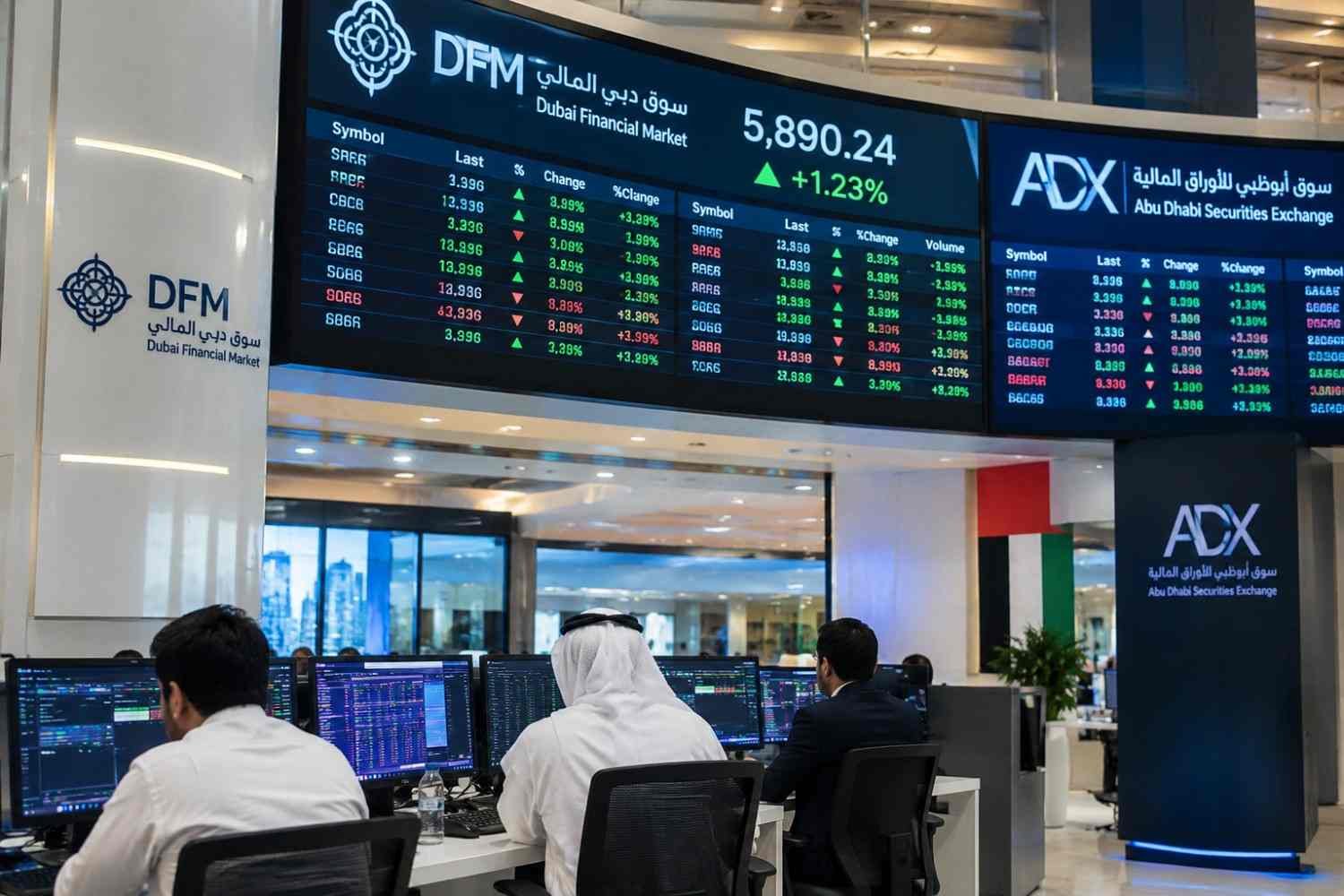
A Split Session Across the UAE’s Two Exchanges
The UAE’s two main stock exchanges delivered contrasting performances as trading resumed for the week, offering investors a snapshot of a market that remains resilient overall but far from uniformly bullish. In Dubai, the Financial Market’s benchmark index edged higher, climbing 0.12 per cent to move above the 5,890-point mark. Across the water in the capital, the Abu Dhabi Securities Exchange told a slightly different story, with its index slipping 0.27 per cent over the same session.
For seasoned observers of Gulf equities, this kind of divergence is not unusual. Dubai’s market tends to carry a heavier weighting toward real estate, financial services and smaller-cap growth names, all of which can move sharply on company-specific news, while Abu Dhabi’s index leans more heavily on large-cap energy and utility names whose share prices often track broader commodity and macroeconomic trends rather than local sentiment.
The Stocks Driving Dubai’s Gains
The standout mover on the Dubai Financial Market was Shuaa Capital, which advanced by roughly 7.4 per cent in a session that saw notably heavy trading interest in the investment bank’s shares. Al Firdous Holding also had a strong day, adding around 5.2 per cent, while Aman Holding and Salama Holding, two names with significant retail investor followings, gained 3.1 per cent and 2.9 per cent respectively.
The breadth of gains across smaller and mid-cap names suggests renewed risk appetite among retail traders, a pattern that has become increasingly common on the DFM in recent months as local investors rotate between insurance, holding companies and financial services stocks in search of short-term momentum plays. Institutional investors, by contrast, have tended to stick closer to the exchange’s blue-chip names, including the country’s major banks and Emaar Properties, whose scale and dividend track record make them a more conservative anchor for long-term portfolios.
Context: A Market Still Finding Its Footing After a Volatile Year
This week’s modest gains come against the backdrop of a turbulent year for regional markets. UAE equities, along with those across much of the Gulf, have spent 2026 navigating a mix of geopolitical tension, shifting oil price expectations and a series of interest rate decisions from the US Federal Reserve that continue to ripple through dirham-pegged Gulf currencies and, by extension, into local equity valuations.
Foreign investor activity has been a particular point of focus for analysts tracking the DFM. Recent weeks have seen fluctuating patterns of foreign buying and selling, with some sessions showing accelerated foreign selling of Dubai stocks and others showing a slowdown in that trend as the benchmark index posted gains. That kind of back-and-forth is typical of a market still working through uncertainty about the durability of regional stability, even as underlying corporate earnings – particularly in banking and real estate – have generally remained solid.
Real Estate and Banking Earnings Still Underpin Sentiment
Despite the day-to-day volatility, the broader narrative for Dubai’s market this year has remained constructive. Major listed banks, including Emirates NBD and Dubai Islamic Bank, posted strong first-half results earlier in the year, with record profitability cited by at least one of the country’s largest lenders. Those results have helped anchor investor confidence even during periods when geopolitical headlines have weighed on sentiment.
Property-linked listings have also continued to draw attention, with the DFM welcoming new real estate investment trust listings this year that have expanded the range of options available to income-focused investors. Analysts say this diversification of the exchange – beyond its traditional concentration in banking and telecoms – is helping to make the Dubai market more resilient to sector-specific shocks than it might have been in previous cycles.
What Investors Are Watching Next
Market participants say the coming sessions will likely hinge on two main factors: any further developments on the regional security front, which has been a recurring driver of volatility throughout the year, and incoming corporate updates as companies prepare for third-quarter reporting season later in the autumn.
For now, the modest gain on the DFM offers a measure of reassurance that Dubai’s market can absorb short-term uncertainty without derailing its broader upward trajectory for the year. Whether Abu Dhabi’s exchange can find similar footing in the sessions ahead remains one of the more closely watched questions for regional investors heading into the final quarter of 2026. Next Article


Comments 1