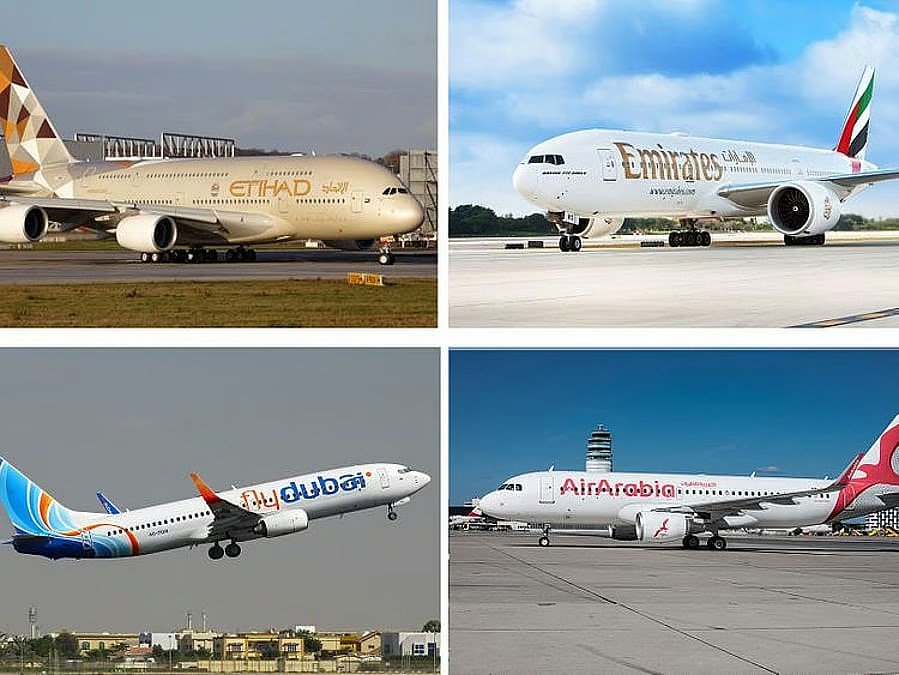
Travellers arriving in the UAE on Monday morning were still feeling the effects of a disrupted Sunday. A scattering of inbound flights landed late at Dubai International even as departures largely ran to schedule.
A difficult Sunday
About 46 flights were delayed or cancelled across airports in Dubai, Abu Dhabi and Sharjah on Sunday, according to reports from regional outlets. The cancellations included a flydubai service from Catania (FZ1502), an Emirates flight from Christchurch (EK413), an Air India Express service from Kochi and SpiceJet’s flight from Mumbai (SG5060).
Other passengers simply waited. Air Arabia’s flight from Tashkent arrived more than two hours behind schedule. A flydubai service from Kabul ran nearly two hours late, and Etihad Airways‘ flight from Delhi was delayed by about an hour and a half. Several flydubai flights from Moscow’s Vnukovo airport were almost three hours late.
The longest delay involved Etihad’s flight EY858 from Sochi, which was held for more than 18 hours after the airport in the Russian city closed, the airline said.
Monday’s knock-on effects
By early Monday the worst had passed, but not all of it. Two flydubai flights from Kazakhstan and Uzbekistan, due at around 7.20am and 7.30am, were running 52 and 64 minutes late. A flydubai service from Dushanbe was pushed from 7.50am to just after 9am. An Emirates flight from London Heathrow, scheduled to land at 6.40am, was rescheduled for 8.30am. Flydubai flights from Moscow, Yekaterinburg and Bishkek were also arriving behind schedule.
Outbound travel looked steadier. Flights leaving Dubai International were operating largely as normal on Monday morning. Services at Abu Dhabi’s Zayed International were also running mostly to schedule as of about 8am. Flight-tracking data showed an Emirates departure to Dallas leaving Dubai just minutes late. An Etihad service to New York left Abu Dhabi around 49 minutes behind its planned time.
Why the delays keep spreading
Flight data points to aircraft positioning as the main pressure. Routes from Russia and Central Asia accounted for many of Sunday’s longer delays, and those late arrivals carried into Monday’s first bank of inbound flights. Dubai’s hub structure amplifies the effect. An aircraft that lands late must be turned around before it can operate a later departure, so a delay at the start of a rotation can reach flights that have nothing to do with the original problem.
Airport restrictions elsewhere have played a part. The Arabian Post noted that temporary closures in Russia can disturb aircraft rotations and onward schedules to the Gulf. The National reported that hundreds of flights from Russia have been affected in recent weeks, and that not every delay can be traced to the conflict affecting the Middle East. Flight-tracking records did not give reasons for individual cancellations or delays on Sunday.
Capacity is recovering
The disruption follows months of upheaval. UAE airlines have been operating close to full capacity after scaling back services at the height of the Iran war. Some airline chiefs expect to exceed full operational capacity by the end of the year, according to Gulf Insider. Emirates and Etihad are operating most of their scheduled services.
That recovery makes the network more exposed to small shocks. With schedules tight and aircraft in constant rotation, a closed airport or a run of late arrivals can spread quickly. Airlines have little slack to absorb it.
What passengers should do
Dubai, Abu Dhabi and Sharjah airports remain open, and most flights are operating. Flydubai advises passengers to check flight status and operational updates before heading to the airport. That is sensible for anyone connecting through the UAE, since a late arrival on one leg can jeopardise the next.
Because these delays stem from aircraft positioning, they usually ease as the day’s rotations reset. Whether that happens on Monday depends on how quickly late inbound aircraft are turned around.


Comments 1