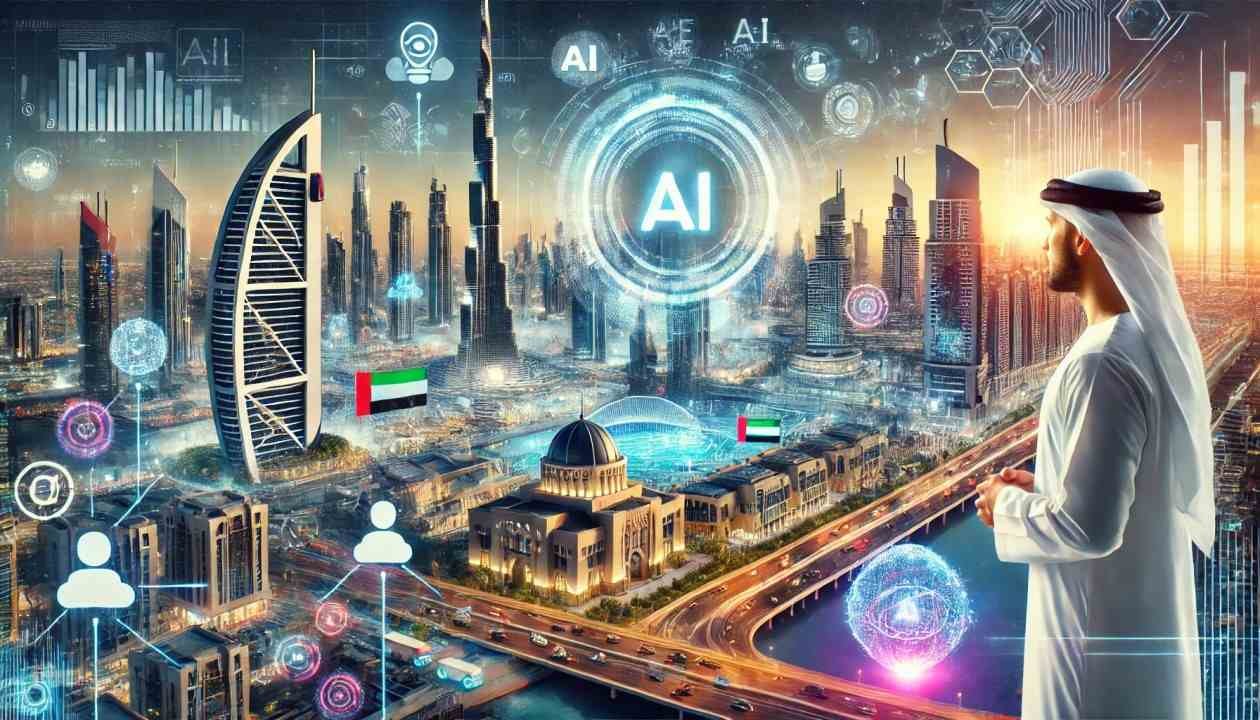
Long before “AI strategy” became a boardroom buzzword, the UAE was already laying the groundwork. That two-decade head start, experts say, is precisely why the country now finds itself ranked first in the world across a striking range of digital government indicators — and why it is positioned to move even further ahead as artificial intelligence reshapes how governments operate.
This week, UAE authorities confirmed the country tops global rankings for digital skills, the institutional framework underpinning digital government, and AI adoption. The UAE also placed second globally for public satisfaction with government services and landed in the top 10 for overall technology and digital competitiveness — a set of results that industry watchers describe as remarkable for a country of its size.
“They were the early movers”
According to Dr Raymond Khoury, a partner and public sector practice lead at Arthur D Little in Dubai who has spent 25 years advising governments across the region on digital transformation, the UAE’s current standing is no accident.
“They were the early movers in this evolution, and because of that drive, have put in place all of the foundational elements,” Khoury said. “When you look at several enabling indicators, they’re ranked number one globally because they’ve invested heavily.”
That investment stretches across telecoms infrastructure, digital skills development and, increasingly, artificial intelligence — with initiatives coordinated at both the federal and local government levels. Officials have pointed out that the modernisation drive began roughly two decades ago with mobile and smart government services, and has since evolved into a near-total digital transformation of the public sector, with 99 per cent of government services now delivered digitally. That shift alone has generated an estimated $4 billion in savings while improving how services are delivered to residents.
The next frontier: agentic AI
The UAE’s ambitions have now shifted toward what officials describe as a “step change” in government — the rollout of agentic AI, a category of autonomous AI systems capable of completing multi-step tasks with minimal human oversight. Rather than simply answering queries, these systems are designed to coordinate across departments, cutting out the friction of moving between different government portals or offices.
Authorities have set a target of delivering half of all government services through agentic AI within the next two years, building on the Zero Government Bureaucracy Programme launched in 2023 to simplify public sector processes. The strategy also includes a major training push: 80,000 government staff have already begun training in agentic AI, while private companies are being encouraged, through dedicated programmes, to adopt similar tools.
Alongside this, the country has introduced an AI curriculum set to roll out across schools nationwide, and AI advisers are being brought in to support ministers in making faster, better-informed decisions.
A structural advantage over larger economies
Part of the UAE’s edge, according to Khoury, lies in the nature of Gulf governance itself. “The GCC countries have that differentiated advantage of pursuing national agendas across government and sectors,” he said, noting that even ambitious national goals that are only partially achieved still represent major undertakings by global standards.
He contrasted this with many developed economies, which often struggle to digitise because of “legacy set-ups” — older systems and processes that are harder to integrate with new technology. Switzerland stands out as a rare Western example of successful digitisation, he noted, while in Asia, Singapore is widely regarded as a comparable leader among smaller, highly developed nations.
Looking ahead
Government call centres already rely heavily on AI-driven chatbots with near-human capability, according to Khoury, who described this as “a fundamental transition” now being extended into the private sector as well. “The talk of AI globally has been around investments in data centres and infrastructure,” he said. “The UAE is doing that, plus all this agentic AI planning and reskilling.”
With the foundations already in place, Khoury believes the UAE is well positioned to move from being merely a world-class digital government to something more ambitious: the world’s most seamless, AI-enabled government — a goal that now appears to be less aspiration than active roadmap. Next Article


Comments 1