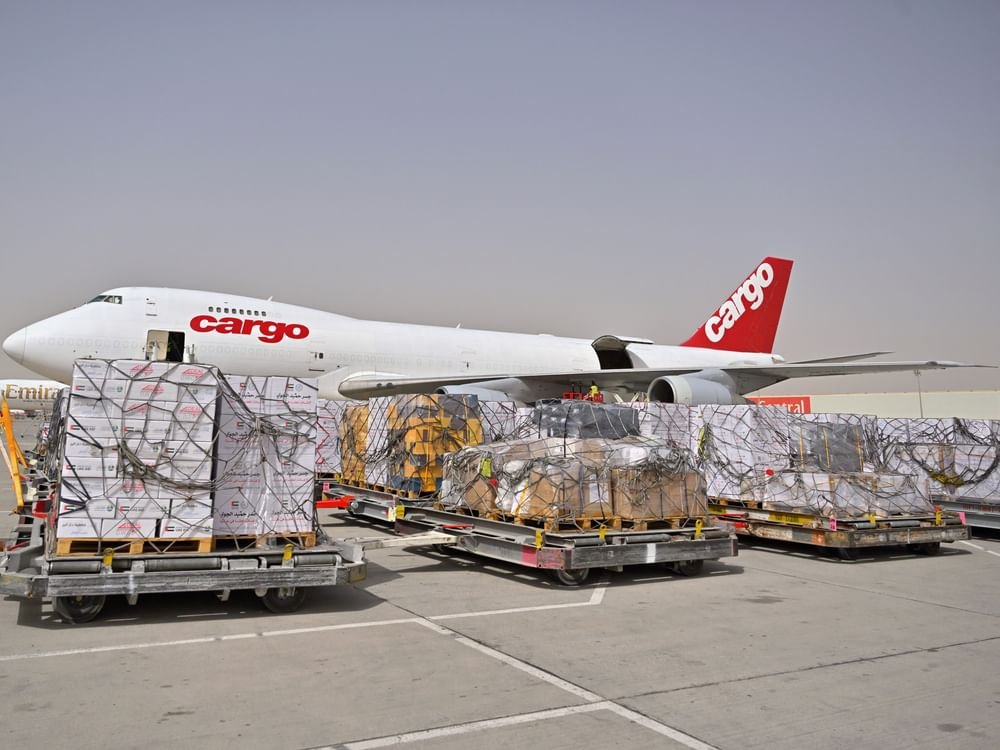
Three years after it began, the UAE’s largest humanitarian effort for Gaza has reached a scale its organisers say few other programmes can match. Operation Chivalrous Knight 3 has now moved more than 136,000 tonnes of assistance into the Gaza Strip, according to the latest figures released by the campaign.
The headline numbers
The aid is valued at more than $4.3 billion. Campaign officials say that equals roughly 46 per cent of all international humanitarian assistance delivered to the territory. That share is the campaign’s own calculation, and the UAE has not published a breakdown of how it was reached.
Hamoud Al Afari, Director of UAE Relief Operations under the campaign, confirmed the figures. He said 15,529 transport assets, among them aircraft, ships and trucks, have been used across what he called an integrated, multi-route logistics network.
The operation was launched on 5 November 2023 on the directive of President Sheikh Mohamed bin Zayed Al Nahyan.
How the aid moves
No single route has been dependable, so the campaign has used several at once.
By sea, 26 aid ships have carried supplies: 14 departed from the UAE, three from Al Arish in Egypt and nine from Cyprus. By air, 218 aircraft have been involved. For areas hard to reach on the ground, a programme called Birds of Goodness has carried out 81 airdrop missions, delivering 4,076 tonnes of aid.
Al Afari said the mix of routes has made the supply chain more flexible and better able to cope with shifting conditions and restrictions. He also stressed that logistics is more than transport. Teams must receive, sort, store and classify supplies, track what recipients need and organise distribution by urgency.
Three command centres
The effort is coordinated from three sites that operate around the clock. An operations room in Abu Dhabi handles overall coordination, assigns tasks and directs relief work with partner organisations. A logistics centre in Al Arish, Egypt, receives aid arriving by air and sea, then sorts, stores and prepares it for onward movement. The third element is a set of relief teams inside Gaza, who monitor conditions and identify priorities.
Al Afari said this division of responsibilities speeds up decisions and helps match each delivery to the most suitable route.
Charities and volunteers
More than 22 UAE charitable institutions have taken part, along with over 500 volunteers, both Emiratis and residents. About 130 doctors, health workers and support staff of various nationalities have also volunteered for medical work. Contributions have included money, food, medical supplies and help with transport and field operations.
Beyond food and medicine
Officials say the operation has widened over three years from emergency supply into a broader programme covering healthcare, water, food, education and shelter. It also arranges medical evacuations and rehabilitation services.
One of the more unusual initiatives is Thoub Al Farah, meaning “The Dress of Joy”, a mass-wedding programme. The first edition saw more than 54 grooms marry. The second took place in Deir Al Balah and brought together 300 brides and grooms, with backing from the Khalifa bin Zayed Al Nahyan Foundation for Humanitarian Works. A third edition aims to support 250 couples, or 500 people. Al Afari described it as a way to ease the financial burden of marriage on young couples and their families and to mark an important milestone despite extremely difficult conditions.
Education has become a focus too. The campaign has distributed school supplies and schoolbags and provided 45 scholarships in the UAE. Its activities now also cover public hygiene, environmental protection and infrastructure support.
Putting the figures in context
Large aid totals are easier to quote than to verify independently, and readers should treat the 46 per cent claim as a statement from the organisers. What can be said is that the operation is notable for how many delivery methods it combines, and for how openly it has set out its logistics.
Gaza’s needs remain acute, and the way aid reaches people there has been contested throughout the conflict. Al Afari said UAE teams continue to work under difficult field conditions and coordinate closely with humanitarian organisations, partners and volunteers.
For the UAE, the campaign has become a central part of its humanitarian profile in the region. Whether the pace can be sustained will depend on access, funding and conditions on the ground, none of which the organisers control.


Comments 1