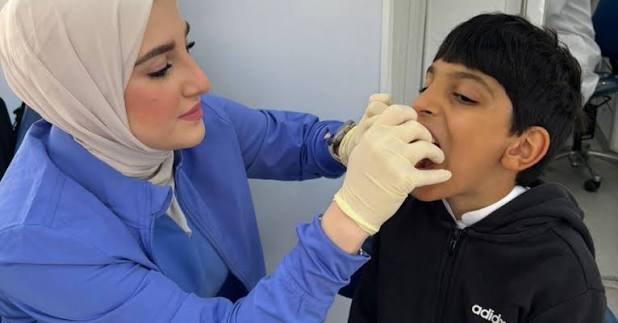
Many children first see a dentist when something already hurts. A new national programme is designed to change that. The UAE’s Ministry of Health and Prevention (MoHAP) has introduced oral and dental health screenings for pupils in Kindergarten 1 (KG1) at public schools across the country.
What the programme covers
The initiative was launched with the Ministry of Education and Emirates Health Services (EHS). Its goal is to identify oral and dental problems before children enter primary school.
Screenings will look for tooth decay, gum disease and other conditions that could affect a child’s health, development and learning. Families can take their children to government health centres run by EHS, or to private healthcare facilities.
Prevention, not reaction
Officials framed the programme around a change of habit. Instead of waiting for pain or other symptoms, the aim is to make regular dental check-ups part of children’s healthcare from an early age.
Dr Hussain Al Rand, assistant undersecretary for the Public Health Sector at MoHAP, said promoting oral health in the preschool years helps build habits that can last a lifetime. He also pointed to the role of families in monitoring children’s health and encouraging good daily hygiene, working alongside the education and health sectors.
Health and learning
The Ministry of Education linked the project to classroom performance. Tareq Al Hashimi, Assistant Undersecretary for the School Operations Sector in Dubai and the Northern Emirates, said children’s health is closely connected to their readiness to learn. In his words, good health supports participation and engagement and lets pupils get more from their education. He said the ministry would keep working with partners on preventive health initiatives for students and families from the early years.
That connection is widely accepted among paediatric health professionals. Untreated dental pain can disturb sleep, make eating difficult and reduce concentration, all of which can affect a young child’s day at school. Catching problems early is also usually simpler and less distressing than treating advanced decay.
The role of Emirates Health Services
Dr Essam Al Zarooni, executive director of the Medical Services Sector at EHS, said offering screenings through its health centres would help detect issues early and refer children who need further care to the right services. He added that EHS will back the screenings with health awareness activities and follow-up care so that support continues through children’s early growth and development.
The follow-up element matters. A screening is only useful if a flagged problem leads to treatment, so the referral pathway is likely to determine how much difference the programme makes.
Where it fits
Officials said the initiative aligns with the UAE’s preventive healthcare plans and with the World Health Organization’s global oral health strategy for 2023 to 2030, which places greater emphasis on prevention and early detection.
What parents should know
Several details have not yet been spelled out in the announcement. It does not say whether screenings are free at every facility, how families will be notified or whether there is a deadline for the first round. Parents of KG1 children in public schools should watch for communication from their school, and can ask their local EHS health centre how to book.
For now, the practical message is a simple one. A short check-up before primary school can catch decay or gum problems while they are still easy to treat, and the programme gives families an easy way to start. The wider test will be uptake. A national screening initiative only works if most families take part, and if the follow-up care is there for those whose children need it.


Comments 1