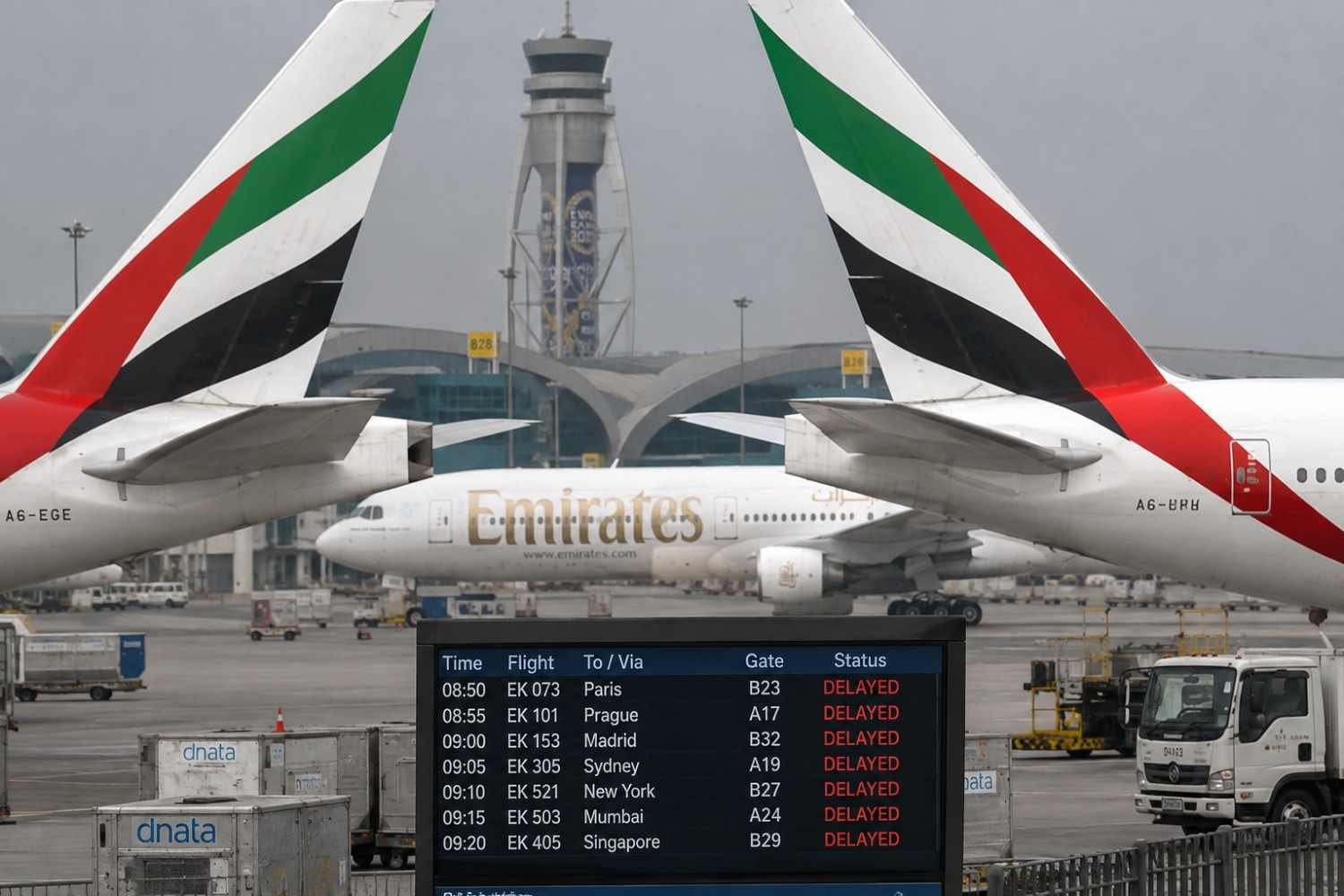
Travellers passing through the UAE’s major airports this week are being told to keep a close eye on their bookings, as a fresh bout of regional turbulence linked to the ongoing US-Iran conflict continues to ripple through Gulf airspace.
Since Wednesday, close to 20 flights connected to UAE airports have either been delayed significantly or cancelled outright, according to data gathered from airline schedules and airport tracking systems. The disruption comes in the wake of a renewed round of US military action against Iran and retaliatory manoeuvres that have kept regional risk assessments elevated for carriers operating across the Gulf.
Despite the unsettled backdrop, the country’s three principal gateways — Dubai International, Abu Dhabi’s Zayed International and Sharjah International — are continuing to function largely as normal. Live tracking data reviewed on Friday showed hundreds of aircraft movements through Dubai alone, with only a small fraction of services affected by outright cancellation. The disruption has instead shown up mostly in the form of rerouted paths, longer flight times and shifted departure slots, rather than wholesale grounding.
Airlines urge caution, not panic
Emirates, Etihad Airways, Air Arabia and flydubai are all continuing to operate the bulk of their scheduled services, though each has acknowledged making rolling adjustments as the security picture develops. Passengers due to fly in the coming days are being advised to check their flight status frequently in the hours before departure, rather than relying solely on booking confirmations made earlier in the week.
The advice reflects a broader pattern that has become familiar to UAE residents over recent months: the conflict is being felt in the emirates less through any direct exchange of fire and more through its knock-on effects on air travel, shipping routes and general risk perception across the wider Gulf region.
Aviation analysts note that airlines flying through the Gulf have become increasingly adept at adjusting flight paths in real time, often adding flying time rather than cancelling services outright, to keep aircraft clear of the most sensitive airspace corridors near the Iranian coast and the Strait of Hormuz.
A conflict now in its seventh month
The current wave of disruption comes as the US-Iran conflict marks its seventh month, with Washington continuing military operations against Iranian targets and Tehran responding with strikes of its own across the region. US officials have sought to project confidence in the durability of the campaign, pointing to what they describe as effectively unlimited stockpiles of munitions, even as reports have surfaced suggesting the pace of operations has placed strain on certain categories of US weapons supplies.
For the UAE specifically, officials have repeatedly stressed the country’s position as a non-combatant that has worked through diplomatic channels, including within the Gulf Cooperation Council, to try to contain the conflict. The UAE has previously and firmly denied Iranian claims that Al Minhad Air Base on its territory had been struck, underlining the importance officials place on residents relying on verified statements from UAE authorities and established news organisations rather than unconfirmed social media reports.
What passengers should do
For anyone flying to or from the UAE in the near term, aviation and travel advisories circulating this week offer a consistent set of recommendations: confirm flight status directly with the airline shortly before heading to the airport, allow extra time for security and check-in processes, and avoid basing travel decisions on unverified claims circulating online.
Airport authorities have not indicated any plans to suspend operations, and officials continue to characterise the disruption as manageable rather than a full-scale shutdown of Gulf airspace. Still, with the security situation remaining fluid, further schedule adjustments in the days ahead cannot be ruled out.
The situation is a reminder of how deeply intertwined the UAE’s role as a global aviation hub is with the wider stability of the region — and how quickly that role can be tested when tensions flare, even when the country itself remains outside the direct line of conflict. Next Article


Comments 1