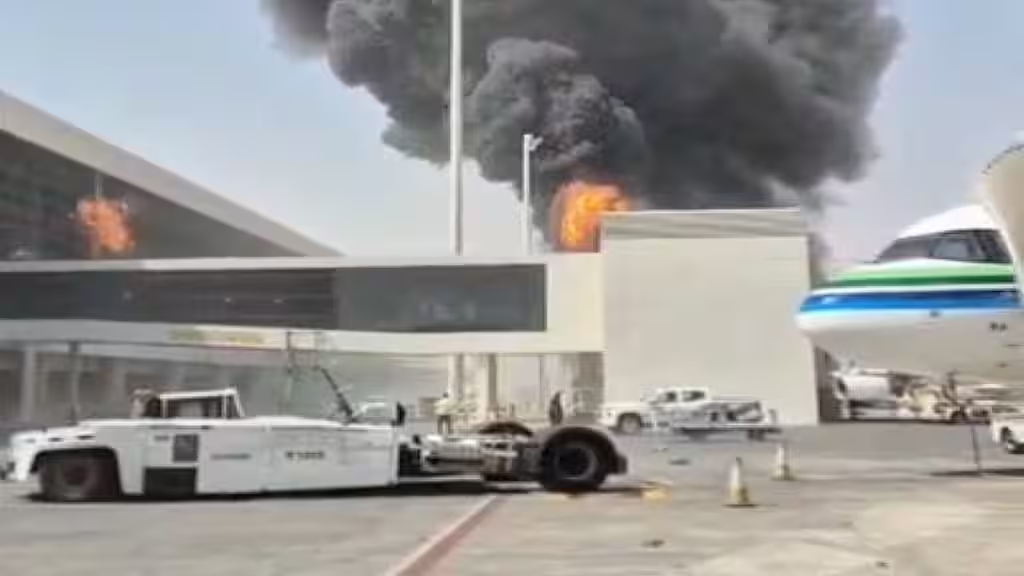
ABU DHABI — The UAE has condemned in the strongest terms a Houthi attack on a tower in Riyadh’s financial district, while the US Mission to the UAE has urged American citizens across the Middle East to stay vigilant. The moves come as the conflict that began as a confrontation with Iran continues to spill across the Gulf.
What happened in Riyadh
Saudi civil defence said 11 people were injured on Tuesday when the Houthis, the Iran-backed group that controls much of Yemen, targeted a tower in the capital’s financial district. According to Saudi authorities, the injured included two Saudis, two Indians, three Nepalis and four Egyptians. The Saudi-led coalition fighting the Houthis described the incident as a terrorist attack. Witnesses told AFP that the capital’s tallest skyscraper had been hit.
It was the second strike on the district in under a week. An earlier attack on 19 November caused material damage but no injuries. On Wednesday, the Houthis claimed attacks on Riyadh’s financial district and on a Saudi refinery, according to Gulf News’ live coverage.
The UAE’s response
The UAE’s Ministry of Foreign Affairs called the attack a flagrant violation of Saudi Arabia’s sovereignty and a threat to its security and stability. It reaffirmed the UAE’s full solidarity with Riyadh and its support for the measures the kingdom takes to protect its security. It also wished those injured a speedy recovery.
India condemned the attack and confirmed that two of its nationals were among the wounded. The UK announced sanctions on the Houthi group and four of its senior officials on Tuesday, saying the group’s renewed aggression against civilians was unacceptable.
The US alert
On Wednesday morning, the US Mission to the UAE issued a security alert urging American citizens across the Middle East to exercise heightened vigilance. It cited the threat of further attacks by Iran and Iranian-backed Houthi forces. The warning follows Iranian attacks on US-linked targets in Bahrain and Kuwait, and Houthi strikes on Saudi Arabia that have hit civilian airports and other infrastructure.
The mission said hostilities could escalate rapidly and told Americans to prepare for possible flight cancellations, airspace closures and other travel disruption. It said Iran, the Houthis and groups aligned with Tehran could target American businesses, institutions and locations associated with the United States.
Its practical advice was familiar: stay aware of your surroundings, avoid demonstrations and large gatherings, keep a low profile and follow instructions from UAE authorities. During an aerial attack, people should stay away from windows and glass doors and avoid fallen debris. Americans are encouraged to enrol in the State Department’s traveller programme and to keep their phones charged. The US Embassy in Abu Dhabi will be closed from 26 to 29 November for the Thanksgiving holiday. Emergency help remains available through the UAE’s 999 line and the embassy’s emergency contacts.
Flights and travel
The conflict is already affecting UAE travellers. Etihad Airways has extended cancellations of flights between Abu Dhabi and both Riyadh and Dammam through 30 November. Flydubai has extended cancellations to Riyadh and Abha through 27 November, while resuming Dammam services on a reduced schedule. Passengers should check their booking with the airline before heading to the airport, and use official channels from Zayed International Airport and Dubai Airports for departure information.
A widening front in Yemen
The fighting in Yemen is intensifying. The Saudi-led coalition said it struck the port city of Hodeida after the Houthis threatened retaliation against the kingdom’s Red Sea ports. Houthi-affiliated media have claimed that a Saudi strike on vehicles in Lahj killed or left missing 25 people, a figure that has not been independently verified. A Yemeni military spokesman said Houthi forces were about 60 kilometres from Aden and that defenders were prepared.
What it means for the UAE
The UAE is not a party to these specific attacks, but its stance matters. Its condemnation of the Riyadh strike fits a consistent pattern of public solidarity with Gulf neighbours. It has issued similar statements after recent attacks on Bahrain and Kuwait. For the large communities of Indian, Nepali and Egyptian workers in both countries, the injuries in Riyadh are a reminder of how exposed ordinary residents are.
For now, the practical message to residents of the UAE is to rely on official guidance, confirm travel plans and treat unverified social media claims with caution. The security picture is changing quickly, and so are the advisories that go with it.


Comments 1