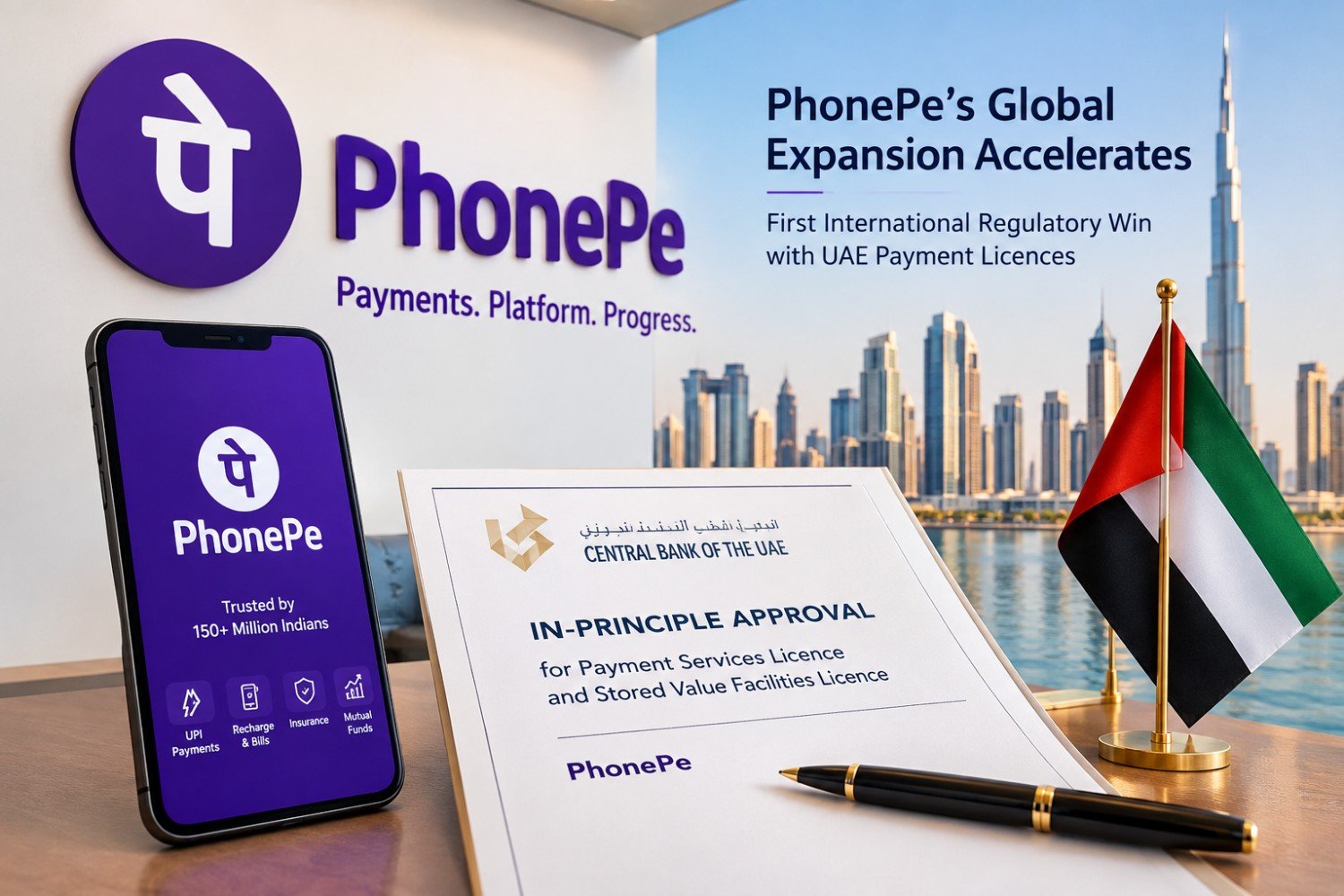
Indian fintech giant PhonePe has taken its first concrete step onto the international stage, securing in-principle approval from the Central Bank of the UAE (CBUAE) for two separate payment licences. The milestone marks the company’s maiden regulatory approval outside India and opens the door to its formal entry into the UAE’s fast-growing digital payments market.
The in-principle approval is an important, if preliminary, regulatory green light. It signals that the CBUAE has reviewed PhonePe’s application and business model favourably enough to allow the company to proceed toward the more detailed licensing steps required before it can begin operating payment services within the Emirates. For a company that has built its reputation as one of India’s dominant digital payment platforms, the move into the UAE represents a deliberate and closely watched test of its ability to replicate that success on foreign soil.
Why the UAE, and why now
The UAE has become one of the most sought-after fintech markets in the Middle East, driven by a combination of high smartphone penetration, a large expatriate population accustomed to digital financial tools, and a regulatory environment that has actively courted fintech innovation through initiatives designed to modernise the country’s payments infrastructure. The CBUAE has in recent years worked to position the Emirates as a regional hub for digital finance, balancing the encouragement of innovation with strict oversight designed to protect consumers and maintain financial stability.
For PhonePe, the UAE’s large Indian expatriate community offers a natural bridge market. Millions of Indian nationals living and working in the Emirates already engage regularly with cross-border remittances, bill payments and everyday transactions — precisely the kind of use cases PhonePe has spent years optimising in its home market. Industry observers note that a successful UAE launch could serve simultaneously as a proof of concept for further Gulf expansion and a fintech bridge product connecting the large flows of capital and communication between India and the Emirates.
A broader trend of fintech consolidation in the Gulf
PhonePe’s move comes amid a broader wave of interest from global fintech players eyeing the UAE as a launchpad into the wider Middle East and North Africa region. The Emirates’ relatively mature digital banking infrastructure, coupled with progressive open-banking and payments regulation, has made it an attractive proving ground for companies looking to scale digital financial services beyond their home markets.
The two licences PhonePe is pursuing would likely cover different categories of payment services, potentially spanning areas such as retail payment processing and money transfer or remittance services, though the exact scope will become clearer as the company progresses through the CBUAE’s formal licensing process. Regulatory approval of this kind typically involves rigorous vetting of a company’s compliance frameworks, anti-money laundering controls, and operational resilience — standards the CBUAE has increasingly tightened as digital payment volumes across the country have surged.
What it means for competition and consumers
For UAE consumers and businesses, PhonePe’s entry — assuming it clears the remaining regulatory steps — would add another significant player to an already competitive digital payments landscape that includes established local platforms, international card networks, and a growing roster of regional fintech start-ups. Increased competition in the space has generally translated into lower transaction costs, faster settlement times, and more innovative product offerings for both consumers and merchants.
For PhonePe itself, this approval is being framed internally as the opening chapter of a broader international growth strategy, one that could see the company pursue similar regulatory pathways in other markets should its UAE entry prove successful. As the company now works through the remaining steps toward a full operating licence, the coming months will be closely watched by both fintech analysts and rival payment platforms eager to gauge how quickly — and how effectively — an Indian payments giant can adapt its model for a very different, and highly competitive, Gulf market.


Comments 1