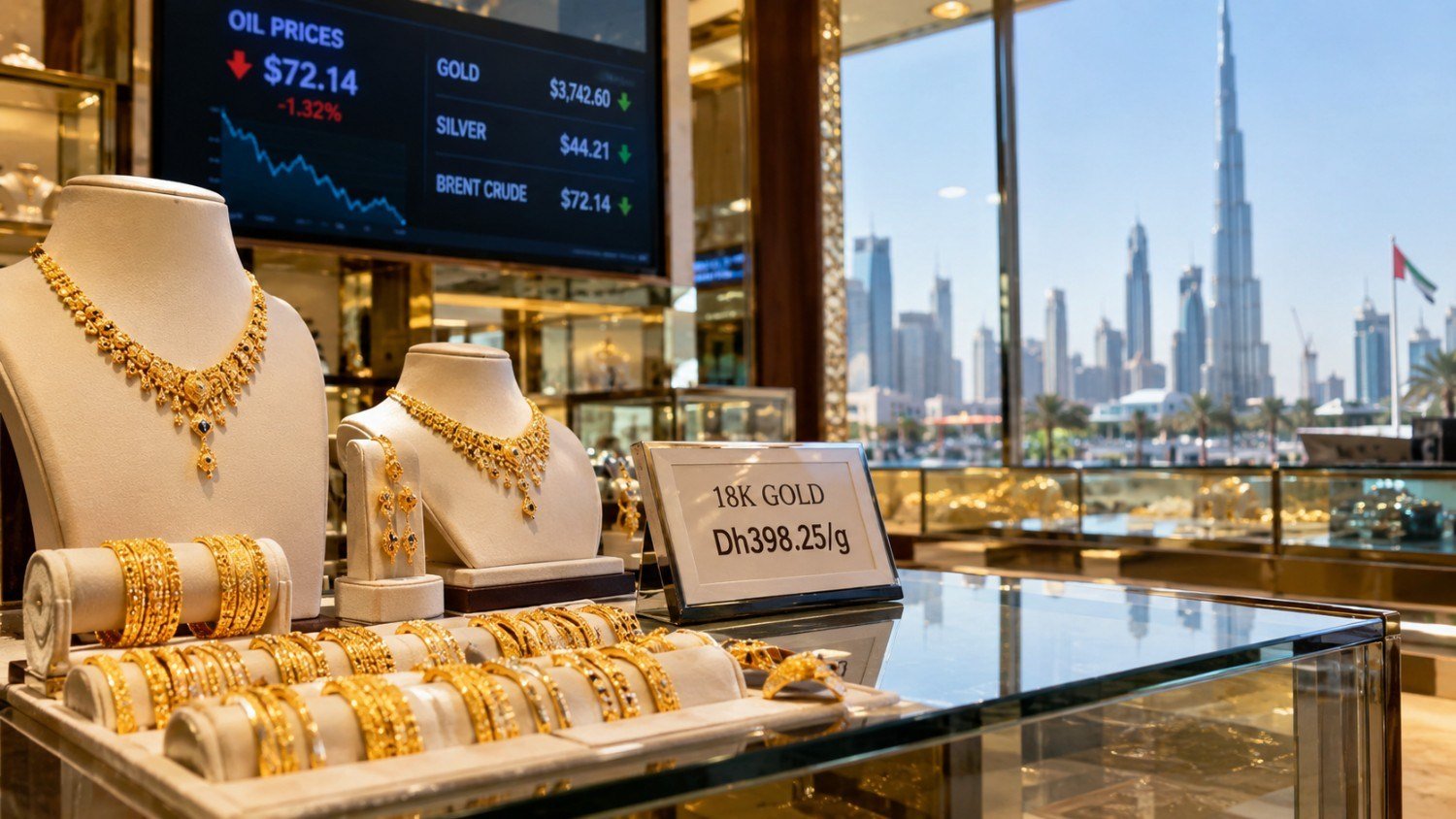
Gold prices in Dubai eased on Tuesday, continuing a downward drift that has seen the precious metal give up some of its recent gains as cooling oil markets ripple through the broader commodities complex. For shoppers eyeing the city’s famed gold souks, the pullback offers a modest but welcome window of relief after a stretch of elevated prices.
According to the latest figures from the Dubai Gold & Jewellery Group, 18-karat gold slipped below the psychologically significant Dh400-per-gram threshold, trading at Dh398.25 on Tuesday morning. Meanwhile, 24-karat gold, the purest and most closely watched benchmark in the local market, eased to Dh523.25, down slightly from the previous night’s close of Dh523.75. Twenty-two-karat gold, a popular choice among UAE jewellery buyers, also recorded a marginal decline.
A volatile month for gold
The latest dip is part of a broader pattern that has emerged over the past month, with gold prices in the UAE recording a drop of more than 6 per cent over the past 30 days alone. That pullback follows a period of sustained highs earlier in the year, when gold — traditionally viewed as a safe-haven asset — benefited from a mix of geopolitical uncertainty and inflation concerns that drove investors toward tangible stores of value.
The recent cooling appears closely tied to movements in the oil market, where prices have softened in recent sessions. Gold and oil, while driven by different fundamentals, often move in loosely correlated patterns during periods of broader risk sentiment shifts, particularly in a region like the Gulf where energy exports play an outsized role in shaping investor psychology and currency dynamics.
What it means for buyers and investors
For everyday consumers in Dubai — a city whose gold souks remain a major draw for both residents and tourists — the current pullback in prices could translate into a modestly more attractive window for jewellery purchases, particularly with the wedding and gifting season on the horizon in several key source markets for Dubai’s gold trade, including India and other parts of South Asia.
For investors holding gold as a hedge, however, the recent volatility serves as a reminder that even traditionally “safe” assets are not immune to sharp swings, particularly in a global environment where interest rate expectations, currency movements and geopolitical developments can shift sentiment quickly. Market watchers note that gold’s performance over the coming weeks will likely hinge on a combination of factors: the trajectory of global oil prices, evolving expectations around US monetary policy, and any fresh geopolitical developments in a region that has seen no shortage of them in recent months.
Dubai’s role as a global gold hub
The price movements also underscore Dubai’s continued significance as one of the world’s most important physical gold trading and jewellery retail hubs. The emirate’s status as a duty-free gold trading centre, combined with its deep logistics and refining infrastructure, means that local price movements are watched closely not just by residents but by traders and analysts tracking regional and global gold flows more broadly.
As the week progresses, analysts will be watching closely to see whether the current dip represents a temporary correction or the beginning of a more sustained pullback. For now, Dubai’s gold souks remain a barometer not just of local jewellery demand, but of the broader currents moving through global commodity markets — from oil price swings to shifting investor appetite for safe-haven assets in an unpredictable global economy.


Comments 1