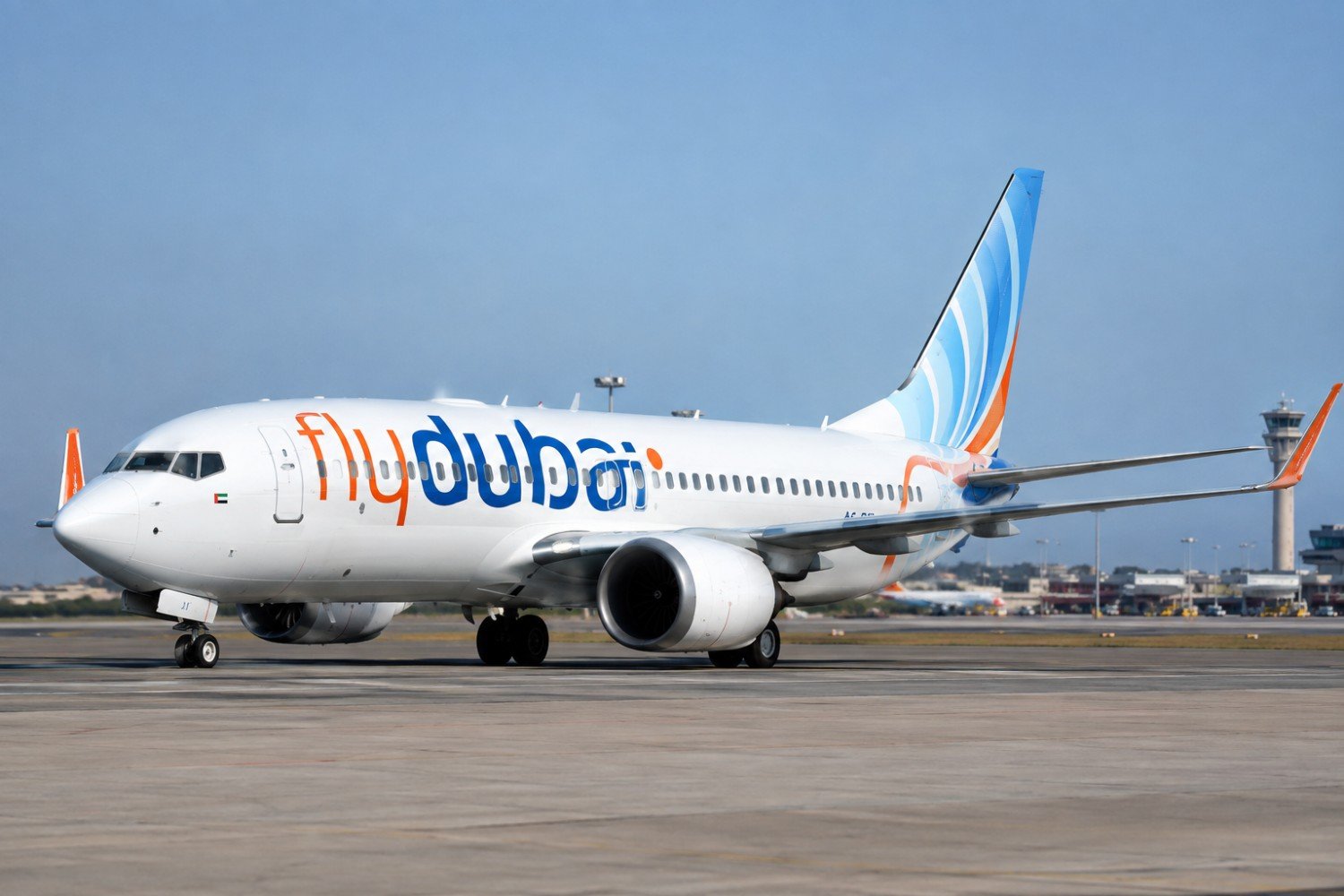
Investigators in at least three countries are retracing the career path of the flydubai co-pilot accused of trying to seize control of a passenger jet. The UAE continues to treat last week’s cockpit attack as a terrorist act.
New Zealand police said on Tuesday that the man spent about six months in the country in 2018 and 2019, completing part of his flight training. Assistant Commissioner Michael Johnson told Reuters that immigration records show the co-pilot arrived on 30 November 2018 and left on 23 May 2019 on a student visa. The training was carried out for a UK-based company that no longer operates in New Zealand, Johnson said. Police are reviewing records and making inquiries about his time there.
A flight that never reached Tel Aviv
Flydubai flight FZ1073 left Dubai on Wednesday, 30 September, bound for Tel Aviv. Partway through the journey a struggle broke out on the flight deck, and the aircraft was diverted to Tabuk in north-western Saudi Arabia, where it landed safely. The airline said crew members stepped in and secured the aircraft. It added that the incident did not affect the rest of its network.
Saudi Arabia’s Interior Ministry said on 1 October that early findings, gathered with a UAE security team, indicated the co-pilot had assaulted the captain and that both men were injured. Reuters reported that a reserve flydubai pilot travelling on the flight took the controls and landed the aircraft, while passengers and crew restrained the co-pilot. More than 170 people were on board, most of them Israeli nationals, according to the agency. Saudi authorities held the co-pilot and handed him over to the UAE on Thursday.
Reuters also consulted an aviation instructor who recreated the incident in a flight simulator. In that reconstruction, the aircraft dropped about 16,000 feet in roughly 30 seconds before being brought under control. The figure comes from a simulation, not official flight data, and investigators have not confirmed it.
What UAE prosecutors have said
On Saturday, UAE Attorney General Dr Hamad Saif Al Shamsi said the inquiry had established that the co-pilot attempted to carry out a terrorist act. In a statement carried by the Emirates News Agency, he said the man attacked the captain with a crash axe and tried to take control of the aircraft. A crash axe is an emergency tool kept in the cockpit for jobs such as cutting through panels.
Al Shamsi stressed that the work is not finished. Prosecutors are still trying to establish the motive and whether anyone else was connected. Technical examiners are analysing physical and digital evidence, and final findings will be announced once those procedures are complete. A special Public Prosecution team was set up earlier in the week to examine whether the incident was linked to terrorist activity, prior planning or outside direction.
The Ministry of Foreign Affairs has also explained why the case falls to Emirati courts. The aircraft was registered in the UAE and flew its flag. Under current law, crimes committed on board are covered even when the aircraft is outside the country’s territory.
Australian counter-terrorism officers join the inquiry
New Zealand is not the only country now examining the man’s history. Australian Federal Police said on Sunday that the Victorian Joint Counter Terrorism Team is investigating his links to Australia. The team brings together federal police, Victoria Police and the domestic intelligence agency ASIO.
Sources briefed on the matter told Reuters that he studied at a Melbourne university around a decade ago. RMIT University later confirmed he had been enrolled there but did not complete an engineering qualification. It did not say when he studied.
What remains unknown
Neither UAE authorities nor flydubai have named the co-pilot. No official motive has been given. Officials have not said whether his training in New Zealand or his time in Australia has any bearing on what happened aboard FZ1073. For now, those periods are lines of inquiry, not conclusions.
Israel has also moved to look at its own exposure. On Sunday, Prime Minister Benjamin Netanyahu told the National Security Council to appoint an examiner to review security aspects of foreign civil aviation to Israel.
Why the case reaches beyond one cockpit
For the aviation industry, the episode raises practical questions about how airlines and regulators verify the education and training histories of pilots who have studied in several countries. No regulator has announced changes tied to the incident so far, and any such steps would depend on what the final findings show.
For the UAE, the immediate priority is the legal process. Investigators have said they will publish their conclusions once the evidence work is finished. Until then, the picture will keep shifting as police forces in Dubai, Wellington, Melbourne and elsewhere compare records.


Comments 1