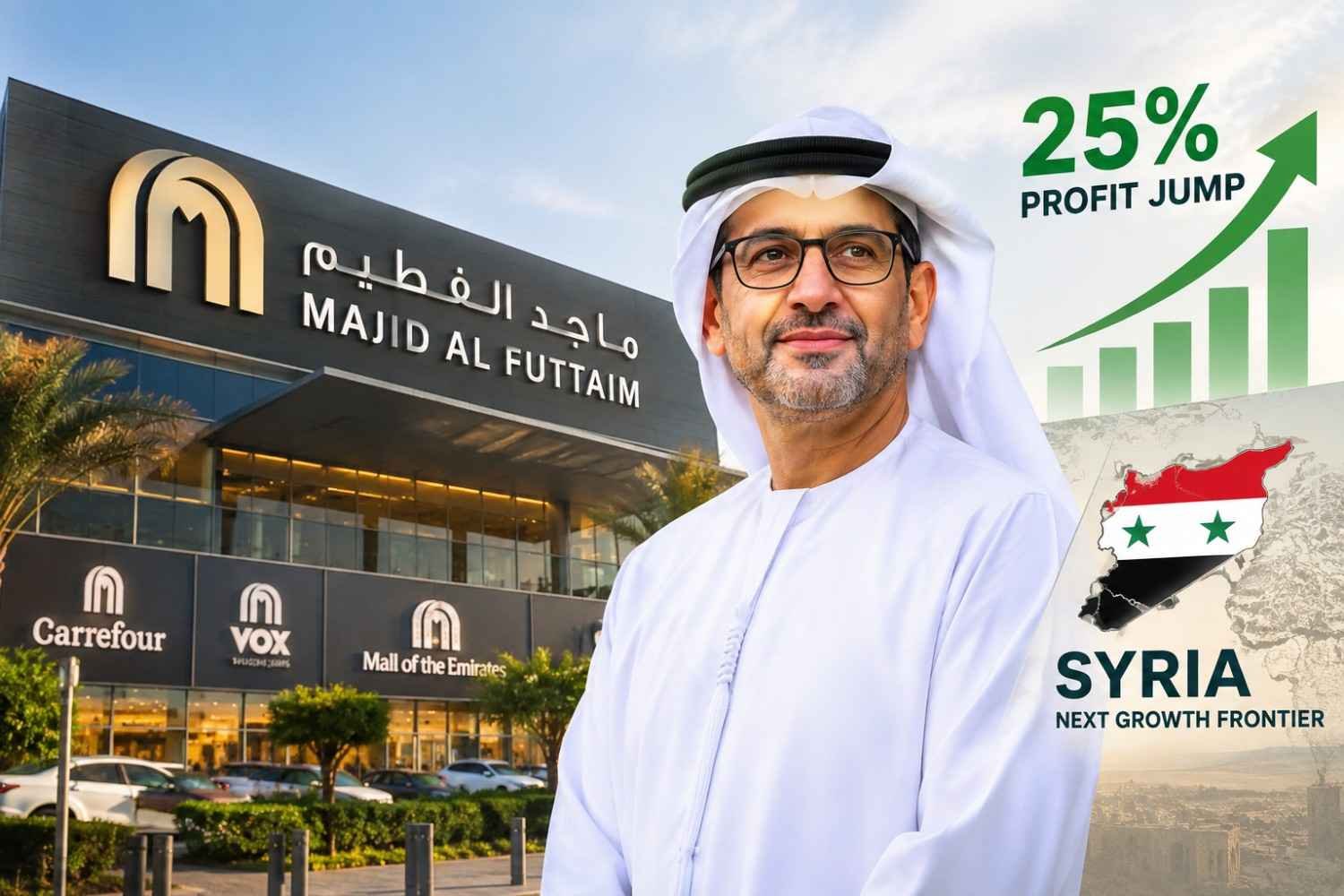
Majid Al Futtaim Holding, one of Dubai’s largest privately owned conglomerates, has delivered a strong set of first-half results, reporting a 25 per cent jump in net operating profit even as the wider region navigates a turbulent geopolitical backdrop. The company also used the results announcement to reveal it is watching Syria closely as a potential future market for expansion.
The group said its net operating profit after tax climbed to Dh1.8 billion, equivalent to roughly $490 million, for the six months to the end of June. Revenue rose a more modest 1 per cent year-on-year to Dh17.5 billion, but the headline figure masked a much stronger underlying story in the company’s development arm, where revenue surged 38 per cent thanks to ongoing construction activity across major projects in Dubai and Cairo.
Earnings before interest, tax, depreciation and amortisation for the period rose 11 per cent annually to Dh2.5 billion, while the group’s total asset base grew 4 per cent year-on-year to approximately Dh73 billion. Net borrowings stood at Dh13.2 billion at the end of the first half.
Syria on the radar
Perhaps the most eye-catching disclosure from the results came from chief executive Ahmed Galal Ismail, who confirmed the company holds an existing land bank in Syria and is closely monitoring how conditions in the country evolve, even though any formal move into the market is not part of its near-term plans. The comments reflect a broader wave of interest from Gulf developers eyeing Syria’s reconstruction opportunity, following years of civil conflict that devastated much of the country’s infrastructure and economy. Other prominent regional developers, including Dubai-based Arada and Emaar’s Mohamed Alabbar, have also signalled interest in Syrian investment as the country works to attract capital and rebuild.
Resilience despite regional headwinds
The results come against the backdrop of an ongoing conflict between Iran, the United States and Israel that has weighed heavily on parts of the regional economy since February. Mr Ismail acknowledged that the war has had an uneven impact on Majid Al Futtaim’s operations, with Gulf markets affected by supply chain disruptions and inflationary pressure, while the company’s operations in East Africa, Egypt and Georgia have remained largely insulated.
Despite these pressures, Mr Ismail said consumer spending across the group’s Gulf markets rebounded quickly, with total mall footfall across its operations remaining almost flat year-on-year, a sign, he said, of how swiftly consumer confidence recovered even amid regional uncertainty. He credited the company’s diversification across multiple markets and cities, along with sustained investment in customer loyalty programmes, for helping cushion the impact.
Segment performance
Shopping mall revenue grew 12 per cent year-on-year on the back of strong leasing activity and tenant performance, helping to offset softer demand in the group’s hotel business during the second quarter. Hotels still managed 4 per cent year-on-year net revenue growth to Dh2.3 billion. Retail revenue, however, declined 6 per cent, a drop the company attributed to more challenging consumer conditions in the UAE specifically, as well as deliberate restructuring measures under way as part of an ongoing business transformation.
Markets outside the Gulf performed comparatively well, with revenue growth of 4 per cent year-on-year supported by particularly strong performances in Egypt and Kenya. The group’s cinema business, which operates more than 600 Vox screens, saw revenue grow 3 per cent over the period.
Development pipeline exceeds Dh100 billion
Majid Al Futtaim’s development pipeline now exceeds Dh100 billion, with Dh2.8 billion in construction contracts awarded so far this year. Among the major projects launched during the first half was a Dh62 billion agreement signed in May with Dubai South to develop a 22-million-square-foot mixed-use community near Al Maktoum International Airport, along with a new $3.1 billion partnership with Egyptian developer Midar for a mixed-use development in Cairo.
Construction continues to progress on the company’s flagship Ghaf Woods development in Dubai and on a roughly Dh5 billion redevelopment of Mall of the Emirates. Founded in 1992, Majid Al Futtaim now operates across 14 markets spanning the Gulf, Egypt, Pakistan, the Levant, Georgia, Kenya and Uganda, with a portfolio that includes 29 shopping malls, seven luxury hotels and five major mixed-use developments.
Looking ahead, Mr Ismail expressed confidence in the company’s trajectory for the remainder of 2026, pointing to the resilience of its diversified business model as a key strength heading into an uncertain second half of the year. Next Article


Comments 1