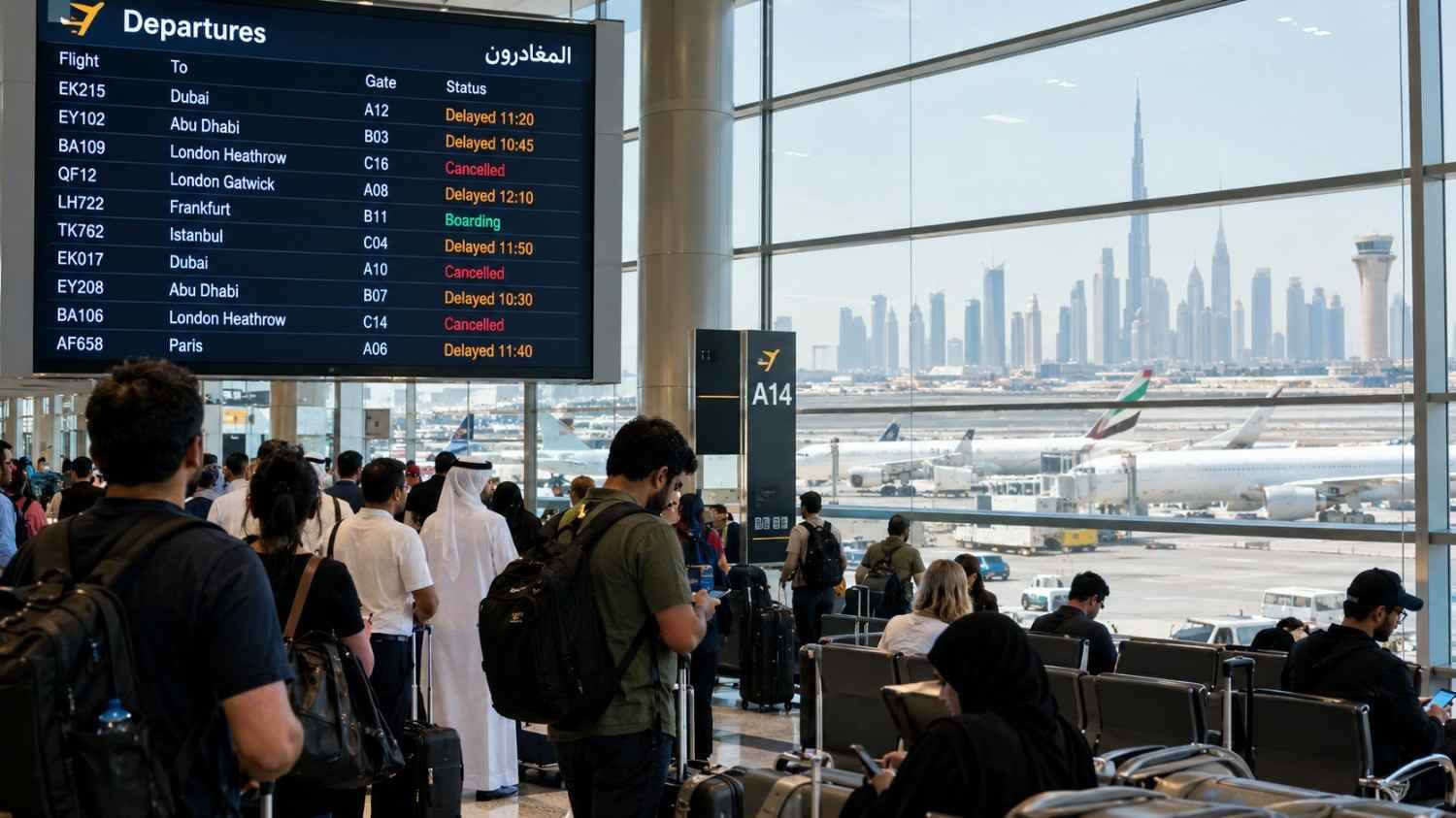
Travellers passing through Dubai International Airport and Zayed International Airport in Abu Dhabi are facing a bumpy few days, as a combination of technical failures thousands of kilometres away, renewed regional tensions and the lingering effects of a volcanic eruption in Indonesia converge to disrupt schedules across the UAE’s two busiest hubs.
The trouble began on Tuesday when a technical failure struck NATS, the United Kingdom’s air traffic control provider. The fault affected the system airlines use to process flight plans, triggering more than 1,000 cancellations across British airports, with London Heathrow among the hardest hit. Heathrow suspended arrivals entirely for the remainder of that night, while departures resumed only gradually and with significant delays.
Although engineers resolved the technical issue by Tuesday afternoon, the knock-on effects have continued to ripple through Wednesday’s schedules, as aircraft and crews found themselves out of position for their next rotations. Several UAE-bound services from the UK have been affected as a result, including two Emirates flights from London Heathrow that were cancelled outright, while other Emirates and Etihad Airways services from Heathrow, Gatwick and Manchester continue to run behind schedule.
Regional tensions add to the uncertainty
Compounding the disruption, fresh missile activity in the region has added another layer of uncertainty to Gulf air travel. Early on Wednesday, Jordanian air defence systems intercepted a barrage of ballistic missiles fired from Iranian territory, with the country’s armed forces confirming that the vast majority were successfully shot down and that no casualties were reported from debris that fell in unpopulated areas.
While flights directly in and out of the UAE were not the primary target of the incident, the broader atmosphere of regional uncertainty has left airlines and passengers alike bracing for further schedule adjustments in the days ahead. UAE carriers have historically shown resilience during periods of heightened regional tension, continuing to operate the bulk of their networks even as individual routes face temporary disruption.
Volcanic ash disruption still lingering
Adding to the mix, airlines serving the UAE are also still working through the aftermath of the eruption of Mount Anak Krakatau in Indonesia’s Sunda Strait, which forced the temporary closure of eight Indonesian airports earlier in the week. The eruption disrupted nearly 3,000 flights globally and affected more than 340,000 passengers before the affected airports reopened.
Emirates and Etihad Airways both cancelled multiple services to Jakarta as a direct result of the closures, with Emirates axing three routes and Etihad grounding flight EY475. Although all eight Indonesian airports have since reopened, airlines are continuing to adjust their schedules as they work to restore full capacity following several days of disruption.
What travellers should expect
At Zayed International Airport, several arrivals are running behind schedule on Wednesday, including Air Arabia Abu Dhabi services from Ahmadabad and Beirut, along with a long list of Etihad Airways flights arriving from destinations including Cairo, Mumbai, Islamabad, Kochi, Jakarta, London Heathrow, Peshawar, Phuket, Kuwait, Vienna, Manchester, Paris, Brussels and Lisbon.
At Dubai International Airport, the picture is similarly mixed. Several flydubai services from Russian and Central Asian destinations are delayed, while flights from Belgrade, Bahrain and St Petersburg have been cancelled entirely. A significant number of Emirates flights from European and North American cities are also running late, and the airline has cancelled its services from London Heathrow and Auckland.
Airport authorities and airlines have urged passengers to check the latest status of their flights directly with their carrier before setting out for the airport, given how quickly conditions are changing. For now, both of the UAE’s major gateways remain operational, but travellers connecting through Dubai or Abu Dhabi this week would be wise to build extra time into their journeys and stay closely tuned to updates from their airlines. Next Article


Comments 1