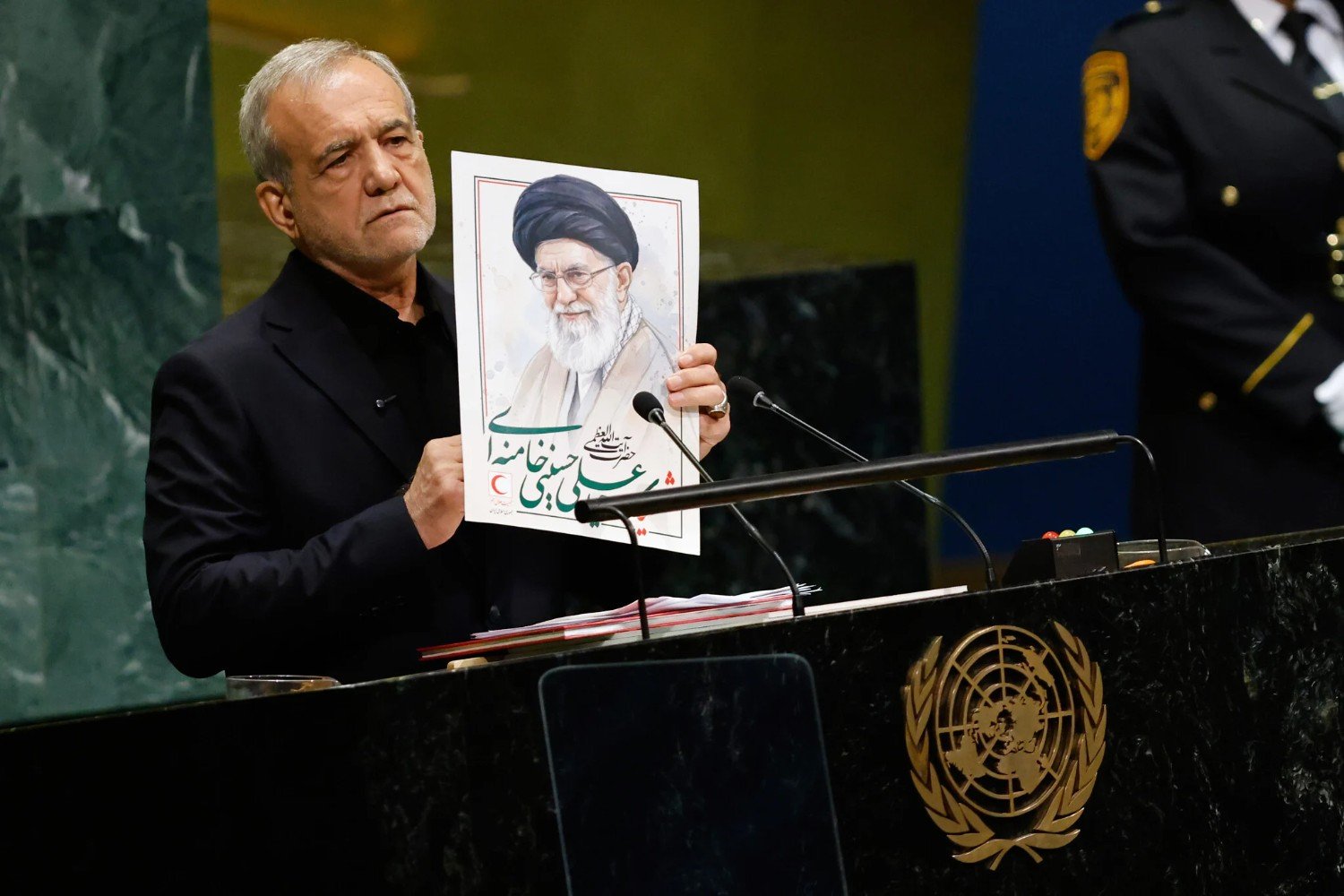
Iran’s president told the United Nations General Assembly on Wednesday that his country would never bow its head to American pressure. On the same day, officials from Tehran and Washington were holding indirect talks in New York that could decide how quickly shipping through the Strait of Hormuz returns to normal.
For the UAE, energy costs, flight schedules and import prices all respond quickly to events in the Gulf. The contrast between public defiance and private negotiation is therefore far more than diplomatic theatre.
A defiant message at the UN
Speaking during the 81st session of the General Assembly, Masoud Pezeshkian said Iran remained willing to talk but would not negotiate under the threat of force. He rejected the suggestion that Tehran started the war and accused the United States and Israel of aggression.
The speech set a hard public tone. Yet the diplomacy around it has been moving in a more practical direction, and neither side appears willing to be seen as the first to give ground.
Talks continue through mediators
Iranian Foreign Minister Abbas Araghchi travelled to New York via Doha. He held roughly three hours of talks with US special envoy Steve Witkoff and Jared Kushner, with Qatar acting as go-between. Iranian officials describe the contacts as indirect and say Tehran’s fundamental conditions have not changed.
Iran has reportedly presented a roadmap with three parts:
- a region-wide ceasefire lasting up to 60 days
- a phased reopening of the Strait of Hormuz
- a timetable for broader negotiations
Tehran has also demanded an end to the US blockade of Iranian ports and the release of frozen Iranian assets.
No agreement has been announced. US Secretary of State Marco Rubio has indicated that Washington remains open to diplomacy but that any deal would need further negotiation.
The blockade at sea
Pressure on the water has not eased. US Central Command said that as of 23 September its forces had redirected 115 commercial vessels while enforcing the blockade of Iran. The figure counts ships turned away, not vessels seized or destroyed, a distinction worth keeping in mind as claims and counterclaims circulate.
The Strait of Hormuz is a crucial route for global energy supplies, which is why the blockade matters well beyond Iran’s ports. Prolonged restrictions can lift crude prices, tanker and marine insurance costs, fuel prices and the cost of imported goods. They can also disrupt wider supply chains.
Oil markets remain on edge
Brent crude traded around $102.80 a barrel on Thursday morning in Tokyo, according to market data cited by Gulf News. West Texas Intermediate stood near $92.02, and the Middle East benchmark Murban was around $113.10.
Prices have eased from recent highs as traders weigh the chance of a diplomatic breakthrough. The market remains exposed to any setback in the talks or new disruption around Hormuz.
There are early signs that Asian buyers are adapting. Kpler data cited by Reuters suggests Asia will import 23.96 million barrels per day of crude in September, up from 23.38 million in August and the highest since February. That is still about 13 per cent below pre-war levels.
China’s August imports recovered to 8.93 million barrels per day, roughly two million below February. High prices could limit how much more Chinese refiners buy.
Flights: check before you travel
UAE aviation remains operational, but airlines continue to adjust their schedules. Air France said on Thursday that it will extend its suspension of flights to Dubai through 13 October and to Riyadh through 28 September, citing its ongoing assessment of regional developments.
Other carriers are still flying to and from the UAE. Schedules can change at short notice, so passengers should confirm their flight with the airline before leaving for the airport. Connections through countries directly affected by the conflict need particular care.
What residents should watch
Three developments will shape the days ahead:
- Hormuz. Any agreement on reopening the waterway could move oil and shipping markets quickly.
- The blockade. The 115-vessel figure shows the maritime confrontation is still active while diplomats talk.
- The ceasefire roadmap. Iran’s 60-day proposal could give negotiators a framework, but nothing has been agreed.
The effects reach ordinary households. Fuel prices at the pump follow global crude, and the UAE’s monthly fuel review is due at the end of September. Freight and insurance costs feed into the price of imported goods, and airline decisions affect anyone planning to travel.
The bottom line
Diplomacy has not stopped the military and economic pressure. A breakthrough could ease shipping and oil-market strain relatively quickly. A stalemate would keep energy and transport costs elevated across the Gulf. For now, both sides are talking while insisting they are not backing down, and the UAE, as a major trading and aviation hub, feels the outcome at its ports, airports and petrol stations.


Comments 1