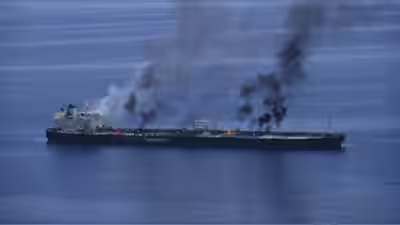
Shipping in the Strait of Hormuz has slowed to a trickle, Bahrain is again defending itself from Iranian drones and Washington has reinforced its naval presence with a third aircraft carrier. For UAE residents, the practical effects are showing up in maritime security, flight schedules and fuel markets.
Tanker attacks on Monday
The UK Maritime Trade Operations agency (UKMTO) reported two attacks on commercial tankers in the strait on Monday, 16 November. No casualties were reported. The extent of the damage, and any environmental impact, remained unclear on Tuesday.
Iran’s Revolutionary Guards navy offered a different account. It said two tankers caught fire after striking naval mines as they tried to cross the southern part of the waterway. Iran’s regular navy said a further tanker had been immobilised after hitting a mine. None of these claims has been independently verified.
A strait almost at a standstill
Tracking data from Kpler shows how sharply traffic has fallen. Only five commodity-carrying vessels crossed the strait on Saturday, 14 November, and none were recorded on Sunday. The weekend before, 31 had passed through.
Before the conflict began on 28 February, more than 130 ships a day used the waterway, which handled roughly a fifth of the world’s crude oil and liquefied natural gas. The UAE has already reported attacks on three vessels operated by the Abu Dhabi National Oil Company (ADNOC). A prolonged disruption would be felt in export revenues, insurance premiums, freight costs and, eventually, the price of imported goods.
Bahrain under fire again
Bahraini authorities said their air defences intercepted Iranian aerial attacks aimed at the kingdom. Iran’s Revolutionary Guards said they targeted a US radar installation at Riffa Air Base using six drones. The reported damage has not been verified.
The UAE’s Ministry of Foreign Affairs condemned the renewed attacks on 15 November. It called them a violation of Bahrain’s sovereignty and a threat to its security, and reaffirmed Abu Dhabi’s support for measures to protect the kingdom.
Washington adds a third carrier
The USS Theodore Roosevelt has arrived in the area covered by US Central Command, joining the USS George H.W. Bush and the USS George Washington. That brings the number of American carrier strike groups in the region to three, as the United States continues its blockade of Iranian ports.
The build-up coincides with reports that Washington and Israel are weighing renewed strikes on Iranian economic and energy infrastructure. Iran’s deputy foreign minister, Kazem Gharibabadi, has warned that Tehran would not necessarily wait for another US attack before responding.
Diplomacy still alive
Despite the escalation, channels remain open. Iranian Foreign Minister Abbas Araghchi is travelling to Muscat for talks with Omani officials, continuing Oman’s long-standing role as an intermediary between Washington and Tehran. Pakistan, meanwhile, is awaiting a US response to Iran’s latest proposals.
No breakthrough has been confirmed. The main sticking points remain the US naval blockade, Iran’s conditions for reopening the strait, sanctions and the future of its nuclear programme.
Oil prices ease despite the risks
Markets have not reacted as sharply as the headlines might suggest. Brent crude traded near $91.71 a barrel on Tuesday, down about 0.8 per cent, with US benchmark WTI at roughly $84.94. The decline reflects expectations that recovering Middle Eastern exports will outpace demand in the fourth quarter. The International Energy Agency has forecast a return to a global supply surplus over the same period.
For motorists in the UAE, it is worth remembering that domestic petrol prices are adjusted monthly rather than daily, so day-to-day moves in crude do not translate straight to the pump.
Energy infrastructure and air travel
The risk extends beyond the Gulf’s sea lanes. Sirens sounded at Iraq’s Khor Mor gas field in the Kurdistan region on Monday after a drone was spotted overhead. No strike or damage was reported. Production there had already been halted the previous week after a suspected drone attack started a fire, affecting about 2.8 gigawatts of electricity generation, according to UAE-based Dana Gas, one of the field’s operators.
In aviation, Etihad has cancelled all passenger and cargo flights between Abu Dhabi and both Riyadh and Dammam through Thursday, 19 November. Flydubai’s Dubai–Tel Aviv service remains suspended until at least late November. Europe’s aviation safety agency has extended its conflict-zone advisory for the Gulf through 31 January 2027. Travellers should confirm flights directly with their airline before heading to the airport.
What to watch
Over the coming days, the key signals are whether tanker attacks continue, whether Araghchi’s Muscat visit produces any movement toward negotiations, and whether the additional US firepower is followed by military action. Oil prices, airline schedules and attacks on energy facilities will show quickly how the situation is developing.


Comments 1