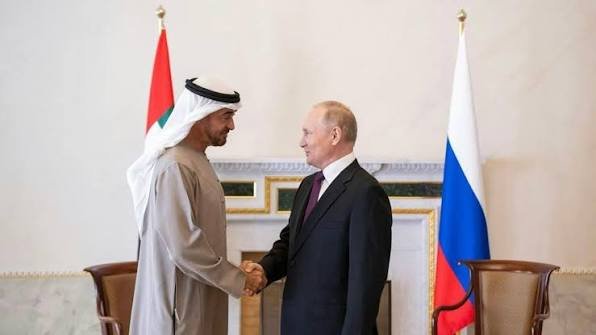
ABU DHABI — UAE President Sheikh Mohamed bin Zayed Al Nahyan received a written message from Russian President Vladimir Putin on Tuesday, handed over in person by Sergei Shoigu, the secretary of Russia’s Security Council. The meeting, reported by the Emirates News Agency (WAM), put the Emirates’ role as a go-between in the Russia-Ukraine war back in focus.
What was said in Abu Dhabi
According to the official readout, Shoigu passed on Putin’s greetings and his thanks for the UAE’s decision to host trilateral talks between the United States, Russia and Ukraine. Those talks are meant to encourage dialogue and help find diplomatic ways out of the crisis.
Shoigu also relayed Moscow’s appreciation for Emirati mediation between Russia and Ukraine. The readout said that mediation continues to secure the release of prisoners held by both sides.
Sheikh Mohamed asked Shoigu to carry his own greetings back to Putin, along with good wishes for the continued progress of Russia and its people. The two men also discussed ways to strengthen the strategic partnership between the UAE and Russia and touched on other issues of mutual interest. The readout gave no further detail on those subjects.
A high-level Emirati line-up
The meeting was attended by several of the country’s most senior figures. They included Sheikh Mansour bin Zayed Al Nahyan, Vice President, Deputy Prime Minister and Chairman of the Presidential Court, and Sheikh Khaled bin Mohamed bin Zayed Al Nahyan, Crown Prince of Abu Dhabi.
Sheikh Abdullah bin Zayed Al Nahyan, Deputy Prime Minister and Minister of Foreign Affairs, was also present. So were Sheikh Theyab bin Mohamed bin Zayed, Sheikh Hamdan bin Mohamed bin Zayed, Sheikh Mohammed bin Hamad bin Tahnoon, who advises the President, and a number of other sheikhs and officials.
Turnout at that level suggests the visit was treated as more than a courtesy call. The readout did not describe the contents of Putin’s letter.
Abu Dhabi’s growing profile as a venue
The UAE has become an unusual meeting point in this conflict. Abu Dhabi hosted three-way talks on 23 and 24 January and again on 4 and 5 February. A third round opened in the capital on 10 November, at Al Shati Palace.
Those sessions were the first meetings involving all three governments since the war began in February 2022. That fact alone has raised the Emirates’ standing as a venue both Moscow and Kyiv are prepared to use.
The UAE’s mediation on prisoners has run on a separate track from the larger political talks. Prisoner releases are among the few areas where both sides have found it possible to reach agreement, and humanitarian exchanges of this kind tend to need a trusted intermediary. The readout suggests Moscow sees the UAE in that role.
Balancing partnerships in a tense region
The meeting comes as the UAE manages a delicate regional position. The country is a close partner of Washington, maintains working ties with Moscow and has been dealing with the fallout of the US-Israel-Iran war, which began on 28 February. Gulf waters, shipping lanes and airspace have all been affected.
Hosting talks while that conflict continues says something about how Abu Dhabi defines its foreign policy. It positions itself as a convener that keeps channels open with parties who are not speaking to one another elsewhere. That approach is not without risk, since a mediator can be criticised by either side. So far, though, the public messages from Moscow have been warm.
It is also worth noting what the readout leaves out. It does not announce a new round of negotiations, a date for further prisoner exchanges or any shift in the UAE’s own stance. It is a statement about appreciation and partnership rather than about a breakthrough, and it should be read that way.
What to watch next
For readers following the diplomacy, three questions stand out. The first is whether the talks that began on 10 November lead to any announced outcome. The second is whether further prisoner releases are confirmed through Emirati channels. The third is whether the “strategic partnership” language leads to concrete economic or political announcements between Abu Dhabi and Moscow.
For now, the day’s meeting is best understood as a signal. Russia is publicly acknowledging the Emirates’ part in the process, and the UAE leadership is receiving that acknowledgement at the highest level. The Emirates Times will follow any announcements from the Presidential Court and the Ministry of Foreign Affairs as they emerge.


Comments 1