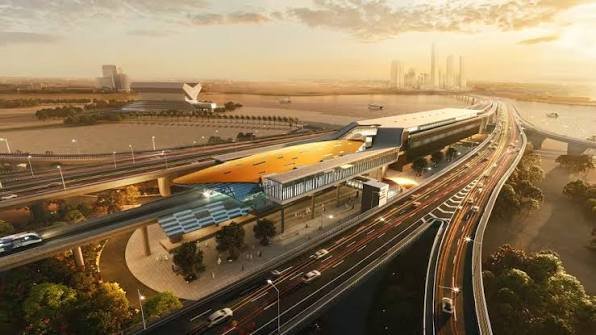
The Largest Transport Project in Dubai’s History
Dubai has laid out the full scope of its most ambitious transport undertaking to date: the Gold Line, a Dh34 billion ($9.26 billion) fully underground metro corridor that will stretch 42 kilometres across the emirate and serve an estimated 1.5 million residents once complete.
Approved by Sheikh Mohammed bin Rashid Al Maktoum, Vice President and Prime Minister of the UAE and Ruler of Dubai, the project marks a new chapter for the city’s public transport network. Unlike existing Dubai Metro lines, which run largely above ground on elevated tracks, the Gold Line will operate entirely underground, at depths reaching 40 metres — making it the emirate’s first fully underground metro line.
Connecting Old Dubai to New Dubai
What sets the Gold Line apart from a purely technical standpoint is its role as a connective thread between the city’s historic core and its rapidly expanding modern districts. The route begins in Al Ghubaiba, one of Dubai’s oldest and most culturally significant neighbourhoods, before winding through Mina Rashid and City Walk, and into major commercial hubs including Business Bay and Mohammed Bin Rashid City.
From there, the line continues through Nad Al Sheba, Mohammed bin Rashid Gardens and Meydan, before passing through Al Barsha South and Jumeirah Village Circle, ultimately terminating at Jumeirah Golf Estates. In total, the alignment touches 15 strategic areas across the city, linking neighbourhoods that represent very different chapters of Dubai’s growth story — from its founding trading districts to some of its newest master-planned communities.
Eighteen Stations, Major Interchanges
The Gold Line’s 18 stations will include several key interchange points designed to integrate the new line seamlessly with Dubai’s existing transport infrastructure. The line will connect with the Red Line at two locations — Business Bay and Jumeirah Golf Estates — and with the Green Line at Al Ghubaiba, effectively knitting the new route into the heart of the city’s established metro network.
Perhaps just as significant, the Gold Line has also been designed to interchange with Etihad Rail’s passenger network at both Meydan and Jumeirah Golf Estates, positioning the new metro corridor as a critical link between Dubai’s urban transport system and the UAE’s broader national rail network — the same network currently expanding its own passenger service into Dubai this month.
An Investment Built on Long-Term Returns
Officials have framed the Dh34 billion investment not simply as an infrastructure expense but as a long-term economic strategy. Projections suggest the project could deliver a cumulative economic return of as much as 430 per cent over 20 years, driven by savings in commuting time and fuel costs, reductions in road accident rates, and lower carbon emissions as more residents shift away from private vehicle use.
Announcing the project, Sheikh Mohammed described it as Dubai’s largest transport undertaking to date, emphasising the scale of the engineering challenge involved in building a fully underground corridor spanning 42 kilometres. He also highlighted the role of Emirati engineering talent in delivering the project, framing it as both a transport milestone and a statement of confidence in the country’s own technical capabilities.
Fuelling Dubai’s Real Estate Growth
Beyond its transport function, the Gold Line carries significant weight for Dubai’s booming real estate sector. The line is designed to enhance connectivity across more than 55 major development projects currently under construction along its route — a deliberate alignment between transport infrastructure planning and the emirate’s rapid pace of urban expansion.
Analysts tracking Dubai’s property market have long noted that proximity to metro infrastructure tends to be a significant factor in property valuations and rental demand. With the Gold Line threading through high-growth corridors including Meydan, Jumeirah Village Circle and Mohammed Bin Rashid City, developers with projects along the route stand to benefit from improved accessibility once construction is complete.
Timeline and Next Steps
The project has been scheduled for completion on September 9, 2032, a delivery timeline officials describe as roughly 30 per cent faster than that of the existing Blue Line, Dubai Metro’s most recently completed expansion. Once operational, the Gold Line is expected to expand the overall length of the Dubai Metro network by as much as 35 per cent, representing one of the most substantial single additions to the system since its original launch.
With tender issuance and contract awards expected to progress over the coming two years, construction activity along the Gold Line’s route is likely to become an increasingly visible feature of daily life in several of Dubai’s busiest districts well before the line’s eventual opening.
A Statement of Confidence
For a city that has built much of its global reputation on ambitious infrastructure projects, the Gold Line represents both continuity and evolution — continuity in its scale and ambition, and evolution in its fully underground design and deep integration with the UAE’s wider national rail strategy. As construction progresses over the coming years, the project is likely to remain one of the most closely watched infrastructure stories in the region. Next Article


Comments 1