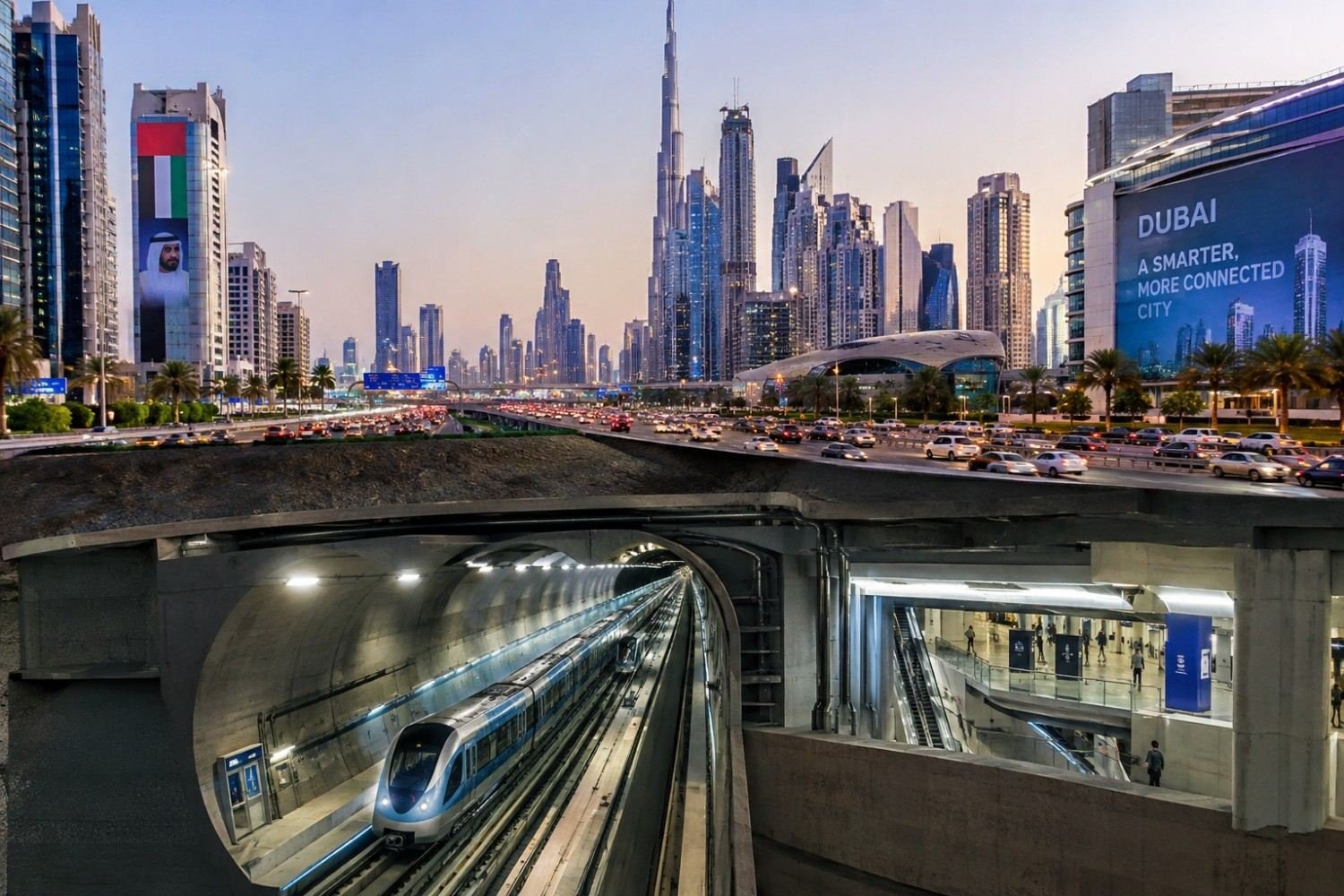
Dubai is studying a new underground transport network designed to carry people, goods and services beneath the city, the head of its Roads and Transport Authority said on Tuesday. The plan reflects how hard the emirate is working to keep pace with a fast-growing population.
Mattar Al Tayer, the RTA’s director general, outlined the idea at the Mohammed bin Rashid Leadership Forum. He told delegates that an RTA team is examining the proposal as part of a broader overhaul of how Dubai moves. He described the future city as one that moves in “three dimensions”: in the sky, at street level and underground.
Why Dubai is looking down
The pressure is clear in the numbers. Mr Al Tayer said Dubai records more than 11 million journeys on its roads every day, more than 7,000 a minute. More than six million people move around the city during daylight hours, a figure he expects to double by 2040.
The population is rising in step. Government statistics put Dubai’s residents at 4.58 million at the end of 2025, up 7.5 per cent in a year. Building more surface roads can only do so much in a dense city, which makes underground space an obvious option to explore.
Mr Al Tayer said the proposed system would not only shift commuters. It is intended to move goods and services as well, and he said it would change how space is used and open new opportunities for investment.
The Dubai Loop is the first piece
The idea builds on a project already under way. The Dubai Loop is a high-speed underground network led by the government in partnership with Elon Musk’s Boring Company. Construction is in progress, and the RTA said in February that the first phase would cost Dh565 million, or about $153.8 million.
That first stretch will connect the Dubai International Financial Centre with Dubai Mall using autonomous Tesla cars. Its first four stations are planned at Burj Khalifa, DIFC 2, Zabeel Dubai Mall Parking and ICD Brookfield Place. The full network is designed to run for 22 kilometres across 19 stations, at an estimated cost of around Dh2 billion.
The Boring Company is also expanding its footprint in the UAE. Last month it was reported to be planning 150 kilometres of tunnels in the Emirates after raising $3 billion in a funding round led by the UAE. Last week it signed an agreement to explore underground transport, utility tunnels and related infrastructure in Abu Dhabi.
Above ground, too
The underground proposal sits within a wider push to automate and diversify travel. The RTA wants one in four journeys in Dubai to be autonomous by 2030. Driverless taxis have covered more than four million kilometres over the past year, Mr Al Tayer said.
Dubai is also moving towards commercial urban air mobility. The first air-taxi station is planned to open this year. A video shown during the presentation pictured air taxis crossing the skyline while buses ran along an underground road network and metro trains and pod-style vehicles pulled into stations.
Mr Al Tayer also credited past transport investment for measurable returns. He said infrastructure spending has delivered savings of more than Dh319 billion ($86.8 billion) and added Dh156 billion to the emirate’s economy.
Open questions
Much remains undecided. In the remarks reported so far, the authority did not give a cost, a route or a timetable for the broader underground network. It is also not yet clear how the new system would connect to the Dubai Loop or the existing Metro.
Those details will matter to residents and investors. For now, the announcement is best read as a statement of direction. The RTA has said it wants Dubai to move in three dimensions rather than one, and it is examining how far underground can take it.


Comments 1