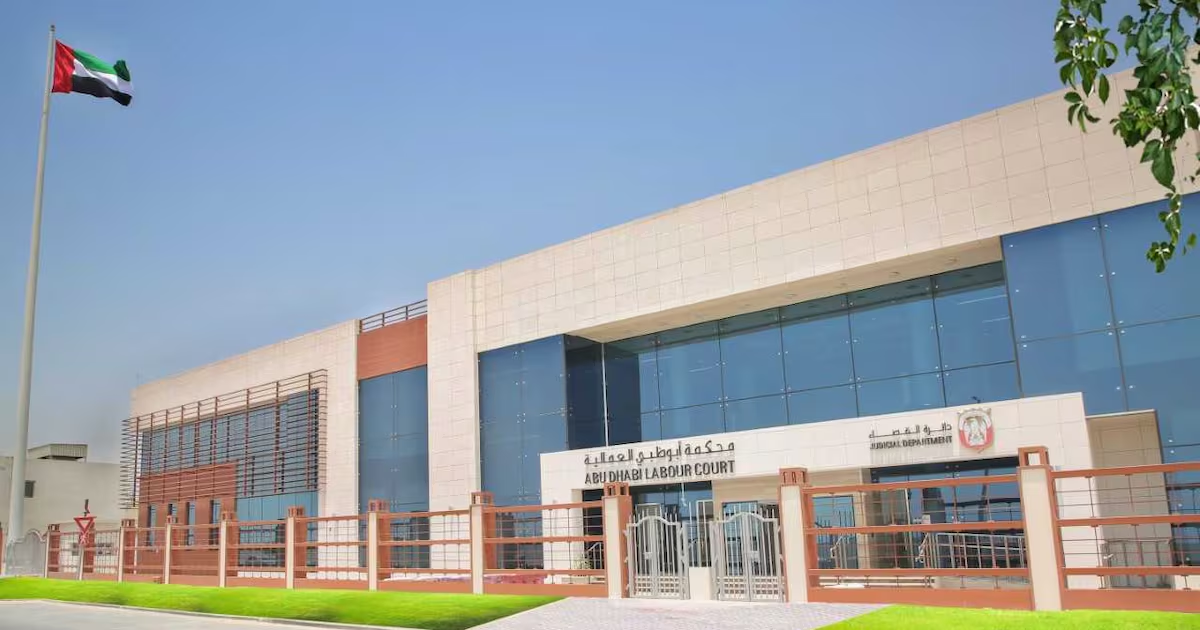
The Abu Dhabi Labour Court has secured the payment of Dh7.8 million in overdue financial entitlements owed to 948 workers, the latest in a long-running series of interventions demonstrating the emirate’s increasingly streamlined approach to resolving collective labour disputes swiftly and decisively.
The case adds to a growing track record for the Abu Dhabi Judicial Department’s labour dispute mechanism, which in recent years has settled tens of thousands of worker claims worth hundreds of millions of dirhams through a combination of expedited legal procedures and, in many cases, direct outreach to workers at their places of residence.
How the system works
Central to the court’s approach is a mobile enforcement mechanism that allows judicial officials to travel directly to workers’ accommodation to process claims, issue rulings and, where necessary, deliver payments without requiring workers to navigate the court system themselves. This approach has proven particularly effective for resolving collective disputes involving large numbers of workers employed by the same company, where a coordinated, on-site process can resolve claims far more quickly than would be possible through conventional individual case filings.
In cases where a company is found to owe its workers overdue wages or other entitlements, the court can also issue orders preventing the evacuation of affected workers from their accommodation until they receive their full dues, alongside facilitating the transfer of workers’ residency to other employers where requested — a measure designed to ensure that pursuing a legitimate labour claim does not leave workers in a precarious position regarding their continued legal status in the country.
Part of a broader worker protection framework
The Dh7.8 million settlement fits within a broader pattern of UAE labour market reform that has gained considerable momentum over the past decade, as the country has worked to strengthen protections for its large expatriate workforce, which forms the backbone of sectors ranging from construction and hospitality to logistics and manufacturing. Reforms in this area have included stronger wage protection systems, expanded rights for workers to transfer employment, and increasingly fast-tracked judicial mechanisms specifically designed to prevent labour disputes from dragging on for months or years, as has historically been a common complaint in labour-intensive economies across the region.
Officials overseeing the Abu Dhabi Judicial Department have repeatedly emphasised that the speed of dispute resolution is treated as a core priority, both as a matter of basic fairness to workers who may be owed wages critical to supporting themselves and families back home, and as a broader signal to the international business community about the reliability and fairness of the UAE’s legal and regulatory environment.
Why swift resolution matters
For migrant workers, many of whom send a significant portion of their earnings home to support families in their countries of origin, delays in receiving owed wages can have immediate and serious consequences. The mobile court mechanism’s ability to resolve disputes and deliver payments directly at workers’ places of residence, without requiring workers to take time off or navigate potentially unfamiliar legal processes, represents a practical recognition of these real-world stakes.
Legal experts and labour rights advocates monitoring the UAE’s evolving labour dispute resolution system note that the continued frequency of these interventions — recovering everything from modest individual claims to settlements worth tens of millions of dirhams — reflects both the scale of the country’s labour market and the judicial system’s ongoing commitment to enforcement, rather than merely the existence of protective legislation on paper.
Looking ahead
As Abu Dhabi continues to attract significant foreign investment and sustain rapid economic growth across labour-intensive sectors, the effectiveness of mechanisms like the mobile labour court will likely remain a closely watched indicator of the emirate’s broader commitment to fair labour practices. For the 948 workers whose claims were resolved in this latest case, the Dh7.8 million settlement represents not just a financial outcome, but a tangible demonstration of a legal system designed to work in their favour when disputes with employers arise.


Comments 1