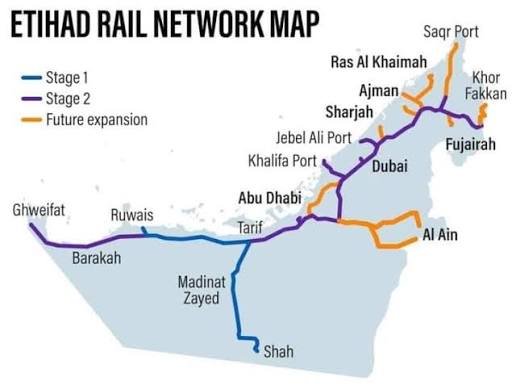
The UAE’s national rail operator, Etihad Rail, is preparing for one of the most significant milestones in its history, with the formal launch of passenger services at new stations in Dubai and Sharjah scheduled for September 30. The expansion marks the next major phase in a national rail project that has steadily progressed from a purely freight-focused network into a genuine passenger transport alternative connecting the emirates.
The new Dubai Station, located near Jumeirah Golf Estates, and the Al Dhaid Station in Sharjah will join the network’s existing passenger route, which began operations on June 30 connecting Abu Dhabi with Fujairah. The addition of these two stations represents a meaningful widening of the network’s practical reach, bringing rail travel within closer proximity to two of the UAE’s most populous and economically significant emirates.
A network years in the making
Etihad Rail’s journey from concept to operational passenger network has spanned more than a decade, initially conceived primarily as a freight corridor designed to reduce the UAE’s reliance on road transport for moving goods across the country. Over time, the project’s ambitions expanded considerably, evolving into a comprehensive national rail network intended to connect all seven emirates, reduce road congestion, cut carbon emissions from transport, and offer residents an entirely new mode of intercity travel.
The launch of passenger services between Abu Dhabi and Fujairah earlier this year represented the first tangible proof of that broader vision, allowing travellers to experience rail transport between two emirates for the first time in the UAE’s history. The addition of Dubai and Sharjah stations now extends that experience to the country’s most densely populated urban corridor, where road congestion during peak commuting hours remains a persistent challenge for residents and businesses alike.
What the new stations mean for commuters
For residents of Dubai and Sharjah, the practical implications of the new stations extend well beyond novelty. A functioning rail connection between the two emirates and the wider Etihad Rail network offers an alternative to the often congested E11 and E311 highways that carry the bulk of inter-emirate road traffic, particularly during rush hour periods when commute times between Sharjah and Dubai can stretch considerably beyond their free-flowing duration.
The Dubai Station’s location near Jumeirah Golf Estates positions it to serve both the western reaches of the city and travellers heading toward Al Maktoum International Airport and the broader Dubai South development area, while the Al Dhaid Station in Sharjah extends rail access into the emirate’s more suburban and semi-rural communities, an area that has historically had comparatively limited access to high-quality public transport infrastructure.
Part of a broader September of change
The rail launch arrives during what has been characterised as an unusually busy month of regulatory and infrastructure change across the UAE, with September also bringing updates to the Nafis programme supporting Emirati employment in the private sector, alongside a range of other adjustments as residents settle back into the working year following the summer months.
For Etihad Rail specifically, the coming launch is widely seen as a proof point for the network’s longer-term ambitions, which include eventual connections to Saudi Arabia and Oman as part of a broader Gulf Cooperation Council rail integration project that has been under discussion for years. Successfully operating and scaling passenger services within the UAE is viewed by transport planners as an essential precursor to any credible cross-border expansion.
Looking ahead
As the September 30 launch date approaches, attention will turn to how quickly ridership builds across the expanded network, and whether the addition of Dubai and Sharjah stations begins to meaningfully shift commuting patterns in a region long dominated by private vehicle use. For a country that has invested heavily in positioning itself as a global leader in ambitious infrastructure projects, a successful passenger rail rollout would mark a significant, tangible addition to that reputation — one that residents, rather than international observers, stand to benefit from most directly.
Soc
, is preparing for one of the most significant milestones in its history, with the formal launch of passenger services at new stations in Dubai and Sharjah scheduled for September 30. The expansion marks the next major phase in a national rail project that has steadily progressed from a purely freight-focused network into a genuine passenger transport alternative connecting the emirates.
The new Dubai Station, located near Jumeirah Golf Estates, and the Al Dhaid Station in Sharjah will join the network’s existing passenger route, which began operations on June 30 connecting Abu Dhabi with Fujairah. The addition of these two stations represents a meaningful widening of the network’s practical reach, bringing rail travel within closer proximity to two of the UAE’s most populous and economically significant emirates.
A network years in the making
Etihad Rail’s journey from concept to operational passenger network has spanned more than a decade, initially conceived primarily as a freight corridor designed to reduce the UAE’s reliance on road transport for moving goods across the country. Over time, the project’s ambitions expanded considerably, evolving into a comprehensive national rail network intended to connect all seven emirates, reduce road congestion, cut carbon emissions from transport, and offer residents an entirely new mode of intercity travel.
The launch of passenger services between Abu Dhabi and Fujairah earlier this year represented the first tangible proof of that broader vision, allowing travellers to experience rail transport between two emirates for the first time in the UAE’s history. The addition of Dubai and Sharjah stations now extends that experience to the country’s most densely populated urban corridor, where road congestion during peak commuting hours remains a persistent challenge for residents and businesses alike.
What the new stations mean for commuters
For residents of Dubai and Sharjah, the practical implications of the new stations extend well beyond novelty. A functioning rail connection between the two emirates and the wider Etihad Rail network offers an alternative to the often congested E11 and E311 highways that carry the bulk of inter-emirate road traffic, particularly during rush hour periods when commute times between Sharjah and Dubai can stretch considerably beyond their free-flowing duration.
The Dubai Station’s location near Jumeirah Golf Estates positions it to serve both the western reaches of the city and travellers heading toward Al Maktoum International Airport and the broader Dubai South development area, while the Al Dhaid Station in Sharjah extends rail access into the emirate’s more suburban and semi-rural communities, an area that has historically had comparatively limited access to high-quality public transport infrastructure.
Part of a broader September of change
The rail launch arrives during what has been characterised as an unusually busy month of regulatory and infrastructure change across the UAE, with September also bringing updates to the Nafis programme supporting Emirati employment in the private sector, alongside a range of other adjustments as residents settle back into the working year following the summer months.
For Etihad Rail specifically, the coming launch is widely seen as a proof point for the network’s longer-term ambitions, which include eventual connections to Saudi Arabia and Oman as part of a broader Gulf Cooperation Council rail integration project that has been under discussion for years. Successfully operating and scaling passenger services within the UAE is viewed by transport planners as an essential precursor to any credible cross-border expansion.
Looking ahead
As the September 30 launch date approaches, attention will turn to how quickly ridership builds across the expanded network, and whether the addition of Dubai and Sharjah stations begins to meaningfully shift commuting patterns in a region long dominated by private vehicle use. For a country that has invested heavily in positioning itself as a global leader in ambitious infrastructure projects, a successful passenger rail rollout would mark a significant, tangible addition to that reputation — one that residents, rather than international observers, stand to benefit from most directly.


Comments 1