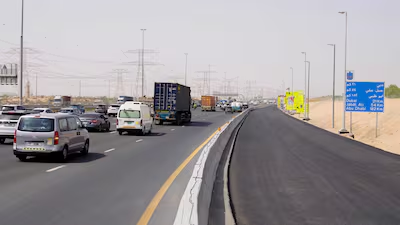
Dubai will close three lanes of one of its busiest motorways for most of the coming week so that self-driving taxi tests can be carried out on a live stretch of road, the emirate’s Roads and Transport Authority (RTA) has announced.
The restrictions apply to Emirates Road, also known as E611, opposite Al Maktoum International Airport. Vehicles will be barred from the three lanes between 9am and 4am each day, from Monday, October 26, until Saturday, October 31. The Al Maktoum International Airport Tunnel will be shut completely for the same six days to allow the autonomous vehicle trials to go ahead.
Motorists have been asked to plan their journeys in advance and to follow road signs on the approach to the affected section. The announcement, as reported, did not name the company or the vehicles taking part in this week’s trials.
Key details at a glance
- Location: Emirates Road (E611), opposite Al Maktoum International Airport
- Lanes closed: three
- Hours: 9am to 4am daily
- Dates: Monday, October 26, to Saturday, October 31
- Also closed: the Al Maktoum International Airport Tunnel, fully
What the closure means for drivers
With the restrictions in force for 19 hours a day, the closure covers the morning rush, the afternoon and the evening peak, and runs well into the early hours. Motorists who normally use the corridor could face slower journeys and heavier traffic on neighbouring routes, particularly at the busiest times, so allowing extra travel time is sensible. The practical advice is to check conditions before setting out and to follow the signs on the day.
A wider push towards driverless transport
The tests form part of a broader strategy to make autonomous vehicles a routine part of Dubai’s transport network. The emirate aims to make 25 per cent of all journeys autonomous by 2030. As part of that effort, the government opened Dubai Mobility Labs at Dubai Silicon Oasis in September, a facility the RTA established with the Dubai Integrated Economic Zones Authority to prepare future fleets for the demands of the city’s roads.
The site combines a controlled, multipurpose testing area with real-world routes on public roads running from Dubai Silicon Oasis to Al Qudra. Vehicles are put through 248 test scenarios designed to probe how they cope with difficult traffic and weather. That gives engineers a chance to examine their sensing and decision-making systems before the vehicles progress to public-road trials and, ultimately, full operation. Technology from global developers including WeRide, Pony.ai and Tesla has already completed successful trials there.
From test track to paying passengers
Passengers are already seeing the results. Sheikh Hamdan bin Mohammed, Crown Prince of Dubai, Deputy Prime Minister and Minister of Defence, launched a self-driving taxi network in the city in February. He inaugurated commercial operations of Baidu’s Apollo Go vehicles and rode in one on his way to the World Governments Summit.
Last month, Uber began operating Apollo Go’s driverless service on its Dubai network, using Baidu’s sixth-generation RT6 robotaxi. The service is initially available in Jumeirah and Umm Suqeim, with plans to expand and to introduce thousands of the autonomous vehicles in the emirate.
Dubai also announced last September that a 15-square-kilometre zone covering Festival City and Dubai Creek Harbour would serve as a testing area for self-driving taxis, delivery vehicles and other service vehicles, to evaluate how autonomous transport performs at a larger scale.
Why live-road testing matters
Test tracks and simulated scenarios can reproduce many hazards, but they cannot fully capture the unpredictability of a major arterial road. Closing lanes on a live motorway lets developers and regulators observe how self-driving taxis behave in a real highway environment while keeping ordinary traffic apart. It is also a visible sign of how far Dubai has moved from planning to practice, with robotaxis now carrying passengers commercially and authorities extending trials to new corridors.
Three developments are worth watching: the results of this week’s tests, the expansion of the Uber and Baidu service beyond Jumeirah and Umm Suqeim, and progress towards the 2030 target.
Officials have not said what will follow the six-day exercise or whether further closures are planned. For now, the message for drivers is to expect disruption on E611 until Saturday, check road advisories before setting out and allow extra time.


Comments 1