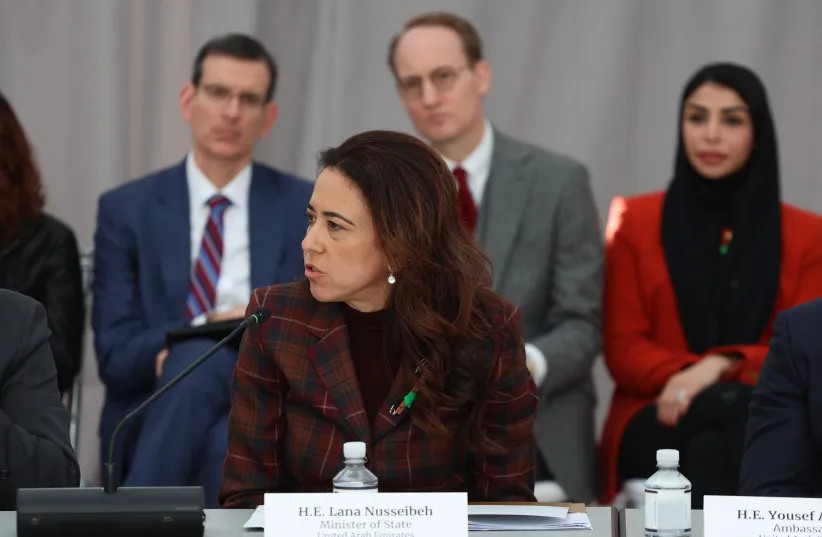
The United Arab Emirates has entered the contest to lead the United Nations, formally nominating Minister of State Lana Nusseibeh as a candidate for secretary-general at a moment when the race has failed to produce a clear favourite.
The UAE announced the nomination on Wednesday, as none of the six existing candidates had emerged as a front-runner. The nomination was submitted in a letter from UAE President Sheikh Mohamed bin Zayed to the heads of the General Assembly and the Security Council.
A deadlocked contest
The outgoing secretary-general, António Guterres, ends his second five-year term on 31 December, and his successor takes office on 1 January 2027. In the most recent informal straw poll, every contender received an effective veto, meaning at least one permanent member of the Security Council signalled opposition. Macky Sall of Senegal withdrew afterwards.
The field includes Rebeca Grynspan, the Costa Rican head of the UN trade and development body, who has led earlier straw polls, and Rafael Grossi, director-general of the International Atomic Energy Agency. Ecuador’s Ivonne A-Baki and María Fernanda Espinosa and Uganda’s Olara Otunnu have also put their names forward.
An informal tradition of regional rotation has raised expectations that the next secretary-general will come from Latin America or the Caribbean, and most declared candidates do. Mike Waltz, the US ambassador to the UN, said after the last vote that Washington understands that desire, adding that it would welcome a woman if she were the best candidate. Richard Gowan of the International Crisis Group has said Latin American states will fight hard to keep the post, but that the veto-wielding powers may care less about rotation.
Who is Lana Nusseibeh?
Nusseibeh is currently minister of state in the UAE foreign ministry and served as the country’s ambassador to the UN from 2013 to 2024. She has also been a vice-president of the General Assembly, president of the Executive Board of UN Women, and twice served as president of the Security Council during the UAE’s time on the council. Her record includes work on General Assembly revitalisation and Security Council reform.
If selected, she would be the first woman to hold the post, the second Arab after Egypt’s Boutros Boutros-Ghali, and the first Gulf Arab. She has said she would aim to build commitments that governments can credibly explain to their own citizens, a pitch that speaks to the trust problems facing the organisation.
What happens next
Under the UN Charter, the General Assembly appoints the secretary-general on the recommendation of the Security Council. That means any candidate must first clear the Council, where the five permanent members hold vetoes, before the full Assembly confirms the choice.
The UAE’s entry is designed to exploit the impasse. Analysts quoted by the Financial Times noted that Washington’s close relationship with Abu Dhabi, and the working ties the other permanent members also have with the UAE, could make Nusseibeh an acceptable compromise. The same reporting noted that an Emirati candidate could raise concerns in Riyadh, and that the Latin American bloc is unlikely to give way easily.
Why it matters
A secretary-general’s influence rests largely on the trust of the Security Council’s major powers and the wider membership. The UAE has built a reputation for quiet, relationship-based diplomacy, and it has used its UN presence in recent years to push for stronger multilateral action on security and humanitarian issues. A successful campaign would give the Gulf its first occupant of one of the most visible posts in international affairs.
The weeks ahead will show whether the existing candidates can overcome their vetoes or whether the Security Council turns to a newcomer. With the clock running down on Mr Guterres’s term, pressure for a consensus choice is growing, and the timing of Nusseibeh’s entry suggests the UAE believes there is room for a fresh name.


