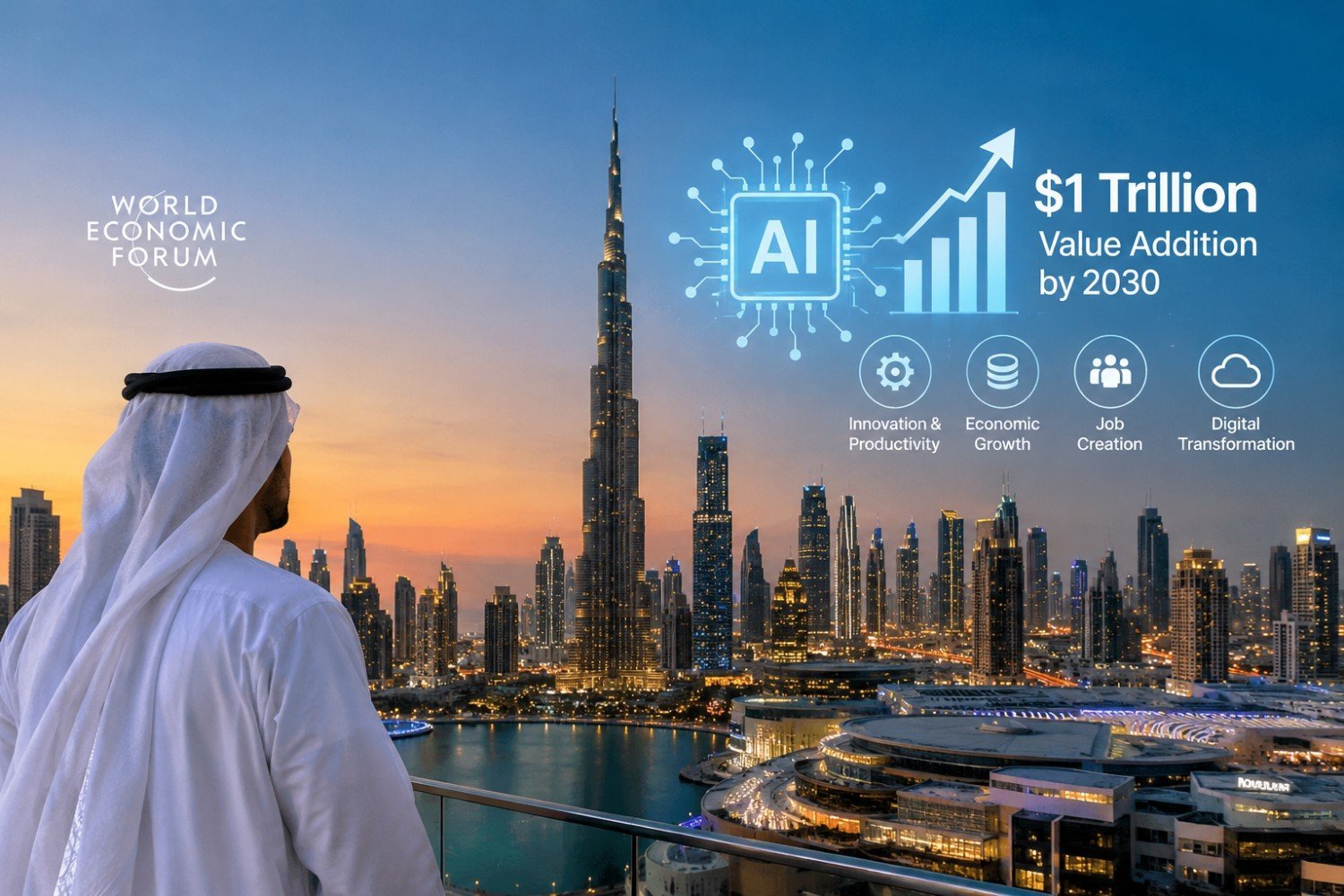
Artificial intelligence could be worth more than $1 trillion to the Middle East and North Africa by 2030, according to new research from the World Economic Forum. The estimate depends on the technology being deployed efficiently.
The WEF published two reports as it and the Government of Dubai host the inaugural Annual Meeting of Global Future Leaders this week. The three-day event brings together hundreds of leaders and specialists for cross-generational discussions on future challenges, and it runs until Thursday.
Where the $1 trillion comes from
The headline figure is a sum of several potential gains, all tied to sustainability and economic performance. The research suggests that:
- The financial sector could mobilise up to $200 billion in sustainable financing.
- The public sector could enable $370 billion in sustainable investment flows.
- Up to $250 billion in long-term asset losses could be avoided.
- Improved sustainability performance could add $90 billion in valuation in the energy sector.
- Cross-sector partnerships could launch $100 billion in sustainable projects.
Together, those components exceed $1 trillion. The WEF framed them as potential rather than certain, and said capturing them will require cross-sector collaboration.
Case studies in the research showed how regional companies are already applying AI. They ranged from First Abu Dhabi Bank, which has used it in sustainable finance, to Adnoc in the energy sector.
The UAE sets the pace
The UAE is the region’s leading AI investor, according to the findings. The US-UAE AI Acceleration Partnership has produced an AI campus in Abu Dhabi, and the country has a $1.4 trillion investment plan stretching over the next decade. Abu Dhabi has separately committed $3.54 billion to bring AI into government services by next year.
Maroun Kairouz, the WEF’s managing director, said the region has the resources, investment capacity and ambition to become a major centre of AI-led growth. He added that turning that into reality will need innovation in data-centre infrastructure, energy and water systems, and in applying AI to sustainability problems.
The resource question
The second report was more cautionary. It focused on the energy and water that data centres consume, a particular concern in a region with extreme heat and water scarcity. Cooling was flagged as a priority area for innovation, with a push towards more sustainable methods that can hold up over the long term.
The region also has advantages. Researchers noted that connecting new data centres to the grid can be much faster in the Middle East and North Africa. It takes between two and five years there, compared with other mature markets.
Nedaa Almubarak, managing director of SRMG Think, said the region is well placed to lead the next wave of digital infrastructure by combining its energy capacity, investment strength and technological ambition. She said the opportunity lies in aligning intelligent infrastructure with efficient use of resources.
Reading the numbers with care
Projections of this kind carry caveats. The $1 trillion figure is an estimate of what could be achieved by 2030 under favourable conditions, not a forecast of what will happen. Its components are built on assumptions about adoption, financing and policy. They also overlap with existing investment plans, so they should not be read as new money on top of announced spending.
Still, the findings land at a moment when Gulf governments are weighing how much of their economic future to tie to AI. The UAE’s commitments are already large, and the WEF’s research gives policymakers a framework for measuring whether they deliver. The Dubai meeting continues through Thursday.


Comments 1