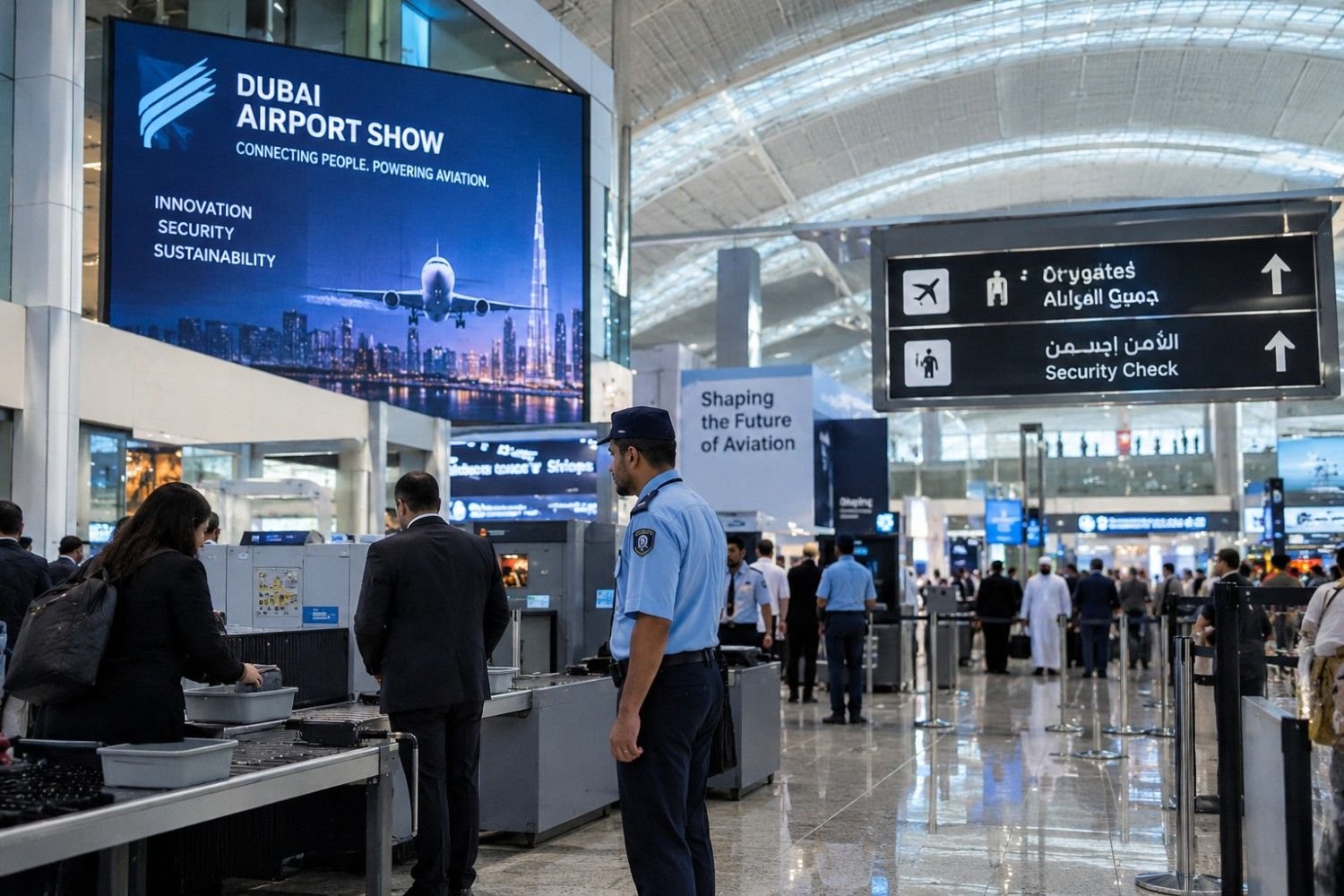
Airports are being forced to rethink how they protect passengers and keep flights running as missile and drone attacks become a more serious threat to civilian aviation, industry experts said at the Dubai Airport Show.
Speakers at the Dubai World Trade Centre event on Monday pointed to repeated attacks by Houthi rebels in Saudi Arabia and months of disruption from the Iran war. Together, they said, these have exposed how vulnerable airports are to modern conflict and how hard it is to stay open through a prolonged security crisis. Operators are investing in new technology and contingency planning, but delegates acknowledged that no facility can ever be fully secure.
The scale of the threat
The numbers presented are stark. The UAE’s Ministry of Defence has reported a total of 2,265 drone attacks on the country since February 28, when the Iran war began. Dubai International Airport alone has dealt with 111 aerial threat alerts.
The wider region has felt the effects too. A Houthi attack on October 8 sent smoke and flames from King Khalid International Airport in Riyadh, and flights there have been disrupted since. Etihad has cancelled its services to Riyadh until October 19.
Resilience, not perfection
Tim Walder, chairman of the British Aviation Group, said the nature of global conflict has created a different set of challenges for airport operators. He argued that resilience will never be total and that systems will fail on occasion, so the goal is to learn faster from each failure. He added that airports can lead in understanding where threats come from, including cyber security and climate change.
Mr Walder stressed the importance of looking after passengers during a crisis. If services go down, he said, confidence can be lost for a long time.
Binu Gopal, chief operating officer of Ras Al Khaimah International Airport, defined resilience as the ability to keep critical operations going through disruption and return to normal safely and efficiently. He said that in a crisis, ground handling, terminal operations, airlines, customs and immigration become more dependent on one another. For him, he said, success depends less on having a contingency plan than on how well teams respond together.
Cyber risk is rising alongside physical risk
Speakers also warned that the danger is not only physical. Mr Walder noted that a few months ago, hackers targeted software supporting check-in processes and disrupted several European airports, including London and Brussels. He said such attacks are likely to hit networks rather than individual airports or airlines, which makes network-wide resilience a pressing question.
New tools on the show floor
Exhibitors at the show demonstrated countermeasures for the drone era. Udi Lowy, sales director for the Gulf Co-operation Council and India at D-Fend Solutions, described a system called EnforceAir Plus that takes over an unidentified drone and lands it safely nearby, rather than jamming its signal. He said jamming can cause damage or injuries on the ground and can interfere with other signals, including those used by aircraft.
Once a drone is under control, the system can help establish where it was launched from and by whom. It can also be configured to handle a swarm entering airspace at the same time, Mr Lowy said.
Across the Gulf, major transit hubs are increasingly linking site security with dedicated anti-drone and air-defence measures. International gateways to the region have added perimeter screening and more police patrols near airports, and some have introduced entry checkpoints at terminals as threat levels have risen.
Designing for attack
Security thinking is also shaping what gets built. Future airport developments, including the expansion of Al Maktoum International Airport, will use blast-proof designs and hardened concrete shells to protect against aerial threats.
For travellers, the immediate effect is likely to be visible but modest, such as tighter screening and more patrols. The longer-term shift is in how airports are designed and run, with resilience planning now treated as a core operating requirement. Industry leaders at the show were clear that defences will need to keep evolving as threats do.


Comments 1