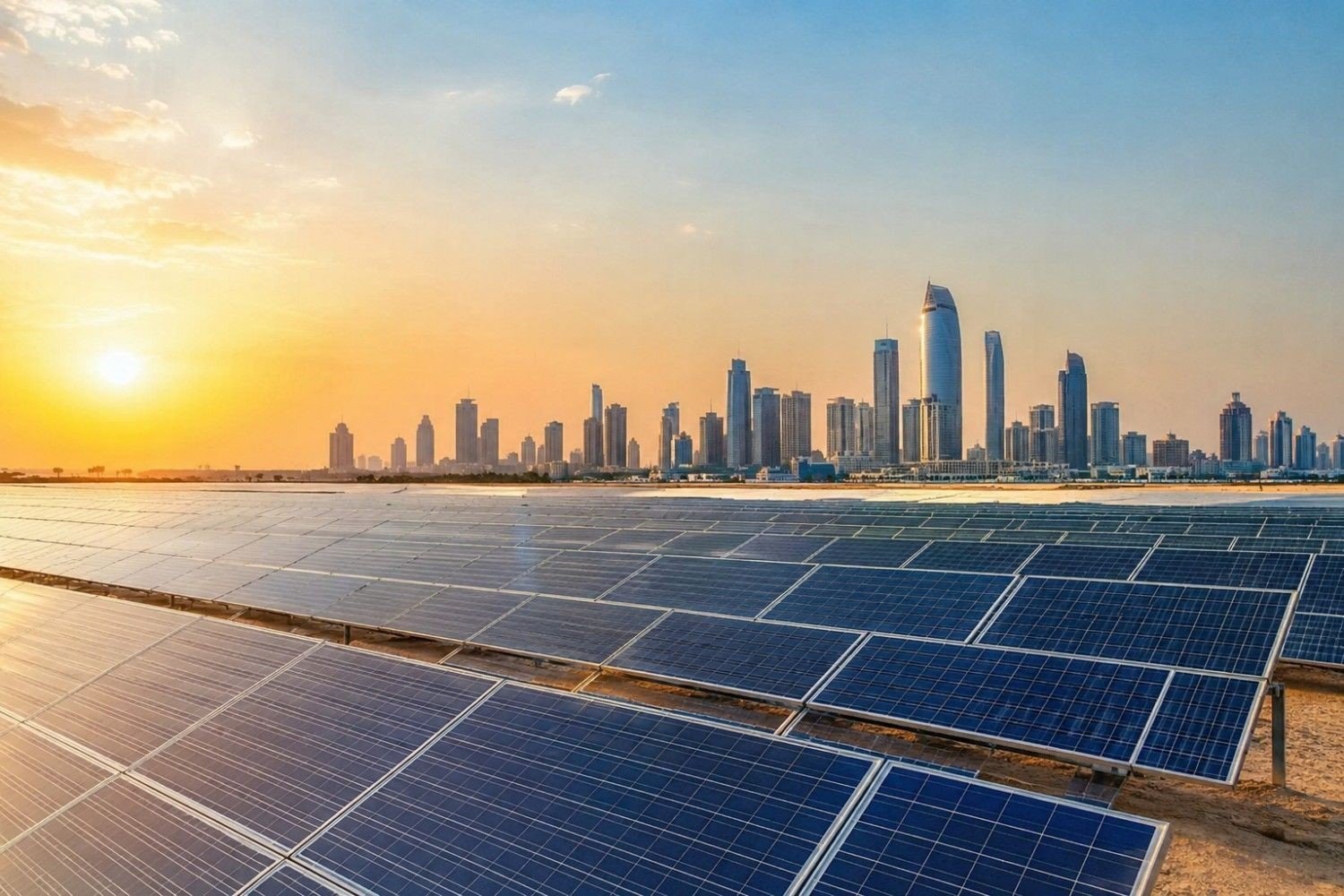
Abu Dhabi’s Emirates Water and Electricity Company (EWEC) has set an ambitious new benchmark in the emirate’s clean energy journey, outlining plans to slash carbon emissions by 45 per cent as the capital’s solar power capacity is poised for significant expansion in the years ahead.
The target represents one of the most concrete markers yet of how Abu Dhabi intends to translate the UAE’s broader net-zero commitments into measurable, near-term action within its power and water sector — historically one of the most carbon-intensive parts of any economy, particularly in a region where desalination and air conditioning place enormous demands on the grid.
Solar at the centre of the strategy
Central to EWEC’s plan is a dramatic scaling up of solar generation capacity across the emirate. Abu Dhabi has already established itself as a regional leader in utility-scale solar, home to some of the largest single-site solar plants in the world, and the latest targets suggest the emirate intends to build further on that foundation rather than treat existing projects as a ceiling.
Expanding solar capacity at this scale requires not just new generation assets but substantial upgrades to grid infrastructure capable of managing the intermittent nature of solar power, alongside continued investment in storage solutions that can smooth out supply during non-daylight hours. Analysts tracking the UAE’s energy transition note that the combination of abundant sunlight, available land, and a clear government mandate has made large-scale solar one of the most cost-effective levers available to Gulf utilities seeking to decarbonise quickly.
Balancing growth with decarbonisation
The challenge facing EWEC, and Abu Dhabi more broadly, lies in decoupling continued economic and population growth from a corresponding rise in emissions — a balancing act that has become increasingly central to how Gulf governments frame their climate commitments. Abu Dhabi’s population and industrial base have continued to expand steadily, placing ever-greater demands on power and desalinated water supply, even as the emirate simultaneously commits to steep emissions reductions.
EWEC’s approach appears to lean heavily on diversifying the generation mix away from traditional gas-fired power, incorporating not only solar but also nuclear capacity from the Barakah plant, which has already contributed meaningfully to reducing the carbon intensity of Abu Dhabi’s electricity supply in recent years. The combination of solar expansion and existing nuclear baseload generation gives the emirate a relatively unusual mix among regional peers, most of whom remain far more reliant on fossil fuel generation.
Part of a wider national push
The emissions target also fits within a broader pattern of UAE climate policy that has gained momentum in recent years, as the country has sought to position itself as a credible voice on energy transition issues on the international stage. Hosting a major global climate conference in recent years put a spotlight on the UAE’s own domestic decarbonisation efforts, creating additional pressure — and opportunity — for utilities like EWEC to demonstrate tangible progress rather than rely solely on long-term pledges.
For residents and businesses in Abu Dhabi, the practical implications of EWEC’s plan are likely to unfold gradually, through continued investment in renewable infrastructure, potential shifts in electricity pricing structures designed to reflect the changing generation mix, and ongoing efforts to improve energy efficiency across both residential and commercial sectors.
Looking ahead
As EWEC moves from target-setting to implementation, the coming years will be a critical test of whether Abu Dhabi can maintain the pace of solar deployment needed to hit its 45 per cent emissions reduction goal while continuing to meet rising demand from a growing population and expanding industrial base. Success would offer a template not just for the rest of the UAE, but potentially for other Gulf states weighing how to reconcile continued economic growth with increasingly urgent climate commitments.
For now, the announcement adds fresh momentum to Abu Dhabi’s clean energy narrative, reinforcing the emirate’s ambition to be seen not merely as a major oil producer in transition, but as a genuine leader in the deployment of large-scale renewable infrastructure across the Gulf region.


Comments 1