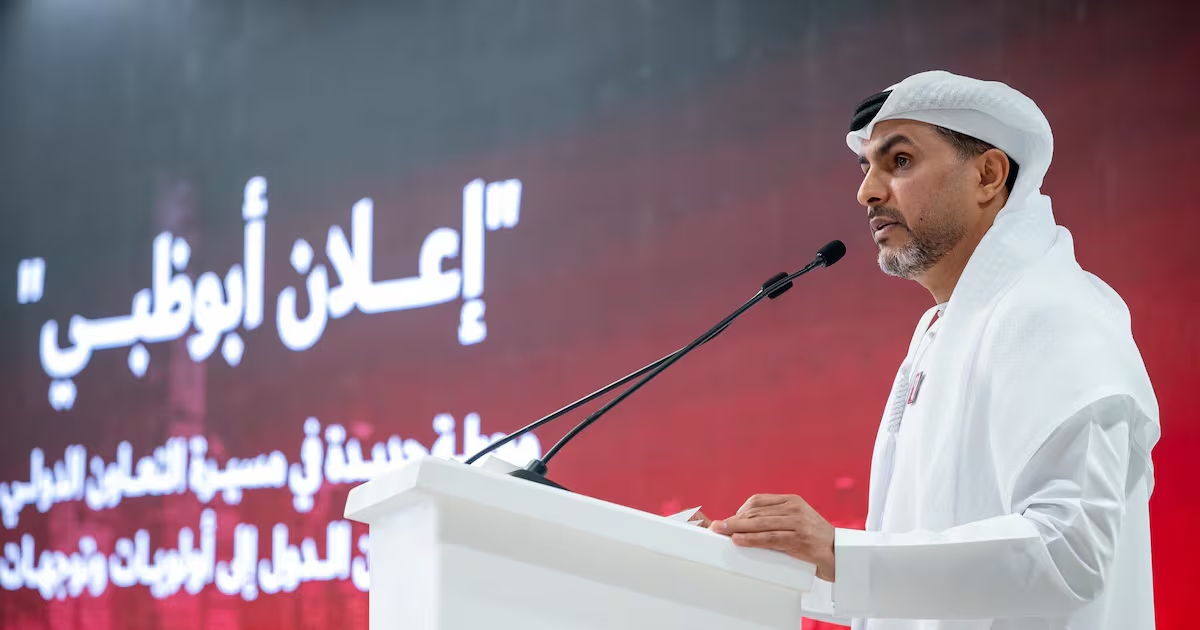
The UAE is putting the finishing touches on preparations to host the 15th United Nations Congress on Crime Prevention and Criminal Justice in Abu Dhabi, with Minister of Justice Abdullah Al Nuaimi confirming that representatives from more than 97 countries will attend what is being billed as the world’s largest specialised platform dedicated to justice issues.
The congress, held once every five years since 1955, represents a significant diplomatic and logistical undertaking for the UAE, positioning Abu Dhabi as the meeting point for governments, civil society organisations, academics and international justice experts converging to address some of the most pressing challenges facing global criminal justice systems today.
A focus on emerging, technology-driven threats
What distinguishes this year’s congress from previous editions is its heavy emphasis on the intersection between rapid technological change and criminal justice. Officials have signalled that discussions will centre heavily on cybercrime, the responsible use of artificial intelligence, and the growing sophistication of organised crime networks that increasingly operate across borders using digital tools that outpace traditional law enforcement capabilities.
The UAE’s own cybersecurity officials have been vocal in recent months about the growing misuse of artificial intelligence by criminal and extremist networks, warning that AI tools are increasingly being used to spread propaganda, produce deceptive synthetic media, and enhance recruitment and radicalisation efforts. That concern is expected to feature prominently in the congress’s thematic sessions, alongside more traditional areas of focus such as drug trafficking, money laundering, human trafficking and violence against children.
The ‘Abu Dhabi Declaration’
Central to the congress will be efforts to secure broad international support for what is being referred to as the “Abu Dhabi Declaration,” a proposed framework document intended to guide global cooperation on criminal justice priorities for the coming years. Securing consensus among member states on such declarations is typically one of the more delicate diplomatic tasks of any UN congress, requiring extensive pre-negotiation among delegations with sometimes divergent legal traditions and enforcement priorities.
Alongside the formal declaration process, the congress will also feature the “Pledge for Justice” initiative, through which participating states are encouraged to announce concrete, measurable commitments aimed at strengthening the efficiency and fairness of their domestic and international criminal justice systems.
Scale and significance for the UAE
Hosting an event of this scale — one expected to include more than 250 side events and dozens of specialised exhibitions — represents a considerable undertaking, and reflects the UAE’s broader ambition to position itself as a serious convening power on global governance issues that extend well beyond its immediate regional interests. In recent years, the UAE has increasingly sought to position Abu Dhabi and Dubai as venues for major international gatherings spanning climate policy, technology governance and now criminal justice reform.
For a country whose economy and society have become deeply intertwined with rapid digital transformation, hosting a congress explicitly focused on adapting criminal justice systems to keep pace with technology carries a particular resonance. The UAE has invested heavily in its own digital infrastructure and has simultaneously moved to strengthen cybercrime legislation and enforcement capacity domestically, making it a logical, if ambitious, choice of host for a global conversation increasingly centred on exactly these issues.
What to expect in the coming days
As delegations arrive in Abu Dhabi, attention will turn to the substantive negotiations expected to take place around the Abu Dhabi Declaration, alongside a packed schedule of thematic discussions covering everything from environmental crime to the rehabilitation of offenders. Youth engagement will also feature prominently, with a dedicated Justice Generation Initiative and Youth Forum preceding the main congress proceedings, reflecting an increasing recognition among policymakers that criminal justice reform efforts benefit from early and sustained engagement with younger generations.
For the UAE, successfully hosting a congress of this scale and securing meaningful international commitments would mark another significant milestone in its ongoing effort to position itself not merely as a regional economic hub, but as a genuine contributor to shaping global policy responses to some of the most complex governance challenges of the digital age.


Comments 1