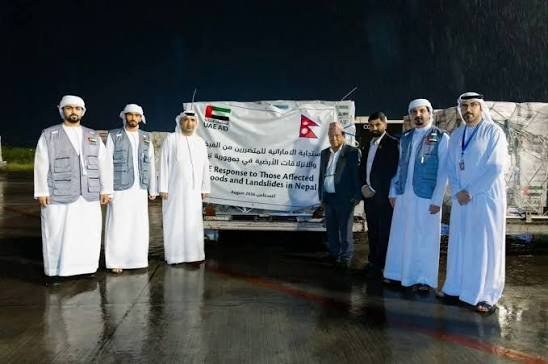
UAE Deploys Search and Rescue Specialists to Nepal Disaster Zone
A team of Emirati search-and-rescue specialists has begun combing through the wreckage left by catastrophic flooding in Nepal, joining local authorities in a desperate effort to locate survivors before time runs out. The Emirati contingent touched down in the Himalayan nation on Friday and moved swiftly into the field, working in coordination with Nepali emergency services in some of the hardest-hit districts.
The scale of the disaster has stunned even seasoned relief workers. Flash floods and mudslides tore through Nepal and the neighbouring Tibetan region of China on August 26, unleashed by torrential monsoon rain that overwhelmed rivers and mountain slopes already saturated from weeks of heavy downpours. Entire hillside communities were buried within minutes, roads and bridges were washed away, and communication networks in several remote valleys have yet to be fully restored.
Nepal’s disaster management authorities now put the confirmed death toll above 1,300, while more than 5,500 people remain missing — a figure that officials warn could rise further as rescue crews reach isolated settlements that have been cut off for days. The Bhotekoshi-Trishuli river basin has been identified as one of the worst-affected areas, with entire sections of villages reportedly swept downstream.
A Rapid, Coordinated Response
The Emirati mission forms part of a broader relief operation the UAE has mounted since the disaster struck. Multiple relief flights have already touched down in Kathmandu carrying emergency supplies, medical equipment and specialist personnel trained in urban and mountain search-and-rescue techniques. Officials say further aid shipments are being organised as the scale of the humanitarian need becomes clearer.
Beyond the immediate search effort, the UAE has also committed significant emergency funding to support relief operations on the ground, addressing the shortage of clean drinking water, sanitation facilities and shelter that has left tens of thousands of displaced people, including large numbers of children, in urgent need of basic support. Aid agencies have flagged particular concern for the wellbeing of children in the affected region, warning that waterborne disease outbreaks could compound the humanitarian emergency if sanitation infrastructure is not restored quickly.
The UAE’s response follows a familiar pattern in its foreign policy: positioning itself as one of the first nations to mobilise emergency assistance when large-scale natural disasters strike, regardless of geography. In recent years, Emirati relief teams have been dispatched to earthquake zones, flood-hit regions and conflict areas across Asia, Africa and the Middle East, part of a wider strategy to project the country as a dependable humanitarian actor on the global stage.
Solidarity Extends Beyond Nepal’s Borders
The UAE’s concern has not been limited to Nepal alone. The same flooding and landslide event caused significant damage and loss of life in the neighbouring Tibetan region of China, prompting the UAE to formally express solidarity with Beijing over the casualties and destruction suffered near the shared border with Nepal. Such gestures of diplomatic solidarity, paired with tangible relief efforts, have become a hallmark of how the UAE positions itself during transnational disasters that cross multiple borders.
For families in Nepal still awaiting word of missing loved ones, the presence of international rescue teams offers a fragile thread of hope. Search operations in mountainous, flood-damaged terrain are notoriously difficult, hampered by unstable ground, damaged infrastructure and the risk of secondary landslides. Rescue workers on the ground have described conditions as challenging, with heavy machinery unable to reach some of the worst-hit valleys, forcing teams to rely on manual search techniques in the most remote locations.
What Comes Next
As the search-and-rescue phase continues, attention is expected to gradually shift toward longer-term recovery: rebuilding washed-out roads, restoring power and water infrastructure, and resettling displaced families ahead of the region’s harsh winter months. International donors, including the UAE, are likely to play a continuing role in that reconstruction effort, given the scale of the destruction and Nepal’s limited domestic resources for a disaster of this magnitude.
For now, though, the priority remains simple and urgent: finding those still trapped beneath the debris. As Emirati rescuers continue their work alongside Nepali counterparts, the coming days are expected to be critical in determining how many more survivors can still be found — and how the death toll from one of the deadliest natural disasters to strike South Asia in recent years may ultimately be tallied. Next Article


Comments 2