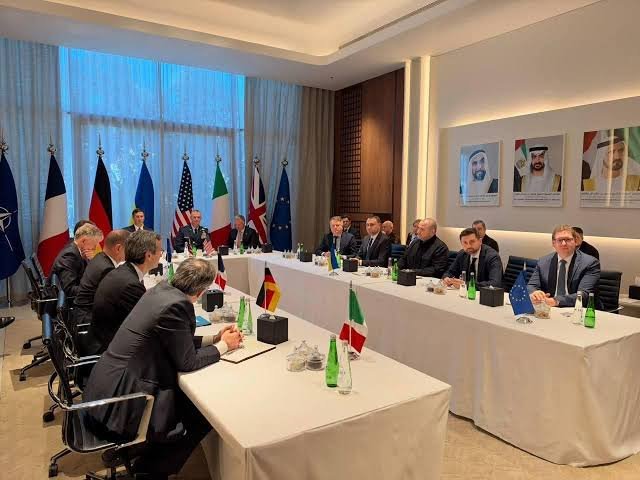
Delegations from Russia, Ukraine and the United States began a second day of talks in Abu Dhabi on Wednesday. The negotiations opened a day earlier and are aimed at ending the war in Ukraine.
The Emirates News Agency, WAM, reported that discussions would resume on Wednesday morning. Ukraine’s lead negotiator, Rustem Umerov, who also heads the country’s Foreign Intelligence Service, said the day would open with a trilateral session involving Kyiv, Moscow and Washington. A separate meeting involving European participants would follow.
How the talks came together
US envoy Steve Witkoff announced at the start of the month that Washington would bring the delegations to the UAE capital on 10 and 11 November. Reuters reported that the meetings are the first in this trilateral format since February. Ukrainian media have described them as resuming after a pause of roughly nine months.
According to US officials cited in reports, the agenda covers ending the war, post-war security arrangements, de-escalation and humanitarian measures. Reuters has reported that American negotiators have been looking for a breakthrough before winter sets in.
What happened on the first day
The first day ended on Tuesday after the delegations spoke for almost four hours, according to the Russian news agency Sputnik. Ukrainian President Volodymyr Zelensky described the session as constructive and substantive. Reports from the room said discussion centred on security guarantees, humanitarian questions and the routes to a lasting settlement.
Russian accounts framed the aim somewhat differently. A source in the Russian negotiating group told Sputnik that the talks were intended to address key elements of a new continental security system. The gap between those descriptions is a reminder that each side is presenting the talks through its own priorities.
What remains unknown
Neither side has published a detailed account of what was agreed, if anything. No joint statement had appeared at the time of writing. Descriptions of the sessions as productive or positive come from the participants themselves and cannot be independently checked. Nor is it clear how far the discussion on security guarantees has moved beyond general principles.
The format also matters. Having the three delegations in one room is different from the shuttle diplomacy that often dominates such efforts, where mediators pass messages between parties who do not meet. Face-to-face sessions can speed up the exchange of positions, but they can also expose how far apart the sides remain.
Why Abu Dhabi
The UAE has cultivated a reputation as a neutral venue that keeps open lines to all parties in several conflicts. It has previously played a facilitating role in contacts between Russia and Ukraine, and hosting a round of US-brokered talks extends that role.
The setting carries some irony. On Tuesday, as the delegations met, an ADNOC Logistics & Services vessel was damaged in an attack inside UAE territorial waters in the Arabian Gulf. The UAE condemned that attack. The country is therefore hosting diplomacy on one war while its own waters feel the effects of another, tied to the conflict involving the United States, Israel and Iran.
What to watch next
Several signals will show whether the two days produced anything concrete:
- A joint or parallel statement from the delegations or from US mediators describing agreed next steps.
- Humanitarian measures, such as arrangements for prisoners or civilians, which are often the easiest area for early agreement.
- Detail on security guarantees, including who would provide them and under what conditions.
- The role of European participants, whose separate meeting on Wednesday suggests Europe is seeking a voice in any eventual arrangement.
- A date for further rounds, which would indicate that all sides see value in continuing.
For now, the most that can be said is that the process is moving again after a long pause, and that it is being conducted in the UAE. Whether it leads anywhere will depend on what the delegations take home from Abu Dhabi and what their leaders are prepared to accept. Next Article


Comments 1