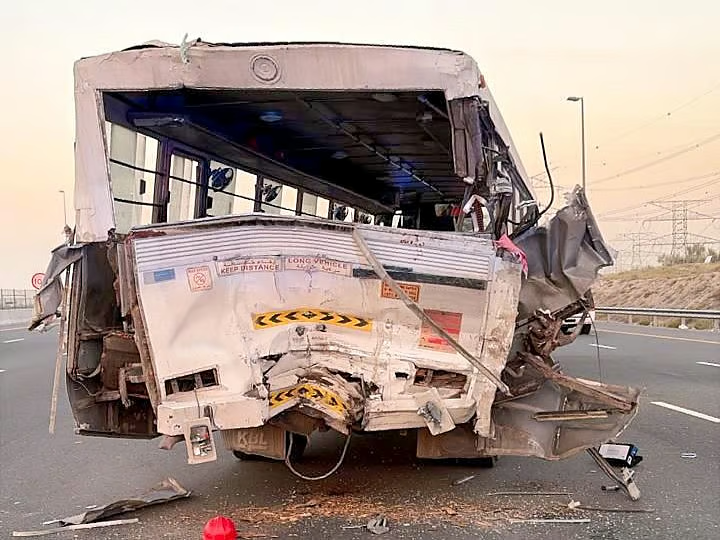
RAS AL KHAIMAH — Two deadly crashes involving heavy lorries within two weeks have prompted road safety experts and transport operators to call for a nationwide overhaul of how the UAE monitors, trains and regulates commercial drivers.
The latest collision, between a lorry and a passenger bus in Ras Al Khaimah on Tuesday, killed 13 people and injured 14 others, The National reported. Early accounts had put the toll at 11, and Indian nationals were among the victims. On 12 November, a multi-vehicle accident involving a lorry on Sheikh Khalifa bin Zayed Road in Fujairah left 14 people dead and around 30 injured. Presidential adviser Dr Anwar Gargash said afterwards that the Fujairah crash had saddened the whole country.
The causes of both crashes have not been publicly established. The specialists who spoke to The National took care not to speculate, and argued that the wider pattern deserves attention regardless.
One standard for all seven emirates
Steve Burnell, chief executive of private bus operator STS Group, said the country needs a single heavy-vehicle safety programme covering every emirate, with mandatory standards, consistent enforcement and clear lines of accountability. Two areas, he said, need particular attention: how roadworthy vehicles are, and how driver fatigue is managed.
Capping driving hours is not enough on its own, Burnell argued. He wants a measurable framework that tracks total duty hours, driving time, rest periods and cumulative working hours. That should be backed by technology and independent audits. Vehicle inspections and preventive maintenance should follow national standards with set testing frequencies. Safety, he said, must never be traded off against commercial pressure or operating margins.
The driver, the vehicle and the enforcement
Thomas Edelmann, founder of Road Safety UAE, framed the challenge as three linked problems: who is behind the wheel, what condition the vehicle is in and how well the rules are enforced. He called for psychological and behavioural assessments, including psychometric testing, before anyone begins professional driver training. He also wants ongoing, realistic education from driving institutes and employers.
Training, he said, should cover driver wellbeing, including enough sleep, healthy diets and regular medical check-ups. Telematics and in-vehicle monitoring can help fleet operators track behaviour, fatigue and vehicle performance. Tachographs, which record driving hours, will be central to enforcing the new limits. Tyres need particular care, he added.
Lanes, limits and technology
Traffic safety specialist Dr Mustafa Aldah focused on how heavy vehicles share the road. Although they make up a smaller share of traffic, crashes involving them tend to be far more serious. He pointed to Abu Dhabi, where lorries are directed to dedicated right-hand lanes, and said other emirates should consider similar arrangements and clearer rules on which lanes each vehicle type may use.
He also urged wider use of technology to monitor the behaviour, rest and sleep of lorry and bus drivers, along with speed limiters to stop heavy vehicles exceeding set speeds. Lorries should stay in the right lane and never overtake dangerously, he said. Other motorists should keep safe distances and concentrate on the road.
Training that goes beyond the test
Khalid Javed, operations director at Excellence Driving Centre, said professional training has to go further than teaching someone to operate a vehicle. He wants accident case studies and real incidents built into courses, so trainees understand how speeding, short following distances, fatigue and poor hazard perception lead to serious consequences. He also recommends mandatory defensive driving courses for professional drivers, covering blind spots, braking distances, hazard anticipation and safe manoeuvres. Passing a test, he noted, does not by itself make someone a safe professional.
What operators say they are already doing
Sridhar Srinivasalu, who manages health, safety, environment and quality at Dubai-based Tristar Group, described a layered approach for a fleet of more than 700 fuel-lorry drivers in the UAE. The vehicles carry systems that monitor driver and vehicle behaviour, including fatigue detection. Drivers are carefully selected and trained when they join and on an ongoing basis. The company also has a fatigue-management policy limiting driving hours and holds quarterly road safety events with speakers from Dubai Police and the Roads and Transport Authority.
Stricter rules are coming
Federal changes are already scheduled. From 1 January 2027, drivers may not drive more than nine hours in any 24-hour period unless the Federal Traffic Council changes the limit. The rule applies to all drivers but will matter most for long-distance lorry and bus operators.
The definition of a heavy goods vehicle is also changing. It will cover vehicles weighing more than 3.5 tonnes when empty, rather than 2.5 tonnes. Cargo safety regulations will tighten too.
The experts’ message was that legislation alone will not be enough without effective monitoring and enforcement. For ordinary motorists, the advice is practical. Keep your distance from heavy vehicles, stay out of their blind spots and never cut in front of them. Whatever investigators eventually find, the calls for a national programme are unlikely to fade quickly.


Comments 1