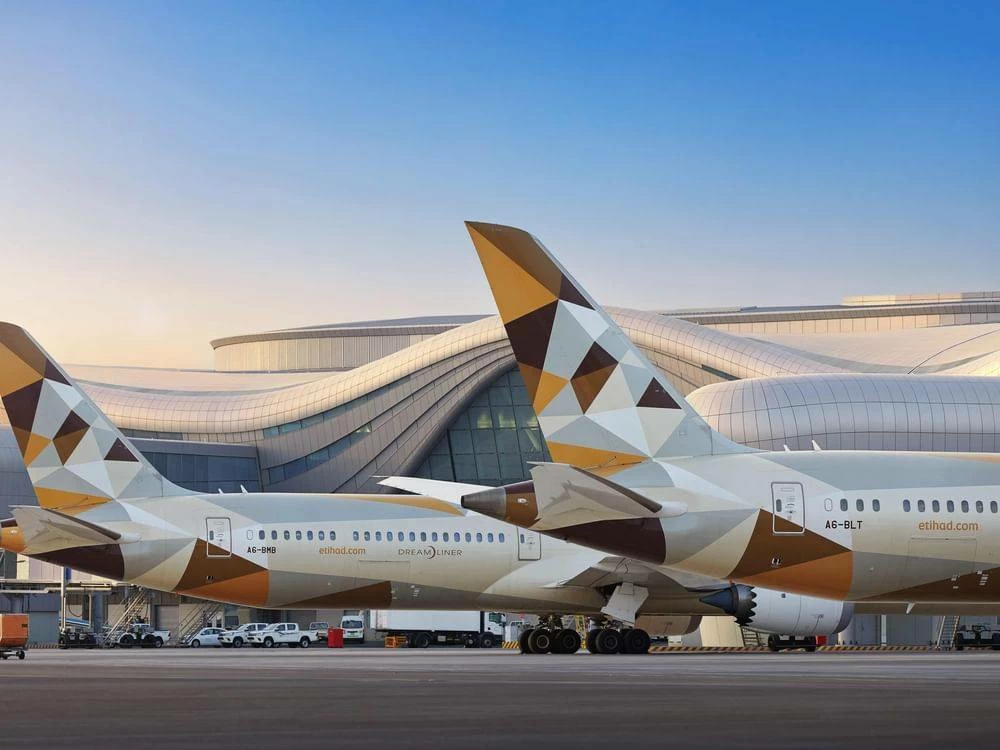
Travellers heading from the UAE to Saudi Arabia got a small piece of good news on Friday, though it came with plenty of caveats. Etihad Airways restarted its daily Abu Dhabi–Jeddah service, while its flights to Riyadh and Dammam remain suspended until Thursday, 19 November.
For anyone with family, business or pilgrimage plans on the other side of the Gulf, the picture is still uneven. It differs by airline, by route and sometimes by the day.
Etihad: Jeddah is back, Riyadh and Dammam are not
The national carrier’s latest travel advisory confirmed that flights EY601 and EY603 from Abu Dhabi to Jeddah, along with the return legs EY602 and EY604, are scheduled to operate from 6 November.
The advisory also said all passenger and cargo flights between Abu Dhabi and both Riyadh and Dammam are cancelled through 19 November. The airline cited continuing regional disruption.
flydubai: a staggered restart
According to the airline’s website, flydubai had earlier cancelled all flights to Abha, Dammam and Riyadh through 5 November. Its booking page now shows a phased return:
- Jeddah flights from Dubai are available from 6 November.
- Dammam services are listed from 10 November.
- Abha and Riyadh flights are listed from 17 November.
Listings can move, so passengers should treat them as indicative until their own booking is confirmed.
Emirates and Air Arabia
Emirates has cancelled several services between Dubai and Riyadh, Dammam and Jeddah. Air Arabia’s picture on Friday was mixed, with some Sharjah–Saudi flights operating, some delayed and others cancelled. The cancelled Sharjah services included G9195 to Abha, G9398 to Jizan, and G9151 and G9154 to Riyadh.
Disruption reports for Dubai and Abu Dhabi on Friday also included a number of delays, which is not the same as cancellation. A delayed flight may still operate, so a departure board should be read alongside the airline’s own notices.
Foreign carriers are adjusting too
The changes are not limited to UAE airlines. Several international carriers have extended suspensions or reshaped their Saudi timetables:
- IndiGo has cancelled flights to Riyadh, Jeddah, Dammam and Madinah until 14 November.
- Air India and Air India Express have suspended Riyadh and Dammam services until 14 November.
- Akasa Air has paused Jeddah flights until 18 November and Riyadh flights until 30 November.
- Lufthansa, KLM, Air France and Philippine Airlines have also lengthened suspensions or adjusted schedules.
Separately, flydubai has suspended Dubai–Tel Aviv flights through at least the end of November.
Why the schedules keep shifting
The cancellations sit against a wider backdrop of security concerns across the Gulf, driven by the US-Israel-Iran conflict and attacks on shipping near the Strait of Hormuz. Airlines tend to revise their schedules at short notice in this kind of environment, and often extend them in stages rather than all at once. That is why dates such as 14, 18 and 19 November differ from carrier to carrier.
Practical advice for passengers
Aviation specialists generally recommend a few simple steps when a route is unsettled.
- Check the airline directly. Official apps and websites are updated faster than third-party listings.
- Confirm before you travel. Look at your flight status on the day, and again a few hours before leaving for the airport.
- Know your rebooking rights. Most airlines offer refunds, credits or rebooking on cancelled flights. Terms vary, so read the conditions on your ticket.
- Build in flexibility. If your trip is time-sensitive, consider a flexible fare or an alternative route.
- Keep contact details current on your booking so you receive change alerts.
Looking ahead
If the Jeddah restart holds, it could be an early sign that capacity is slowly returning. Riyadh and Dammam are the harder test. Etihad’s 19 November date is its current position, not a promise, and it could be extended or brought forward depending on conditions.
For now, travellers should expect a patchwork. Some corridors are reopening, others are closed, and the details can change quickly.


Comments 1