UAE Takes Its Seat at the Table as BRICS Expands Its Influence
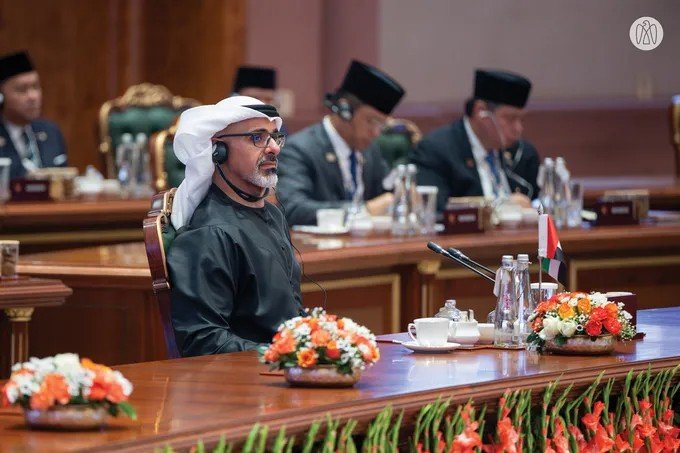
The UAE’s growing role on the world stage was on full display this past week in New Delhi, where Sheikh Khaled bin Mohamed bin Zayed Al Nahyan, Crown Prince of Abu Dhabi, led the UAE delegation at the 18th BRICS Summit, representing President Sheikh Mohamed bin Zayed Al Nahyan at one of the year’s most closely watched gatherings of emerging-economy leaders.
The two-day summit, held at Bharat Mandapam in New Delhi under India’s chairmanship, brought together heads of state and senior officials from a bloc that has expanded well beyond its founding members. Alongside Brazil, Russia, India, China and South Africa, the table now includes Egypt, Ethiopia, Indonesia, Iran, Saudi Arabia and the UAE — a lineup that reflects how significantly the grouping’s composition, and its ambitions, have shifted since it first came together in 2009.
Who Travelled, and Why It Matters
Sheikh Khaled’s delegation included Sheikh Khalifa bin Tahnoon bin Mohammed Al Nahyan, Chairman of the Abu Dhabi Crown Prince Court; Reem Al Hashimy, Minister of State for International Cooperation; and Dr Sultan Ahmed Al Jaber, Minister of Industry and Advanced Technology, among other senior officials — a delegation weighted heavily toward economic and industrial portfolios rather than pure diplomacy, a signal of where the UAE’s priorities at the summit lay.
India’s Ministry of External Affairs welcomed Sheikh Khaled’s arrival by highlighting the depth of the India-UAE relationship, describing the visit as an opportunity to deepen the countries’ Comprehensive Strategic Partnership, particularly around trade and energy security. That framing matters: the UAE and India have built one of the most substantial bilateral economic relationships in the Gulf-Asia corridor over the past several years, and BRICS increasingly serves as one more forum in which that relationship gets reinforced on a multilateral stage.
What the Summit Focused On
India’s chairmanship theme for this year’s summit, “Building for Resilience, Innovation, Cooperation and Sustainability,” set the tone for discussions that centred on financial cooperation and the global energy transition among member states, alongside efforts to deepen ties between emerging and developing economies more broadly. Officials described the goal as promoting a more integrated global economic system and expanding opportunities for shared development — language that reflects BRICS’ broader positioning as a counterweight, or at minimum an alternative venue, to Western-led economic institutions.
Ahead of the leaders’ summit itself, a UAE delegation from the Ministry of Finance had already taken part in a separate meeting of BRICS finance ministers and central bank governors, along with a special session of the Board of Governors of the New Development Bank, held in Mumbai. Mohamed Al Hussaini, Minister of State for Financial Affairs, used that earlier gathering to stress the importance of BRICS as a platform for coordinating positions on financial and economic issues facing developing economies, particularly given the pressures many of those economies continue to face.
The UAE has also welcomed the establishment of a new BRICS Task Force on Growth and Development this year, and officials have specifically flagged digital transformation, innovation, labour mobility and future-skills development as priority areas where they want to see that task force make tangible progress.
The UAE’s Bigger Bet on Multilateralism
The UAE’s presence at the summit is part of a deliberate, longer-running strategy. Since formally joining BRICS as a full member in January 2024, alongside Egypt, Ethiopia, Iran and Saudi Arabia, the UAE has positioned itself as a bridge-builder — a country capable of maintaining close ties with Western partners while also embedding itself firmly within emerging-economy groupings like BRICS. That dual-track approach has become a defining feature of Emirati foreign policy, allowing the country to hedge against shifts in the global economic order while expanding its own diplomatic and commercial reach.
With Chinese President Xi Jinping, Russian President Vladimir Putin and several other heads of state also in attendance, the summit offered Sheikh Khaled a dense schedule of potential bilateral engagements on the sidelines — the kind of high-level access that has become a hallmark of BRICS gatherings as the bloc’s membership, and its global weight, continues to grow. For the UAE, the visit reinforces a message its leadership has repeated consistently in recent years: that the country intends to be an active participant in shaping the next phase of the global economic order, not merely a bystander to it.


Comments 1