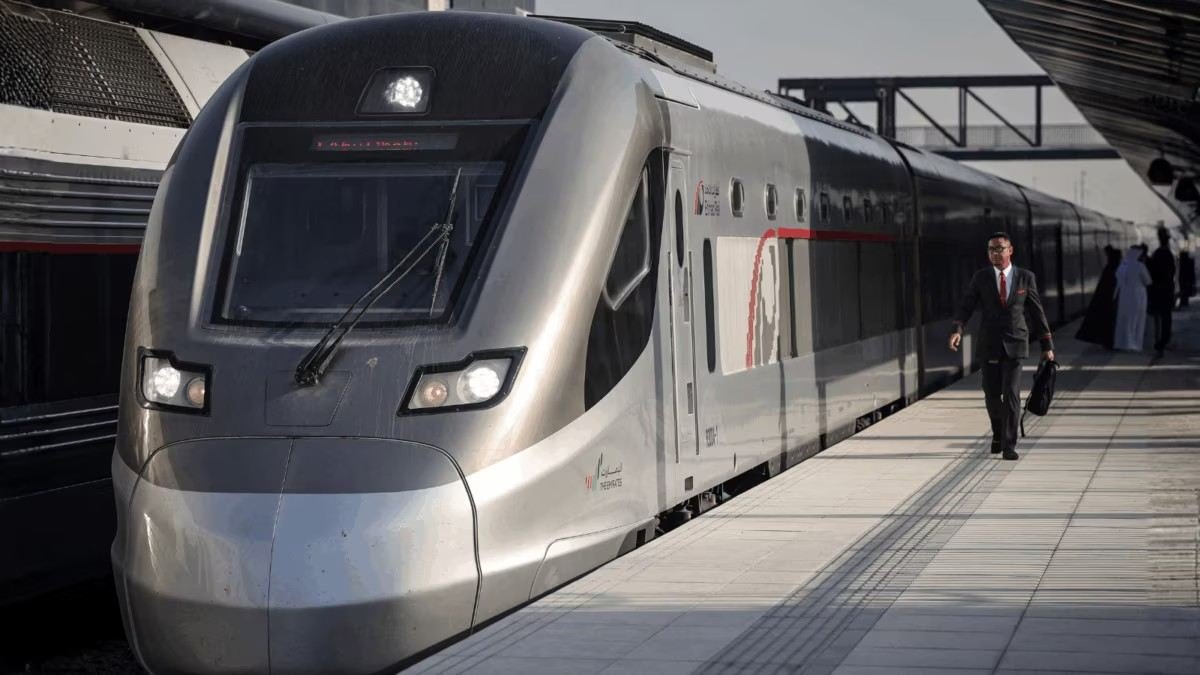
The UAE’s National Railway Finally Reaches Dubai
Nearly two decades after Etihad Rail was first established to build a national railway spanning the UAE, the project is about to hit one of its most symbolically important milestones: a train station in Dubai. From September 30, passenger services will formally expand beyond the introductory Abu Dhabi–Fujairah route to include Dubai’s Al Yalayis station and Sharjah’s Al Dhaid station, giving residents of the country’s two largest cities a direct rail link for the first time in the UAE’s history.
The expansion follows the June 30 launch of an introductory phase connecting Abu Dhabi’s Mohamed bin Zayed City station with Fujairah on the east coast, a journey that takes just one hour and 45 minutes by train — a notable improvement over the equivalent road trip during peak traffic. That first phase served as a proving ground for the wider network, allowing Etihad Rail to test operations, ticketing systems and passenger flow before scaling up to busier corridors.
What Changes on September 30
With the Dubai and Al Dhaid stations coming online, passengers will for the first time be able to travel by train between Abu Dhabi and Dubai, two cities separated by roughly 140 kilometres of highway that carries some of the busiest commuter and business traffic in the country. The Dubai station sits within the Jumeirah Golf Estates area, with direct access to Sheikh Mohammed bin Zayed Road, and has been designed as a future interchange point with the Dubai Metro’s Gold Line — a detail that signals how deeply the new railway is meant to integrate with existing city transport rather than operate as a standalone system.
Fares on the original Abu Dhabi–Fujairah corridor start at Dh55 for Comfort Class and Dh120 for Premium Class, with Comfort offering guaranteed seating, Wi-Fi, power outlets and luggage space, and Premium adding wider reclining seats, extra legroom and complimentary refreshments. Pricing for the newly opened Dubai and Al Dhaid routes is expected to follow a similar tiered structure, though Etihad Rail has said fares for each new destination will be released in step with the phased rollout rather than announced all at once.
A Network Built in Phases
The Dubai and Al Dhaid launch is only the second of four planned phases. Stations across Abu Dhabi’s Al Dhafra region — Al Sila, Al Dhannah, Al Mirfa, Madinat Zayed and the Liwa area — are scheduled to open on December 30, extending the network into the emirate’s industrial and energy corridor. The final piece, a station serving Sharjah’s University City, is due to open on March 30, 2027, completing the initial 11-station network that will eventually connect all seven emirates.
The fleet supporting this rollout comprises 13 trains, each capable of carrying up to 400 passengers, running along roughly 900 kilometres of track stretching from Al Sila near the Saudi border in the west to Fujairah on the east coast. Etihad Rail has structured ticket sales so that fares for each newly opened route only go live in the weeks before that phase begins, with bookings generally possible up to four weeks ahead of travel through the operator’s app, website and contact centre.
Part of a Broader National Ambition
The passenger network sits within the UAE’s “Projects of the 50” initiative, a package of strategic programmes launched to support economic diversification beyond oil. Officials have consistently framed the railway not just as a convenience for commuters but as critical infrastructure meant to ease road congestion, cut transport-related emissions, and physically bind the country’s seven emirates more closely together — both economically and socially.
Sheikh Khaled bin Mohamed bin Zayed Al Nahyan, Crown Prince of Abu Dhabi, personally inaugurated the Mohamed bin Zayed City station ahead of the June launch, touring its facilities and reviewing operational readiness — a level of high-profile attention that underscores how significant officials consider the project to be for the UAE’s long-term transport strategy.
What Comes Next
For now, the immediate focus is making sure the September 30 launch goes smoothly. Ticketing for the Dubai and Al Dhaid routes is expected to open in the lead-up to the launch date, following the same pattern used for the original Abu Dhabi–Fujairah service. Once fully complete in 2027, the network promises to reshape how residents think about travelling between emirates — replacing what has always been a road trip with a rail option that planners hope will prove faster, more predictable and considerably less stressful than sitting in cross-emirate traffic.


Comments 1