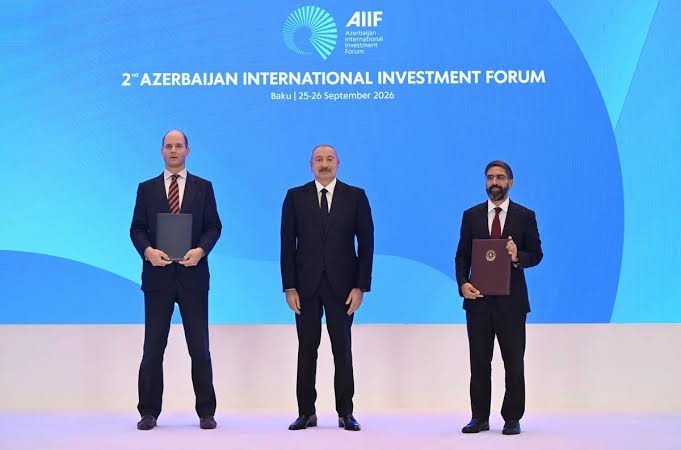
Abu Dhabi’s international energy investment arm has committed to the next stage of one of the Caspian Sea’s largest gas developments, clearing the way for a major expansion of Azerbaijan’s Absheron field.
XRG, the overseas investment company of the Abu Dhabi National Oil Company (ADNOC), announced on Saturday that it had taken a final investment decision on the field’s next development phase. The announcement was made at the Azerbaijan International Investment Forum in Baku, and the Emirates News Agency carried the details. No figure was given for the value of the investment.
What the expansion will deliver
Absheron is an offshore field that produces both natural gas and condensate, a light liquid hydrocarbon. XRG says the new phase should unlock up to five trillion cubic feet of recoverable gas. Production is scheduled to begin in 2029 and to rise to as much as 600 million cubic feet of gas a day, roughly 17 million cubic metres. Condensate output is expected to reach 47,000 barrels a day.
The expansion builds on a first phase that started producing in 2023. Azerbaijani outlet Report.az has reported that the first phase currently yields about 1.5 billion cubic metres a year. It said the second phase is expected to lift annual output to at least 4.5 billion cubic metres. According to the same report, part of the new gas will be exported to Türkiye and the rest sold in Azerbaijan’s domestic market, with condensate shipped through the Baku–Tbilisi–Ceyhan pipeline.
Who is behind the project
XRG holds a 30 per cent interest in the concession, a stake acquired in August 2023. French energy group TotalEnergies and Azerbaijan’s state oil company SOCAR each own 35 per cent.
In its statement, XRG said its investments in Absheron, the Southern Gas Corridor and the wider Caspian region were meant to support Azerbaijan’s energy ambitions and strengthen regional energy security. It added that they also advance the company’s own international gas strategy.
A widening Caspian footprint
Absheron is one piece of a larger push. XRG was launched in 2024 with an enterprise value above $80 billion and has said it intends to double the value of its assets over the next decade.
In Azerbaijan, it is also a partner in the Southern Gas Corridor. The roughly 3,500-kilometre pipeline network carries Caspian gas through Georgia and Türkiye into southern Europe and connects to more than 15 European countries. XRG completed its purchase of a stake in the corridor earlier this month. Across the Caspian, it holds a 38 per cent participating interest in Turkmenistan’s offshore Block I concession. It has also entered Venezuela’s gas sector.
Separately, ADNOC, XRG and Masdar have signed agreements with German energy companies, another sign of the group’s interest in European demand.
Why the timing draws attention
The decision comes at a sensitive moment for global energy markets. Traffic through the Strait of Hormuz has slowed sharply since the war involving Iran began on 28 February. Roughly a fifth of the world’s traded oil passed through the waterway in peacetime. The UAE has repeatedly accused Iran of attacking ADNOC-linked vessels there.
Gas from the Caspian reaches European customers by pipeline through Georgia and Türkiye, a route that does not rely on Gulf shipping lanes. For an Abu Dhabi company, holding a stake in supply outside the Gulf’s chokepoints offers a degree of diversification. That is context rather than stated motive. Neither the company’s announcement nor the accompanying reports link the decision to the conflict.
What comes next
With first gas from the expansion still three years away, the practical effects will be felt first in construction and contracting rather than in supply. Investors and industry observers will be watching for the project’s cost, which has not been published, and for whether the 2029 start-up date holds.
For the UAE, the announcement reinforces a strategy that has been visible for months: using state-backed capital to secure positions in gas-producing regions and to build direct relationships with European buyers. For Azerbaijan, it brings a committed foreign partner to a field whose second phase has been discussed for some time.


Comments 1