The UAE Just Became a Carmaker: Inside Abu Dhabi’s New Automotive Bet
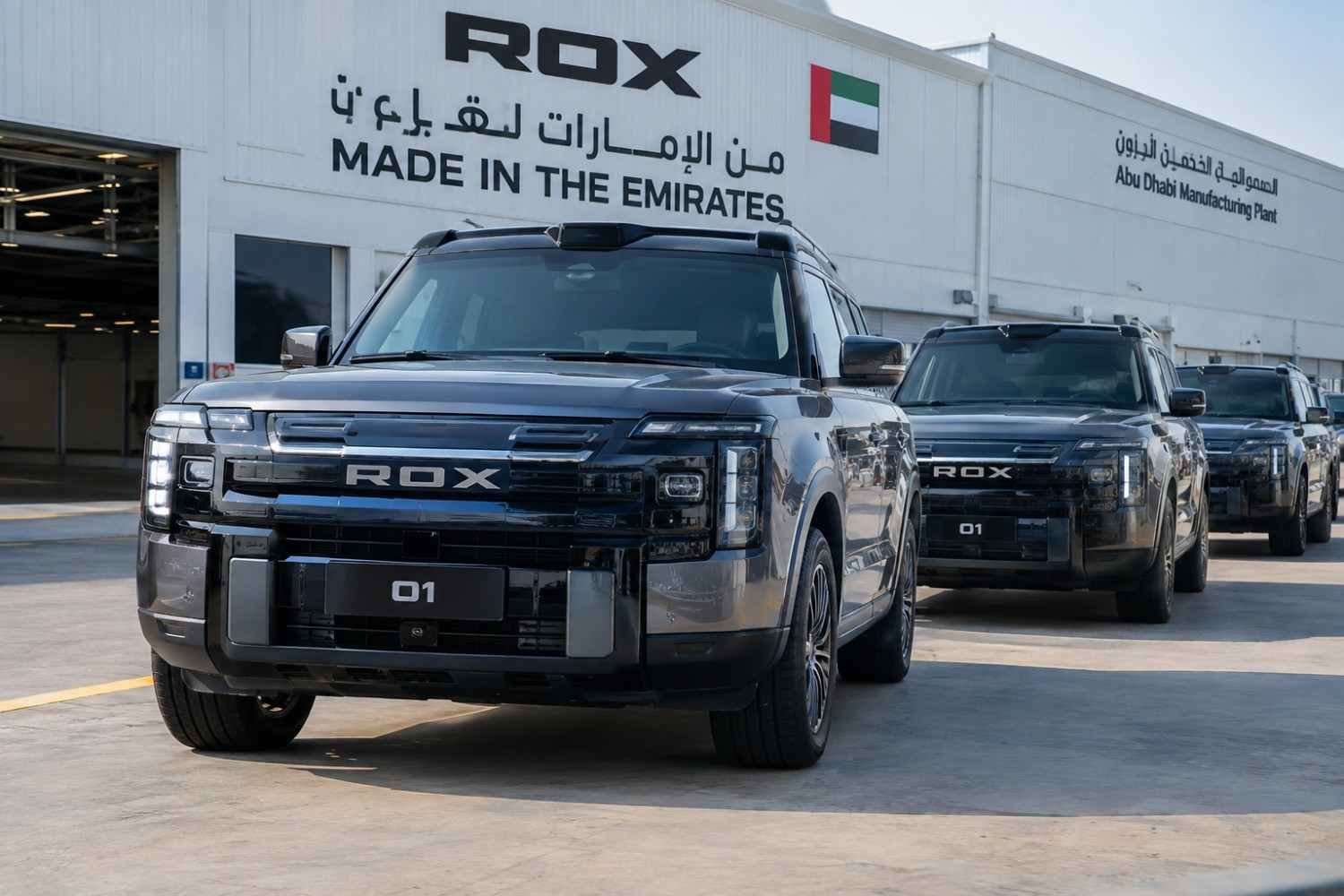
For a country better known for oil wells and towering skylines than assembly lines, the sight of a finished SUV rolling off a production belt in Abu Dhabi marks a genuinely new chapter. This week, Chinese automotive brand ROX confirmed that its Advanced AI Manufacturing Centre in the emirate’s Khalifa Economic Zones Abu Dhabi (KEZAD) has produced its first vehicles, three ROX ADAMAS SUVs, each carrying the freshly minted “Made in the Emirates” mark.
It is a small physical moment with outsized symbolic weight. The UAE has spent years talking about economic diversification away from hydrocarbons; watching an actual, driveable vehicle emerge from a UAE-based factory floor is about as tangible a proof point as that strategy can offer.
Inside the New Facility
The manufacturing centre itself spans roughly 10,000 square metres within KEZAD and was developed through a partnership between ROX and the Abu Dhabi Investment Office (ADIO). It is designed to handle local sub-assembly of more than 80 different vehicle component types, alongside full vehicle assembly, calibration, rain testing, road testing and final quality inspection before cars are cleared for delivery to customers.
Crucially, the plant is not simply a bolt-together assembly shed. ROX has paired the manufacturing line with an AI Lab and Design Studio on the same Abu Dhabi campus, signalling an ambition to eventually handle not just vehicle assembly locally, but genuine product design and engineering work within the UAE itself. Company leadership has spoken of drawing design inspiration from Khoos, the traditional Emirati craft of weaving palm fronds, worked into elements of the brand’s vehicle styling, an attempt to root a global automotive brand in distinctly local identity.
Ambitious Production Targets
ROX’s stated targets are notably aggressive. The Abu Dhabi plant is expected to reach an initial annual production capacity of around 20,000 vehicles in 2027, before scaling dramatically to an annual capacity of 300,000 vehicles by 2030. Vehicles produced at the facility are intended to serve the domestic UAE market initially, with plans to expand into regional and international export markets as production capacity grows.
ROX Founder and CEO Jarvis Yan described the opening of the manufacturing centre as a starting point for the company’s broader expansion into international markets, framing Abu Dhabi not simply as a manufacturing outpost but as the anchor for the brand’s wider global growth strategy going forward.
Fitting Into a Bigger National Strategy
The plant’s launch is being positioned squarely within two of the UAE’s flagship industrial initiatives: “Make it in the Emirates,” a national push to boost domestic manufacturing and reduce reliance on imports, and “Operation 300bn,” the country’s broader National Strategy for Industry and Advanced Technology, which aims to raise the industrial sector’s contribution to GDP and position the UAE as a global hub for advanced manufacturing.
A senior official from the UAE’s Ministry of Industry and Advanced Technology framed the milestone as evidence the country can attract and localise advanced industries spanning production, design, research and development, and artificial intelligence applications, all under one roof. The emphasis on In-Country Value, a metric the UAE government tracks closely to measure how much economic benefit from a given industry stays within the domestic economy, was a recurring theme in official comments accompanying the announcement, alongside the creation of specialised job opportunities for Emirati nationals.
The Regional Race to Build Cars
ROX is not operating in isolation. Gulf states have been steadily building out homegrown automotive manufacturing ambitions at varying scales over recent years. Saudi Arabia’s sovereign wealth fund backs Lucid Motors, whose assembly plant near Jeddah is expected to reach full production capacity this year, alongside CEER, the kingdom’s own domestically developed EV brand. Qatar, too, has signalled interest in developing a domestic automotive manufacturing footprint.
Abu Dhabi’s approach with ROX differs in one notable respect: rather than building a brand from scratch domestically, as Saudi Arabia has attempted with CEER, the UAE has instead attracted an established international automotive brand to relocate its global headquarters and manufacturing base to the emirate, betting that existing product development expertise combined with Abu Dhabi’s capital, infrastructure and logistics connectivity can accelerate the timeline to meaningful production scale.
What Comes Next
For now, ROX’s Abu Dhabi output remains a handful of vehicles rather than a mass-market wave, and the gap between three cars rolling off a line and 300,000 units annually by 2030 is substantial. But the infrastructure, workforce training pipelines and supply chain relationships being built now will determine whether that target is realistic or aspirational.
If ROX hits even a fraction of its stated targets, the UAE would move from a country that imports the vast majority of its vehicles to one with a genuine, export-capable domestic automotive manufacturing base, a shift that would rank among the more unexpected chapters yet in the country’s decades-long economic diversification story.


Comments 1