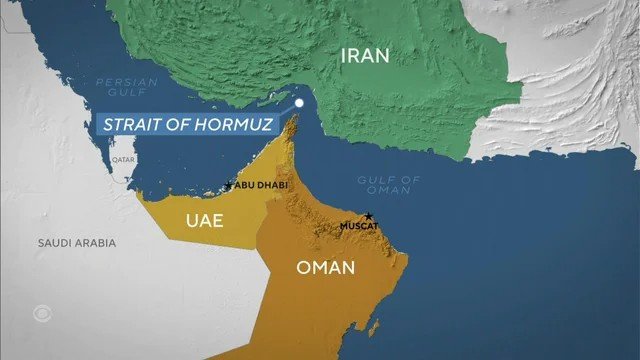
The United Arab Emirates has once again drawn a firm line over the Strait of Hormuz, with a senior UAE official describing the strategic waterway as a “red line” for the country and insisting it must remain fully open to international shipping, free from tolls, restrictions or unilateral control by any single party.
The comments continue a consistent and increasingly urgent message that UAE officials have delivered across multiple international forums throughout the year, as the ongoing conflict involving Iran, the United States and Israel has repeatedly threatened to disrupt one of the world’s most important energy corridors. Roughly a fifth of the world’s oil has historically passed through the strait, which separates Iran to the north from Oman and the UAE along its southern coast.
A message repeated on the world stage
UAE Minister of Foreign Trade Dr Thani bin Ahmed Al Zeyoudi has been among the most vocal officials pressing this point internationally. Speaking earlier this year at the GLOBSEC Forum in Prague, during a panel session examining how the conflict with Iran is reshaping global economies and policy, Dr Al Zeyoudi stated plainly that the Strait of Hormuz must remain a free and open international waterway, and that no single party should be permitted to dominate it or use it as leverage against the wider global economy.
That message has been echoed by other senior UAE figures throughout the year. At the United Nations, Mohamed Abushahab, the UAE’s Permanent Representative, told a media briefing that the country rejects any imposition of fees for passage through the strait, describing such international maritime corridors as routes that must never be subjected to what he called extortion. Separately, Reem Al Hashimy, UAE Minister of State for International Co-operation, has described the strait as a “public good” that should not be under anyone’s control, stressing that its continued weaponisation by Iran carries consequences that extend well beyond the immediate region.
Why the stakes are so high
The Gulf region’s economic significance to global energy and food markets makes the strait’s status a matter of concern far beyond the countries that border it directly. Officials have pointed out that Gulf states account for close to a third of global fertiliser exports and roughly a quarter of the world’s oil and gas supply, with much of that trade dependent on safe passage through Hormuz. Any prolonged disruption carries the potential to push global energy prices sharply higher and complicate supply chains for industries well outside the region.
Since the conflict between Iran and the US and Israel began earlier this year, the UAE has faced direct consequences from the instability, including missile and drone attacks that were intercepted over its territorial waters and, at various points, disruptions to shipping and aviation. The country has consistently condemned attacks on regional shipping and infrastructure while pushing diplomatically for de-escalation and a return to secure, unrestricted maritime trade.
A balancing act
Analysts have described the UAE’s position on the strait as reflecting a broader diplomatic balancing act the country has had to manage throughout the conflict, opposing Iranian actions that threaten regional shipping and security while also working to avoid becoming a direct party to the wider war. UAE officials have repeatedly framed their position not as taking sides in the conflict itself, but as defending a principle, that critical international waterways must remain open to all nations, regardless of the political disputes playing out around them.
With oil prices climbing in recent days amid fresh exchanges of strikes between Iranian and US forces, and with tanker traffic through the Gulf remaining a persistent flashpoint, the UAE’s insistence that the strait represents a red line is likely to remain a central theme of its diplomacy in the weeks ahead, as the country continues pressing international partners for a durable resolution to the conflict.


Comments 1