UAE Property Market Shows Broad-Based Strength Through First Half of 2026
The UAE’s real estate sector has maintained strong momentum through the first half of 2026, supported by robust transaction activity, rising foreign investment and sustained demand across residential, commercial, industrial and logistics segments. While Dubai remains the country’s largest and most internationally active property market, the latest figures point to a notably broad-based expansion, with Abu Dhabi and Sharjah both recording sharp acceleration in transactions and investor participation.
The data offers one of the clearest pictures yet of how the UAE’s property market has evolved beyond its traditional Dubai-centric narrative, with smaller emirates increasingly carving out their own distinct investment identities.
Sharjah’s Growing Investment Appeal
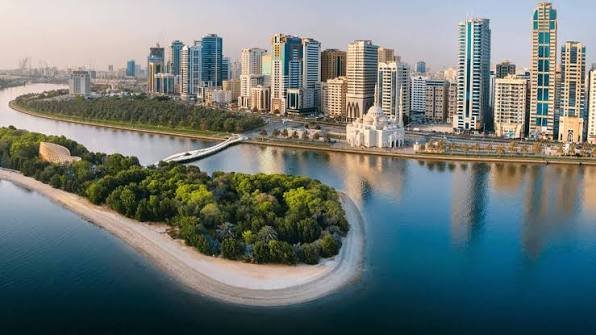
Sharjah’s performance during the period stands out in particular. Real estate transactions in the emirate reached approximately AED 29.5 billion during the first half of 2026, an increase of 9.3 percent year-on-year. More striking still was the rise in transaction volume, which climbed 23.7 percent to 59,460 individual transactions, indicating that growth was driven not simply by rising prices but by a genuine increase in the number of deals being completed.
Perhaps the most notable figure from Sharjah’s first-half data is the diversity of its investor base: the emirate attracted buyers from 121 different nationalities during the period, a remarkably international profile for a market that has traditionally been viewed as more locally focused than Dubai’s globally oriented property sector. Residential properties accounted for the vast majority of activity, representing 82.2 percent of all sales transactions during the first half of the year.
Expanding Ownership Opportunities
Much of Sharjah’s growing international appeal appears tied to a deliberate expansion of property ownership rights for non-UAE and non-GCC nationals. Six additional projects received approval for sale to non-UAE and non-GCC nationals during the first half of 2026, bringing the total number of approved projects in the emirate to 50. This steady widening of eligible projects has given international buyers an increasingly broad range of options within Sharjah, a factor that likely contributed directly to the sharp rise in transaction volume recorded during the period.
Alongside residential activity, 11 new real estate projects were registered in Sharjah during the first half of the year, suggesting developers are responding to the strengthening demand with fresh supply rather than relying solely on existing inventory to absorb growing investor interest.
Abu Dhabi’s Accelerating Momentum
While Dubai continues to dominate headline transaction values across the UAE, Abu Dhabi has recorded what market observers describe as a sharp acceleration in both transaction activity and foreign investment during the first half of 2026. The capital’s property market, historically seen as more institutionally driven and less speculative than Dubai’s, appears to be attracting an increasingly diverse pool of buyers as the emirate continues to diversify its economy and expand its residential and commercial offerings.
This acceleration in Abu Dhabi comes against a backdrop of sustained infrastructure investment and economic diversification efforts across the capital, factors that have consistently featured in analysts’ explanations for the emirate’s improving investment appeal relative to prior years.
A Market Beyond Residential Property
Market analysts tracking the sector have been careful to note that the UAE’s real estate strength in 2026 is not confined to residential property alone. Commercial, industrial and logistics segments have also contributed meaningfully to the broader picture of market resilience, reflecting the UAE’s continued positioning as a regional trade, logistics and business hub attracting corporate as well as individual investment.
This diversification across property types is seen as an important structural strength for the UAE market overall, reducing its historical reliance on residential speculation and instead reflecting genuine, broad-based economic activity across multiple sectors of the property industry.
What It Means for the Market Going Forward
Taken together, the first-half 2026 figures paint a picture of a UAE property market that continues to mature and diversify, both in terms of geography, with Sharjah and Abu Dhabi increasingly standing alongside Dubai as significant investment destinations, and in terms of investor base, with an expanding pool of international nationalities participating across multiple emirates.
For prospective buyers and investors, the data suggests that opportunities within the UAE property market are no longer as heavily concentrated in Dubai as they may have been in previous cycles, with Sharjah’s rapidly expanding list of approved ownership projects and Abu Dhabi’s accelerating foreign investment both pointing toward a genuinely UAE-wide property growth story taking shape through the remainder of 2026.


Comments 1