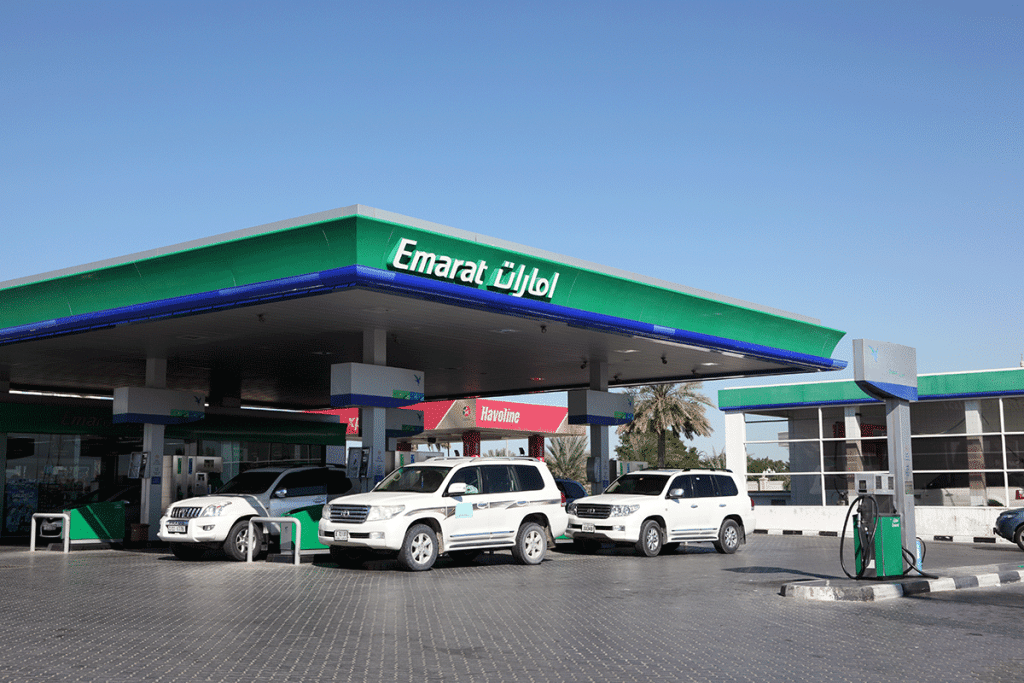
Drivers across the UAE are paying less at the pump this month, though not by enough to erase the sharp rises of recent months. The UAE Fuel Price Committee, which announced the rates on Saturday, October 31, cut all three petrol grades by 24 fils per litre for November and diesel by 5 fils.
November prices at a glance
The new prices took effect on November 1 and apply until the end of the month:
| Fuel | November | October | Change |
|---|---|---|---|
| Super 98 | Dh4.16 | Dh4.40 | −24 fils |
| Special 95 | Dh4.04 | Dh4.28 | −24 fils |
| E-Plus 91 | Dh3.97 | Dh4.21 | −24 fils |
| Diesel | Dh4.75 | Dh4.80 | −5 fils |
E-Plus 91 slips back under the Dh4 mark, while Super 98 and Special 95 remain just above it.
First cut after three rises
The reduction ends a run of increases. Prices climbed for three straight months, and Super 98 reached Dh4.40 in October, up from Dh3.80 in September, a rise of roughly 16 per cent. The November cut therefore reverses only part of that jump.
The longer view shows how large the energy shock has been. According to Gulf News, before the latest Middle East conflict in February, Super 98 cost Dh2.59 per litre, Special 95 Dh2.48, E-Plus Dh2.40 and diesel Dh2.72. Even after the November reduction, Super 98 is roughly Dh1.57 higher than in February. It is also the second-highest Super 98 price this year, behind October.
The all-time highs are still higher. In July 2022, Super 98 hit Dh4.63, Special 95 Dh4.52 and E-Plus Dh4.44.
How a tank fill changes
The monthly cut is easier to see in a tank fill. Based on the new prices:
- A 60-litre fill of Special 95 now costs about Dh242.40, compared with Dh256.80 at October’s rate, a saving of about Dh14.40.
- A 120-litre tank of Special 95, typical of a large SUV, costs about Dh484.80, which is Dh28.80 less than last month.
- A 40-litre fill of Super 98 costs Dh166.40.
These figures are straightforward calculations from the official per-litre prices. Actual spending depends on how much a driver needs to top up.
Why prices moved
The UAE sets fuel prices monthly under a mechanism linked to global price movements, with changes passed through to the domestic market. That is why the cut follows recent softness in crude. Gulf News’s latest oil-market coverage noted that Brent fell nearly 7 per cent on Monday and traded around $103 on Wednesday, helped by hopes of a diplomatic breakthrough between the United States and Iran. Those prices are still far above levels seen before the conflict began.
That link cuts both ways. If diplomacy stalls or shipping through the Strait of Hormuz worsens, crude could rise again, and the pump price would follow in the monthly review.
What it means for households and businesses
For commuters, the change is modest but welcome. A driver who uses 240 litres of petrol a month saves about Dh57.60 compared with October at the 24-fils reduction (240 × 0.24). For delivery firms and logistics companies, the diesel cut of 5 fils is smaller, and diesel remains well above its February level.
Transport costs also feed into consumer prices. Analysts have pointed out that higher fuel and freight costs can raise prices for imported goods, so a stable or lower fuel price helps ease pressure on household budgets.
What comes next
December’s prices will be announced at the end of November. Nobody can predict them reliably, since they depend on global oil prices and the course of diplomacy in the Gulf. Motorists who want to plan can watch Brent crude movements during November as a rough guide.
For now, the picture is of partial relief. Prices are lower than in October, but not by enough to feel like a return to normal.


