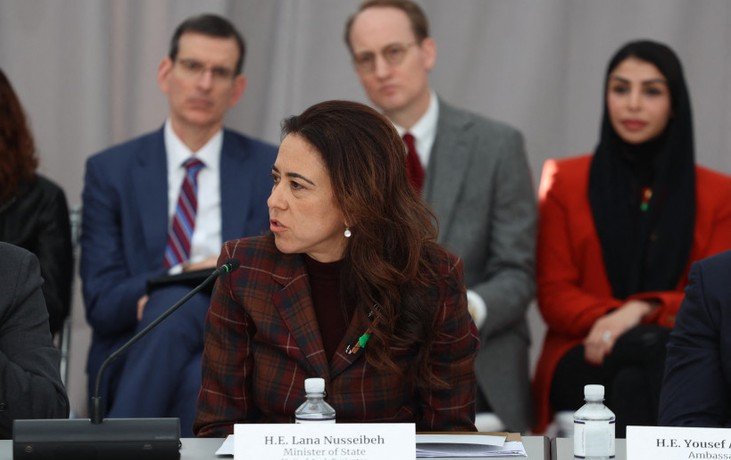
The United Arab Emirates has entered a candidate into the race to lead the United Nations, nominating Minister of State Lana Nusseibeh to succeed António Guterres at a moment when the contest has struggled to find a clear winner.
The nomination was conveyed in a letter from UAE President Sheikh Mohamed bin Zayed Al Nahyan to the UN Security Council, according to the state news agency WAM. The announcement came on Wednesday and was widely reported on Thursday.
A historic first, if she succeeds
Nusseibeh would make history on several counts if chosen. No woman has held the UN’s top job since the organisation was founded. She would also be the first leader from the Gulf region and only the second Arab to hold the post, after Egypt’s Boutros Boutros-Ghali, who served in the early 1990s.
Guterres is finishing his second and final term, which ends at the close of this year. That leaves limited time for the Security Council and the General Assembly to settle on a successor.
A diplomat with a long UN record
Nusseibeh’s career has been closely tied to the world body. She joined the UAE’s mission to the United Nations as ambassador in 2013 and held that post for more than a decade, including during the country’s recent two-year term on the Security Council. She left the role in 2024 to become a minister of state in the UAE government.
Before moving to New York, she worked in the Foreign Ministry, where she helped set up its policy planning department and led the task force behind the successful bid to host the International Renewable Energy Agency in Abu Dhabi.
Her UN résumé also includes work on how the organisation picks its leaders. In 2016 and 2017, she co-chaired a General Assembly working group whose reforms made the selection of a secretary-general more open and participatory. Those procedures now govern the contest she has entered.
Brett McGurk, a former senior US official, described her on social media as a diplomat who knows everyone and gets things done, and called her an inspired choice for what he termed an impossible job.
A crowded, deadlocked field
Nusseibeh joins eight declared candidates: Carolyn Rodrigues-Birkett of Guyana, Rafael Grossi of Argentina, Rebeca Grynspan of Costa Rica, Macky Sall of Senegal, Ivonne Baki and María Fernanda Espinosa of Ecuador, Michelle Bachelet of Chile, and Olara Otunnu of Uganda.
None has yet won enough backing among Security Council members. Grynspan has led the informal straw polls, including the sixth round held last week, but opposition from two permanent members with veto power has blocked a decisive result. Because the five permanent members can each block a candidate, a stalemate of this kind often prompts late entrants who might serve as compromise options. Commentary on Thursday framed Nusseibeh’s entry in exactly those terms.
Her case to member states
In announcing her candidacy, Nusseibeh said the moment called for greater urgency, with earlier action, broader coalitions across differences and a focus on delivering concrete results. She described her approach as speaking frankly to every government and answering to none.
According to WAM, her priorities would include:
- Peace and security as the central task of the organisation.
- Clearer priorities, leadership and resources placed closer to the crises the UN exists to address.
- Stronger accountability for results and less duplication across agencies.
- A UN development system better suited to a world in which progress on the Sustainable Development Goals remains deeply uneven.
- Equal application of international law, without double standards, which she argues is necessary for the UN to keep its credibility.
What happens next
The Security Council will keep holding straw polls before moving to formal votes, after which the General Assembly must approve its recommendation. There is no fixed timetable beyond the end of Guterres’s term on 31 December.
For the UAE, the nomination is a notable diplomatic step. The country has invested heavily in multilateral diplomacy and mediation in recent years, hosting talks and positioning itself as a convener. Whether that profile translates into support from all five permanent members will determine whether Nusseibeh becomes a serious contender or remains an outside entry in a long contest. Next Article


Comments 1