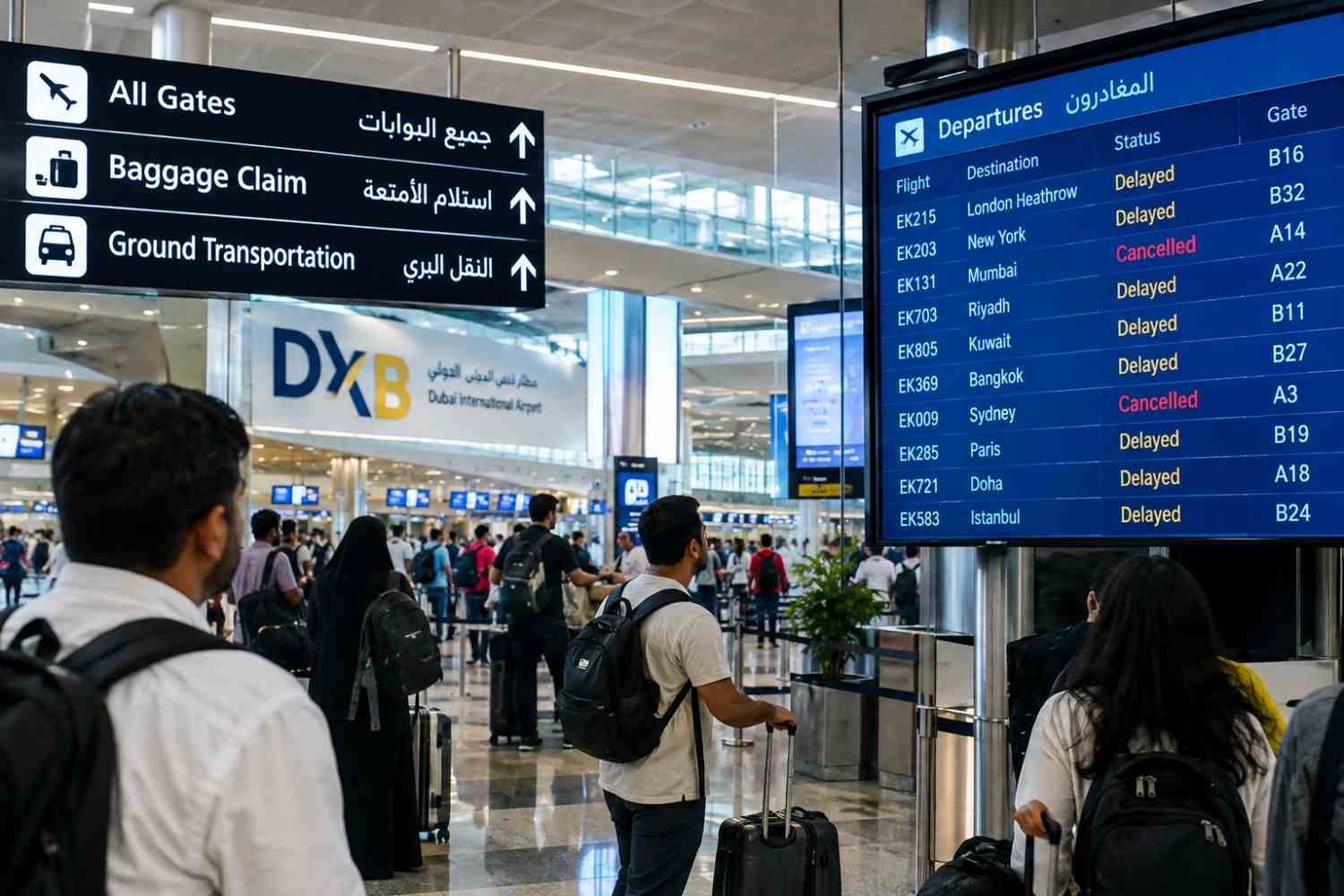
UAE Airports Stay Open, But Travellers Face a Bumpy Monday
Air travel across the UAE is proving unpredictable again today, with a handful of cancellations and delays rippling through the schedules of the country’s four major carriers even as the nation’s three primary airports continue normal operations.
Dubai International, Abu Dhabi’s Zayed International and Sharjah International are all functioning as usual this morning, according to publicly available airport and flight-tracking data. The vast majority of scheduled departures and arrivals are going ahead close to time. But a subset of regional routes — particularly those that brush against airspace flagged in international aviation notices — are seeing the kind of stop-start disruption that has become a recurring feature of UAE air travel in recent months.
What’s Actually Being Affected
The clearest example today involves flydubai’s Dubai–Abha corridor. The budget carrier’s own schedule shows two services on that route with entirely different fates: one flight due out in the early hours has been cancelled outright, while an afternoon departure remains on the board as scheduled. Dubai Airports’ separate listing adds a third Abha-bound service to the cancelled column, underscoring how granular — flight by flight, rather than route by route — today’s disruptions are.
Air Arabia, the region’s low-cost pioneer, has cancelled a number of its services connecting the UAE with Kuwait and Bahrain. Emirates and Etihad, by contrast, are reporting a mix of on-time departures and delays rather than wholesale cancellations, continuing a pattern seen over recent days as both airlines work to stabilise their networks after a difficult few weeks.
Emirates has told affected passengers to check official channels before heading to the airport and is continuing to offer flexibility for eligible travellers, including free date changes to Dubai and one complimentary global date change on tickets booked since the start of April. flydubai, meanwhile, is reminding customers that check-in counters close a full 60 minutes before departure unless they are told otherwise by SMS or email, and is urging anyone flying out of Dubai to arrive at least four hours early, complete online check-in where possible, and monitor their flight status closely.
The Backdrop: A Region on Edge
None of this is happening in a vacuum. Aviation advisories for parts of the Gulf have remained active for weeks, reflecting continued caution around the Strait of Hormuz and the wider security picture involving Iran and the United States. Airlines operating in and out of the UAE have been routing more conservatively as a result, adding buffer time to flight plans and, in some cases, pulling specific services rather than risk last-minute diversions.
It’s worth stressing what today’s disruption is not: a closure of UAE airspace or a shutdown of any of the country’s airports. Officials and airlines alike have been careful to frame the picture as one of selective, route-specific caution rather than a blanket suspension of services. Not every delay or cancellation being reported today is even linked to the security situation — operational issues, technical faults and routine scheduling changes remain part of the everyday churn of running an airline, and outlets tracking today’s disruptions have flagged that distinction directly.
Still, for ordinary travellers, the practical effect is much the same regardless of the cause: a need to double-check before leaving for the airport, and a willingness to build in extra time.
What Passengers Should Do Today
Aviation trackers and airline advisories converge on a simple message for anyone flying today: stay flexible, stay informed, and don’t assume yesterday’s schedule holds. Passengers on regional routes, in particular those touching Abha, Kuwait, Bahrain and similar short-haul corridors, are the most likely to see changes. Long-haul travellers on Emirates and Etihad services are, for now, facing a comparatively smoother ride, though isolated delays are still being reported on selected sectors.
Airlines are directing customers to their official apps and websites for real-time status rather than relying on second-hand reports, and travel advisories continue to recommend arriving well ahead of the standard recommended check-in window. For a market that handles some of the busiest long-haul traffic in the world, today’s disruptions are modest in scale — but they are a reminder that the aviation ripple effects of regional tensions have not fully settled, and may not for some time yet.


Comments 1