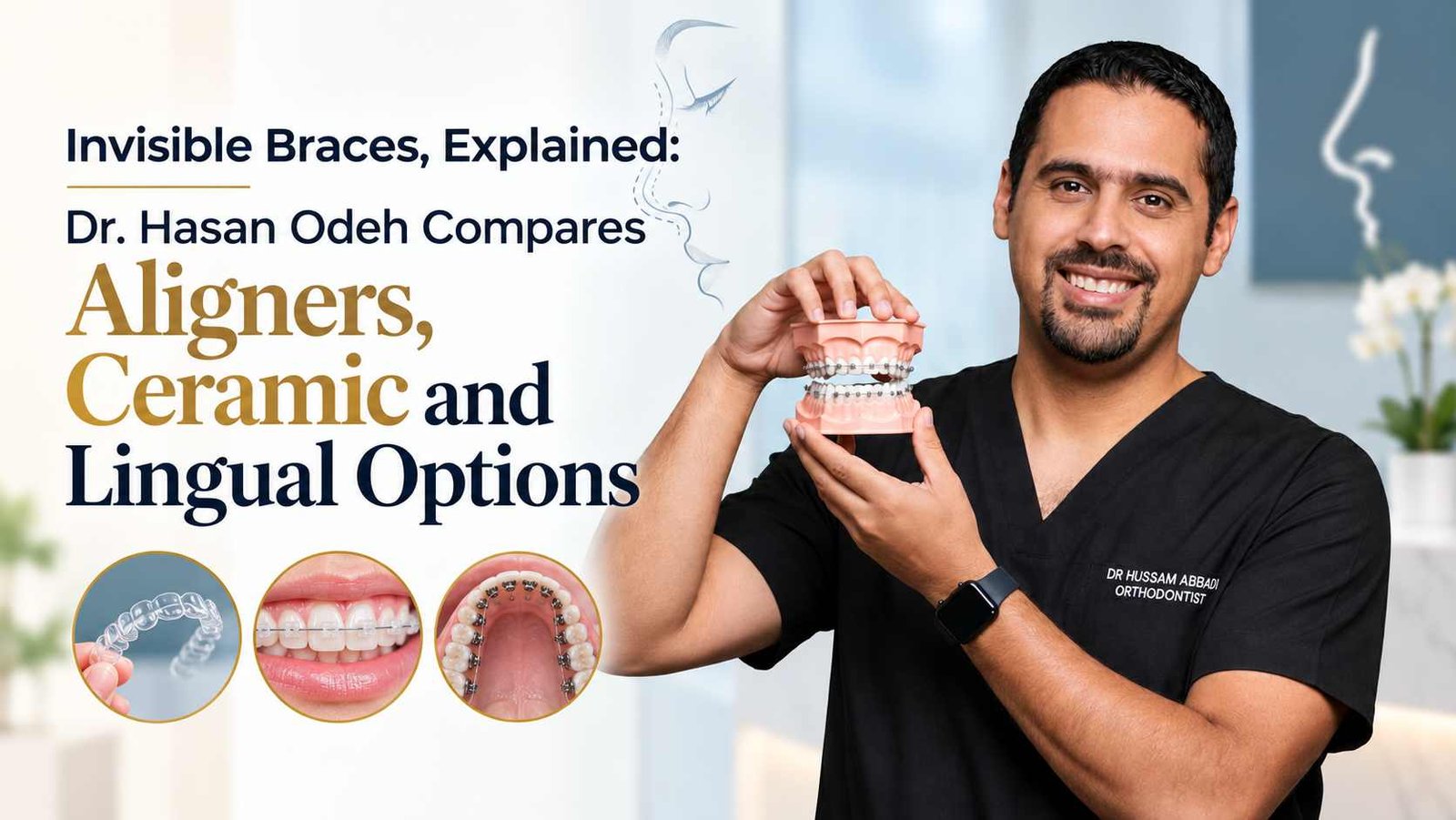
Ask a group of adults in Dubai whether they would straighten their teeth if nobody could tell, and plenty of hands go up. That is why “invisible braces” has become one of the most searched phrases in orthodontics. It promises a straighter smile without the metal-mouth years many people remember from school.
The trouble is that “invisible braces” is not one treatment. It is an umbrella term patients use for three quite different options, each with its own strengths, limits and lifestyle demands. Choosing between them without understanding the differences is how people end up disappointed.
Why the Term Causes Confusion
For specialist orthodontist in Dubai Dr. Hasan Odeh, clearing up this confusion is often the first part of a consultation. Many patients arrive having already decided on a product they saw advertised. Only then do they learn that two other options exist, and that one of them may suit their teeth far better.
Demand for orthodontic and dental care in the city is high. According to Dubai Health Authority figures reported by Gulf Business, dentistry was the most sought-after speciality among medical tourists in Dubai in 2023. With so much choice on offer, understanding the basics before you book is worth the time.
Option 1: Clear Aligners
Clear aligners are a series of custom-made, removable plastic trays. Each set moves the teeth slightly, and you switch to a new set every week or two. Invisalign is the best-known brand, but several other systems exist.
Best suited to
Mild to moderate crowding, spacing and some bite problems.
The advantages
Clear aligners are nearly invisible. You can remove them to eat, drink and brush, and there are no food restrictions. Most systems also show a digital preview of the planned result before treatment starts.
The limitations
Clear aligners only work while you wear them, which means 20 to 22 hours a day. Patients who often forget, lose or leave them out will see slower progress or a weaker result. They are also less predictable for complex bite corrections and some types of tooth movement.
Option 2: Ceramic Braces
Ceramic braces work exactly like traditional metal braces, with brackets bonded to the front of the teeth and connected by a wire. The difference is that the brackets are tooth-coloured or clear, so they blend in.
Best suited to
Almost any case, including complex crowding and bite problems.
The advantages
Ceramic braces are fixed, so there is nothing to remember, and they can handle a wide range of orthodontic problems. They are also usually the most affordable of the three “invisible” options.
The limitations
Ceramic braces are less visible, not invisible. Up close, people can see them. The small elastic ties holding the wire can pick up colour from coffee, tea and strongly pigmented food, although they are replaced at each adjustment visit.
Option 3: Lingual Braces
Lingual braces are fixed brackets bonded to the inside surface of the teeth, the side facing the tongue. From the front, they cannot be seen at all.
Best suited to
Patients who want fixed treatment that is completely hidden, including many complex cases.
The advantages
Lingual braces are the only fixed option that is truly invisible when you smile, and they are effective for a wide range of problems.
The limitations
The tongue needs time to adjust, so speech can feel different for the first few weeks. Cleaning takes more care. Lingual braces are typically the most expensive of the three, and not every practice offers them, because fitting them requires additional training.
Invisible Braces at a Glance: Comparing the Three Options
| Feature | Clear Aligners | Ceramic Braces | Lingual Braces |
|---|---|---|---|
| Visibility | Nearly invisible | Less visible than metal braces | Hidden from the front |
| Fixed or removable? | Removable | Fixed | Fixed |
| Complex cases | Limited for some complex cases | Suitable for complex cases | Suitable for many complex cases |
| Requires patient compliance? | Yes, 20–22 hours a day | No daily removal routine | No daily removal routine |
| Food restrictions | None when removed for eating | Avoid hard and sticky foods | Avoid hard and sticky foods |
| Relative cost | Mid to high | Usually the lowest of the three | Usually the highest of the three |
How to Decide Which Invisible Braces Are Right for You
In Dr. Odeh’s experience, the right choice usually comes down to four honest questions.
- How complex is your case? This is a clinical question, and it is the most important one. Some bites can be corrected reliably only with fixed braces.
- How disciplined will you be? Aligners reward consistency. If you travel often, eat throughout the day, or know you will forget, a fixed option may give a better result.
- How much does visibility matter? If no one must know, lingual braces or aligners are the strongest options. If “discreet” is enough, ceramic braces may be ideal.
- What is your budget? All three can deliver excellent results, and cost is a legitimate factor in the choice.
A proper consultation should include a clinical examination, X-rays or 3D scans, and a frank explanation of what each option can and cannot do for your teeth. It should not be a sales pitch for a single product.
A Word on DIY Aligners
Aligners sold online and posted straight to your door can look like a shortcut. Moving teeth, however, is a medical procedure. The World Federation of Orthodontists has issued a statement on do-it-yourself and direct-to-consumer orthodontics, cautioning against treatment that happens without proper in-person examination and supervision.
Problems such as gum disease, decay or bone loss need to be ruled out before teeth are moved, and that requires someone to actually look.
Choosing Your Orthodontist in the UAE
In the UAE, “specialist orthodontist” is a regulated title. It means a dentist who has completed postgraduate specialist training in orthodontics.
It is also worth asking whether the practice offers all three options. A clinic that only provides one type of treatment has less reason to recommend another, even when it would suit you better.
One Thing All Three Options Have in Common
Whichever option you choose, the work does not stop when the braces come off or the last aligner is finished. Teeth naturally try to drift back, so every patient needs a retainer afterwards, often for the long term. A good orthodontist will explain your retention plan before treatment begins, not after.
“Invisible braces” is a promise about how treatment looks. The more important question is how well it works for your teeth, and that is a decision best made with a specialist, not a search engine.


