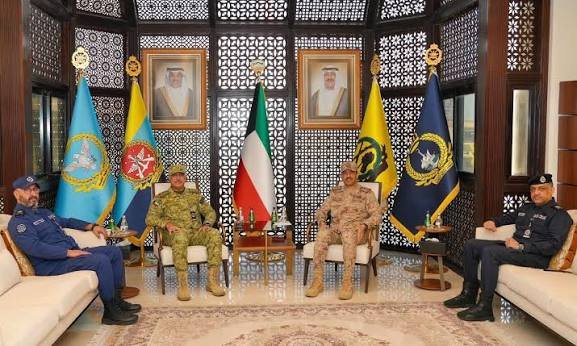
KUWAIT/RIYADH: Gulf Arab states have agreed to set up an advanced headquarters for their joint military command in Kuwait, a step that deepens defence coordination across the six-nation bloc at a time of acute regional danger.
The Gulf Cooperation Council’s secretary-general said member states approved the new headquarters and the deployment of “appropriate” forces to it, according to Saudi state television Al Ekhbariya, as reported by Reuters.
What was announced
The announcement is short on operational detail. At the time of writing, the publicly available reports did not include troop numbers, a timetable or a command structure for the Kuwait site. The wording, an “advanced” headquarters for the existing unified command, points to a forward element of the current arrangement rather than a relocation of it.
A command with a long history
The idea of a joint Gulf military structure is not new. GCC leaders agreed to create a joint military command at their summit in Kuwait in 2013. The structure took years to formalise. In December 2019, Saudi Arabia’s foreign minister and the GCC secretary-general signed an agreement in Riyadh under which the kingdom hosts the command’s headquarters.
That Riyadh base remains active. In March this year, the secretary-general visited the Unified Military Command headquarters in the Saudi capital, where he was briefed on its role in military integration and coordination among member armies.
So the new decision builds on a framework that has existed on paper and in practice for years. What changes is geography: part of the command’s presence will now sit in Kuwait, at the northern end of the Gulf.
The security backdrop
The timing is hard to separate from the wider war. Gulf states have absorbed a series of attacks since the US-Israeli conflict with Iran began. The UN Security Council earlier adopted Resolution 2817, which condemned Iranian attacks on GCC countries and Jordan, including strikes on residential areas and civilian infrastructure.
Internal security has also been in focus. In May, GCC interior ministers called the security of member states “indivisible” after Kuwait arrested cells allegedly linked to Iran’s Revolutionary Guard.
The threat picture shifted again this week. Saudi air defences intercepted a ballistic missile and a cruise missile fired by Yemen’s Houthis at Riyadh, and the coalition reported further missiles and a drone targeting the south and the Eastern Province. Saudi Arabia’s East-West pipeline, a key route that bypasses Hormuz, was also attacked on Monday, though operations were unaffected.
Diplomacy runs in parallel
The military announcement landed on a day of mixed signals over the conflict itself. US President Donald Trump said on Monday that renewed strikes on Iran did not seem necessary at this point, and that regional states including the UAE, Saudi Arabia, Bahrain, Kuwait and Qatar favour keeping the current naval blockade in place instead.
At the same time, UAE officials have urged realism. Dr Anwar Gargash, the diplomatic adviser to the UAE President, has warned the region to prepare for a long period of uncertainty in which neither a decisive resolution nor a stable regional order can be assumed.
Read together, the two tracks suggest Gulf governments are hedging. They are backing diplomacy and the blockade while building up their own collective capacity in case talks stall.
What it means for the UAE
As a founding member of the GCC, the UAE is part of the arrangement, though the reports so far do not say which states will contribute forces to the Kuwait headquarters or in what numbers. Those details are likely to matter, both for how the command functions and for how it is read in Tehran and in Washington.
For the wider bloc, the decision is a signal. After years in which the joint command was often described as more aspiration than reality, member states are now putting people and infrastructure behind it. Whether that translates into smoother coordination in a crisis will depend on the specifics still to come.


Comments 1