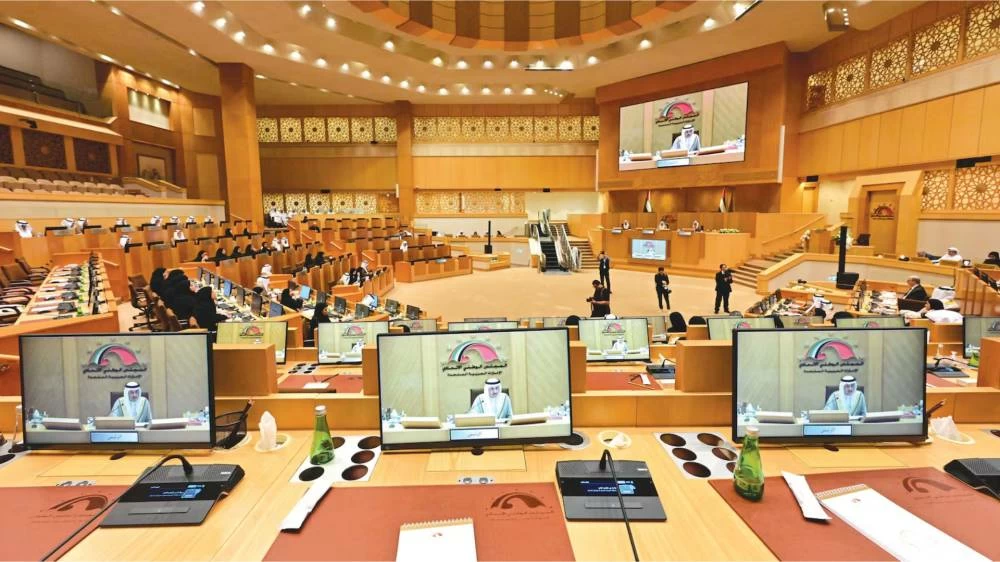
ABU DHABI — The UAE’s Federal National Council (FNC) has approved a federal budget of Dh90.1 billion for 2027. The plan puts social development, education and healthcare at the centre of next year’s public spending.
The council passed the draft federal law on Tuesday during its second sitting of the fourth ordinary session of the 18th legislative chapter. The session was chaired by FNC Speaker Saqr Ghobash. Mohamed bin Hadi Al Hussaini, Minister of State for Financial Affairs, presented the figures. The law covers both the Union General Budget and the budgets of independent federal entities. Revenue and expenditure are each set at Dh90.1 billion, or about $24.5 billion, so the plan is balanced on paper.
Officials described the budget as an exercise in fiscal discipline. They said it aims to balance income and spending while directing resources towards quality of life and sustainable development for future generations.
Where the money goes
The allocations presented to the council show a clear bias towards services and citizens’ welfare:
- Social development and pensions: more than one-third of the total. The Cabinet’s earlier breakdown put this at Dh34.6 billion, or 38.4 per cent.
- Education: Dh16.8 billion, covering public and university education, curricula and technical pathways.
- Public order and public safety: Dh10.7 billion.
- National readiness and defence: Dh7 billion.
- Healthcare: Dh5.9 billion, aimed at more advanced, preventive and proactive services and wider use of smart solutions.
- Housing: Dh3.9 billion for support, grants and housing facilities for UAE nationals.
- Social affairs: Dh3.3 billion for supporting families and strengthening the social support system.
- Economic affairs: Dh2.1 billion for competitiveness, innovation, the investment environment and national projects, including space initiatives.
- Culture and the arts: Dh1.1 billion. Environmental protection receives Dh509.2 million.
The bigger picture: a three-year plan
The 2027 figure is the first year of a longer plan. On 12 October the Cabinet, chaired by Sheikh Mohammed bin Rashid Al Maktoum, approved a federal budget for 2027–2029 totalling Dh292.5 billion. That is roughly 28 per cent more than the Dh227.1 billion allocated for 2024–2026.
Within the 2027 envelope, the Cabinet’s split looked like this:
| Sector | Allocation | Share |
|---|---|---|
| Social development and pensions | Dh34.6bn | 38.4% |
| Government affairs | Dh29.1bn | 32.3% |
| Federal expenses | Dh17.8bn | 19.7% |
| Financial assets and investments | Dh5.6bn | 6.2% |
| Infrastructure and economic resources | Dh3bn | 3.4% |
Sheikh Mohammed said the UAE’s financial model seeks to balance economic growth, funding for strategic projects and fiscal discipline. He added that tax and development-related legislation continues to be updated.
How 2027 compares
One analysis of Ministry of Finance data puts planned federal spending for 2026 at about Dh92.4 billion. That would make next year’s figure slightly lower in nominal terms, although the multi-year plan as a whole is larger. The federal budget is also only one layer of public spending in the UAE. Emirate-level budgets, such as Dubai’s record Dh302.7 billion plan for 2026–2028, are set separately and cover local infrastructure and services.
Security and the regional context
The Dh17.7 billion earmarked for public safety and national readiness (Dh10.7 billion plus Dh7 billion) will draw attention given the past year. The UAE has faced missile and drone attacks linked to the wider Iran conflict, and members of the council used the new session to praise the leadership’s response, Gulf News reported. According to the figures presented, the defence allocation is intended to strengthen the national system in protecting the country and maintaining its security and stability.
What residents should take from it
For most households, the immediate effects are indirect. Education and healthcare receive more than Dh22 billion between them, which funds federal schools, universities and health services. Housing grants for nationals continue to be a visible line item. Expatriate residents and businesses are more likely to feel the budget through the quality of federal services than through any change in taxes or fees, and no such changes were announced in the figures presented to the council.
What happens next
The FNC’s approval covers a draft federal law. The measure is expected to follow the usual federal process before it takes effect for the 2027 financial year. The council’s session, opened this week on behalf of the UAE President by Sheikh Mohammed bin Rashid, marks the start of a new legislative term. Budget scrutiny is likely to remain one of its main tasks.


Comments 1