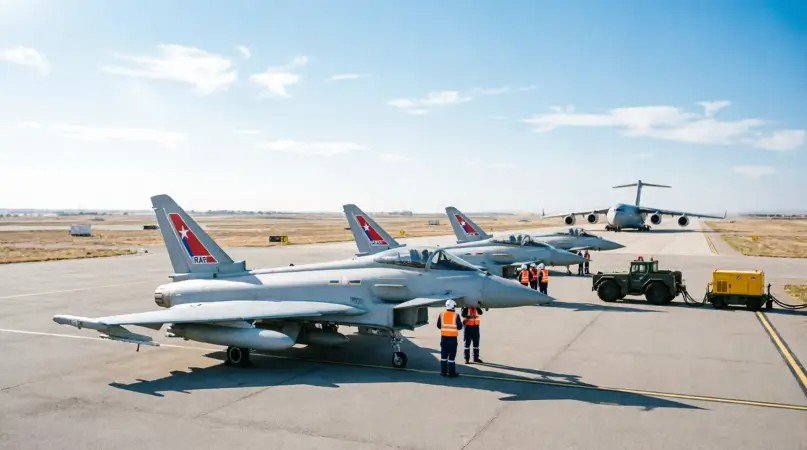
Britain is stepping up its military role in the Gulf. The government says Royal Air Force Typhoon fighters will fly defensive missions over Saudi Arabia, which has come under sustained drone and missile fire from Yemen’s Houthi movement.
The UK Ministry of Defence said on Tuesday the aircraft would help protect Saudi cities and critical national infrastructure, and would operate only in a defensive role without carrying out offensive strikes against the Houthis.
What London has announced
Defence Secretary Wes Streeting called the continuing Houthi attacks on Saudi Arabia “absolutely despicable” and said he had approved further military support. The new commitment also includes an Atlas A400M transport aircraft and military advisers.
The package builds on what Britain has already put in place. It expands assistance announced in September, which covered an RAF Voyager air-to-air refuelling aircraft but no fighter jets. A Downing Street spokesperson said Britain was already providing refuelling support and had deployed air defence equipment and personnel to help protect the kingdom.
The Typhoons will intercept missiles and drones launched at Saudi Arabia and will not strike targets inside Yemen, the spokesperson said. That distinction matters politically, because London has been keen to present its role as protective rather than as entry into Yemen’s civil war.
An escalating campaign
The announcement follows a sharp deterioration in security. Over the past month the Houthis have intensified attacks on Saudi Arabia, firing ballistic missiles and drones at key infrastructure including oil facilities and airports. The conflict has been building since July, when the group said it would target Saudi shipping in the Red Sea and infrastructure inside the kingdom after a Saudi attack on the Houthi-controlled airport in Sanaa.
The effects have reached well beyond Saudi borders. Riyadh’s King Khalid International Airport was shut after the attacks and reopened on October 18, although many foreign carriers kept their cancellations in place. Airlines serving the UAE have been among those adjusting schedules.
Why Britain is getting involved
When the UK announced refuelling support in September, officials said it would let the Royal Saudi Air Force keep its British-built Typhoons airborne for longer on air-defence patrols. One aviation analyst told The National at the time that the tanker would give Saudi fighters only a limited boost in endurance. Sending British-flown jets is a more direct commitment.
The UK has deep ties to the kingdom as one of its largest arms suppliers and a close military ally for decades. It has also acted elsewhere in the region this year. In March, British Typhoon and F-35 jets flew defensive missions over Cyprus, Jordan, Bahrain, Qatar and the UAE, and Sky Sabre air defences were sent to Saudi Arabia.
The British government argues that protecting Saudi airspace is also about protecting trade. In September, Prime Minister Andy Burnham said the support was meant to keep key energy and shipping routes open and to protect the interests of Britain and the wider region.
What it means for the Gulf
For Gulf states, including the UAE, any widening of Western air defence cover is closely watched. The UAE has itself faced regional attacks this year and has sought closer defence partnerships, as this week’s agreement with France shows. A stronger allied air shield over Saudi Arabia could help ease pressure on air travel and energy infrastructure across the region.
There are limits to what jets and tankers can achieve. Houthi drones and missiles are cheap to launch and hard to stop in large numbers, so interception alone is unlikely to end the campaign. Analysts also point out that defensive support without a political settlement can leave the underlying conflict unresolved.
Key questions remain. Officials have not said how many Typhoons will deploy or where they will be based, nor how long the mission will last. The September support was described as time-limited, and Downing Street has not yet indicated whether the same applies here.
For now, the announcement sends a clear signal to Riyadh and to the Houthis. Britain is prepared to put aircraft and personnel into the defence of Saudi airspace, even as it stresses that it is not seeking a wider war.


Comments 1