Inside the UAE’s Next Step Toward an AI-Run “Government of the Future”
The UAE’s ambition to build what officials call the “Government of the Future” has entered a new and more technically ambitious phase, with Sheikh Mansour bin Zayed Al Nahyan, Vice President, Deputy Prime Minister and Chairman of the Presidential Court, chairing a review of the country’s expanding Agentic AI programme.
The session, held with the Ministerial Council for Artificial Intelligence and Development at Qasr Al Watan in Abu Dhabi, focused on a project that goes well beyond the kind of AI tools most government agencies have experimented with to date. Agentic AI refers to systems capable of taking autonomous action — not just answering questions or generating text, but actually executing tasks, making decisions within defined parameters, and adapting to changing conditions without constant human direction.
From Groundwork to Execution
According to officials briefed on the programme, its first phase focused on foundations: building internal government capabilities, surveying and assessing existing services, operations and tasks across federal entities, and establishing priorities for where AI could have the most impact. That groundwork is now giving way to a second phase centred on actually deploying Agentic AI at scale.
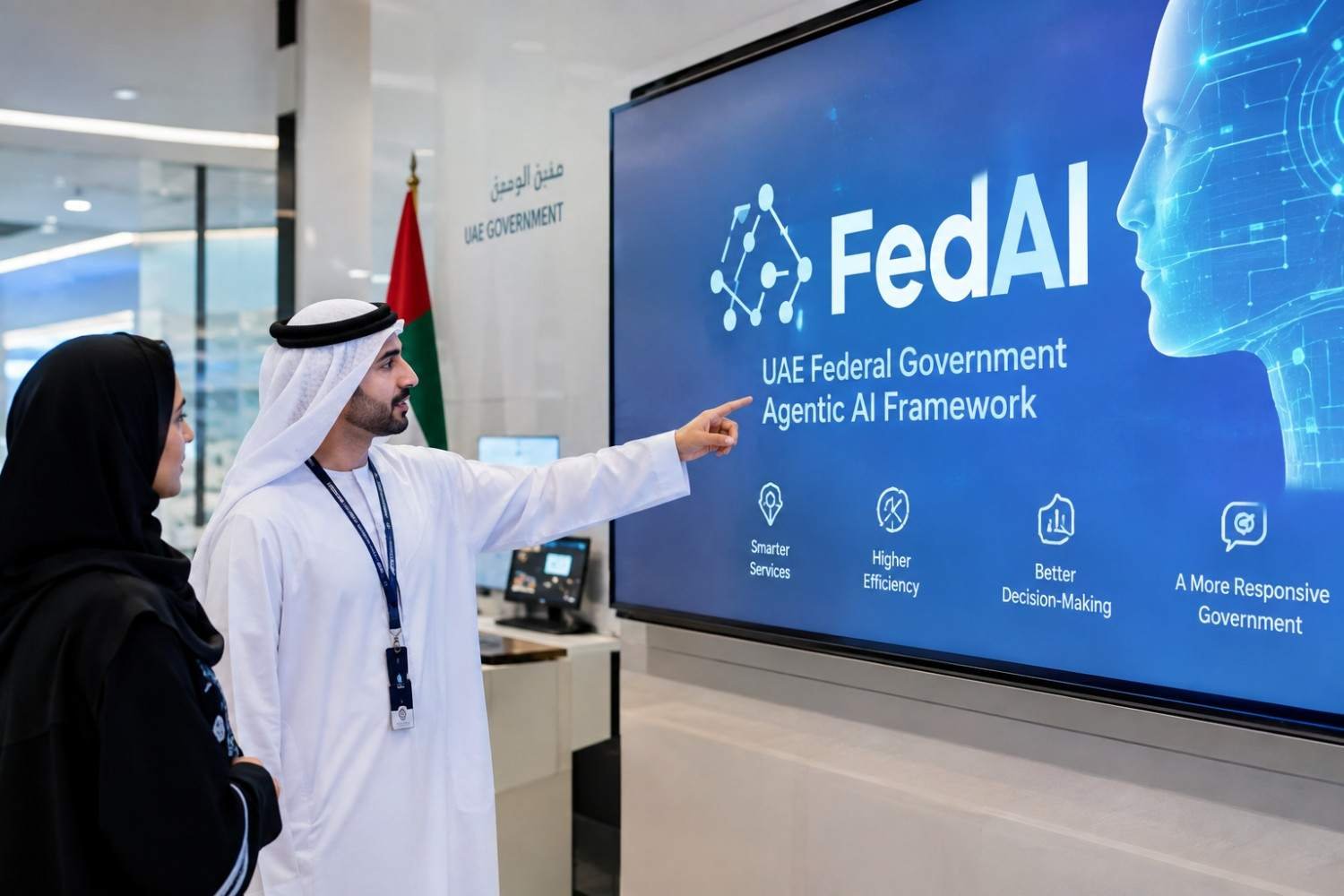
Central to that rollout is a new national technical ecosystem named FedAI, designed to give federal government entities a flexible, secure environment in which to develop, adopt and operate their own Agentic AI solutions rather than relying on a single centralised system. The approach reflects a recognition that different ministries and agencies have different needs — immigration processing looks nothing like healthcare regulation or tax administration — and that a one-size-fits-all AI deployment would struggle to serve them all effectively.
Alongside FedAI, the Council reviewed plans for a dedicated customer experience lab, where Agentic AI applications can be tested directly against real government services before wider rollout. Internal competitions are also being launched to involve government employees directly in developing AI-driven solutions, an approach aimed at building homegrown expertise rather than depending entirely on external vendors.
The Stated Goal: Tangible, Not Theoretical, Impact
Sheikh Mansour was direct about what success is meant to look like, describing the target as translating AI capability into measurable improvements in government efficiency, service quality and speed of execution — not simply adopting the technology for its own sake. He also emphasised the importance of building national talent capable of leading the transformation, a recurring theme in the UAE’s broader AI strategy, which has consistently paired technology adoption with workforce development.
The government’s framing positions the current push as building a public sector that is, in Sheikh Mansour’s words, smarter, more flexible and more proactive — one that uses Agentic AI not just to deliver services more efficiently but to help shape policy and decision-making itself over time.
A Broader AI Push Across Sectors
The Council’s review extended beyond the core FedAI initiative. Members also discussed AI applications across areas including cybersecurity, corporate governance and business regulation, alongside separate government decisions touching healthcare and genomics regulation, commercial company rules, telemarketing oversight, food safety, and improvements to the tax system — signalling that AI adoption is increasingly treated as connective tissue across otherwise unrelated policy areas rather than a standalone technology initiative.
The UAE has spent much of the past decade positioning itself as a first mover on government AI adoption, from its early appointment of a dedicated AI minister to a steady stream of sector-specific AI strategies. The FedAI initiative marks a maturing of that ambition — a shift from pilot projects and proofs of concept toward an operational framework meant to run across the full breadth of federal government.
Whether Agentic AI delivers on the efficiency gains officials are promising will likely become clearer as FedAI moves from framework to live deployment in the months ahead. For now, the direction of travel is unambiguous: the UAE intends AI to be not just a tool government uses, but a system woven into how government itself functions.


Comments 1