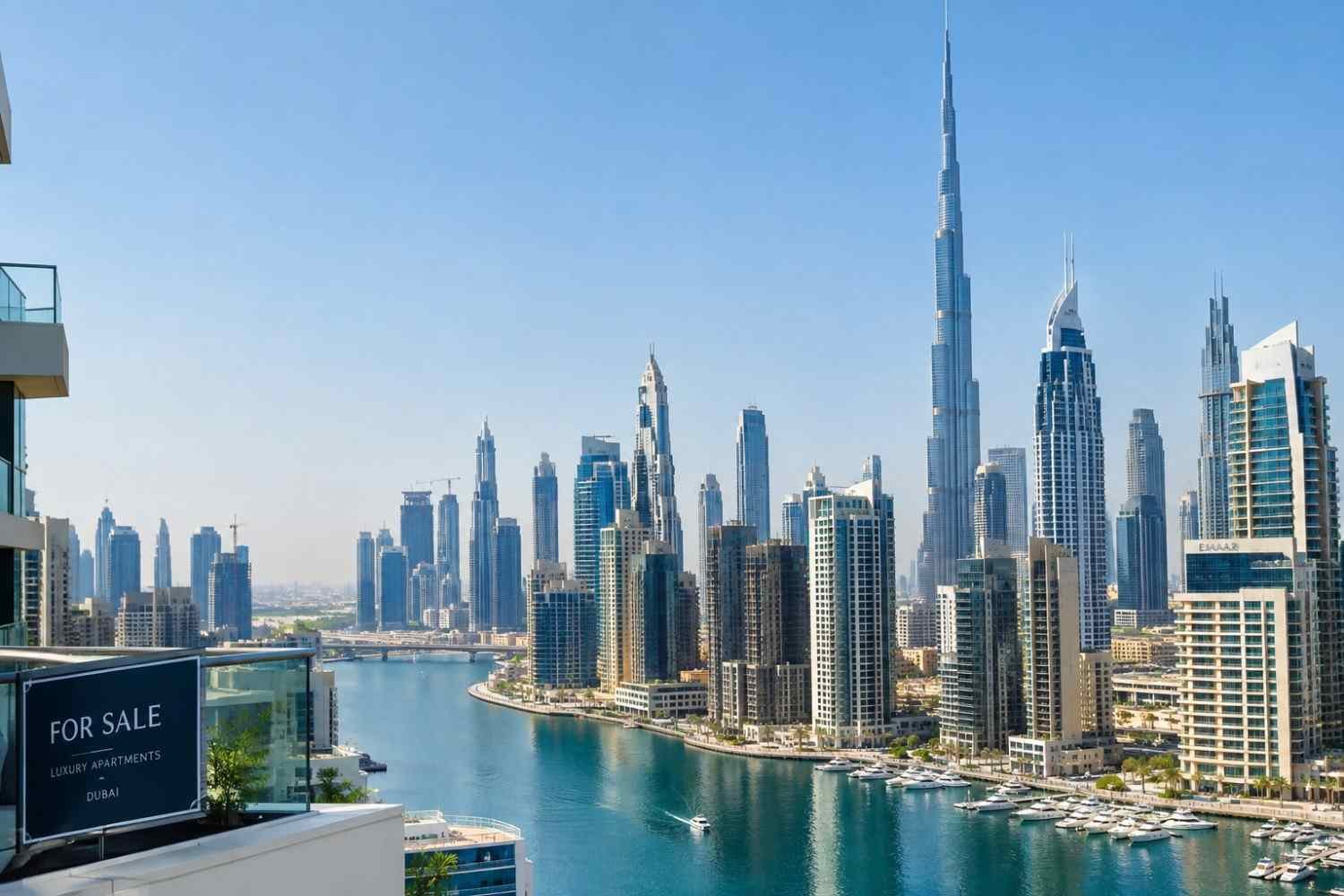
Dubai’s Property Market Just Crossed Half a Trillion Dirhams — With Four Months Still to Go
Dubai’s real estate machine shows no sign of slowing down. Newly released figures from the Dubai Land Department show that property transactions across the emirate reached AED523.44 billion in the first eight months of 2026, spanning 148,564 individual transactions. To put that in perspective, Dubai has already logged nearly 57 percent of the entire value it recorded across all of 2025, a year that itself closed as the most valuable in the emirate’s history at roughly AED919 billion.
With four months still remaining in the year, and September through December historically representing Dubai’s strongest transaction window as the winter season draws buyers and investors back into the market, 2026 appears firmly on track to challenge, or potentially surpass, last year’s record.
Breaking Down the Numbers
Of the AED523.44 billion total, straightforward property sales accounted for AED349.83 billion across 112,020 transactions. Within that figure, ready properties, homes and units already built and available for immediate handover, led by value at AED180.05 billion across 35,370 deals, while off-plan sales, properties still under construction or in early development, contributed AED169.77 billion across a larger volume of 76,650 transactions.
Mortgage activity has also remained robust, reflecting sustained bank and buyer confidence in the market’s fundamentals, while a further tranche of transactions came through gift transfers, often used for estate planning and intra-family property transfers among Dubai’s wealthy resident base.
August itself, traditionally Dubai’s quietest month for transaction volume, still produced 11,600 property sales worth AED27.89 billion, alongside AED14.36 billion in mortgage activity, bringing the month’s combined sales and lending activity to roughly AED42.25 billion. Notably, even as overall volume dipped seasonally, the average transaction size actually rose, climbing to roughly AED2.40 million from AED2.37 million in June, while the number of deals valued above AED10 million increased from 149 to 193 over the same period.
A Market That Is Maturing, Not Just Growing
Property analysts tracking the shift describe what is happening less as simple growth and more as a market becoming more selective. After several years in which prices climbed steadily across almost every segment and buyers frequently found themselves competing against each other for limited stock, 2026 is beginning to show a more nuanced picture: entry-level demand has cooled somewhat as new supply comes online, while the top end of the market, branded residences, waterfront villas and ultra-luxury towers, continues to accelerate.
Villas in the family-sized segment remain notably scarce relative to demand, keeping that category resilient even as broader apartment supply expands. Off-plan sales, meanwhile, are increasingly concentrated around specific well-regarded projects and developers rather than performing uniformly across the city, a sign that buyers are becoming more discerning about which launches they commit capital to.
High-value transactions continued to punctuate the data throughout the period. The Burj Khalifa district alone produced standout individual deals, including a mortgage on a single building valued at AED725 million and a sale reaching AED471 million, alongside a AED34 million off-plan apartment sale within the Cedarwood Estate development. Palm Jumeirah, Business Bay and areas anchored by branded residences from names like Aman, Omniyat and Bugatti continued to attract some of the market’s largest individual cheques.
Why This Matters Beyond Real Estate
Dubai’s property performance carries significance well beyond the construction and brokerage sectors. Real estate activity is a core pillar of the emirate’s broader Dubai Economic Agenda D33 strategy, which targets doubling the size of Dubai’s economy by 2033 and explicitly aims for the property sector to reach AED1 trillion in annual transactions as part of that push. At the current run rate, 2026’s full-year total could land meaningfully closer to that long-term target than many analysts had projected even a year ago.
The sustained transaction volume also reflects continued confidence from both resident and international investors despite a year marked by regional geopolitical tensions, suggesting that Dubai’s property market has, so far, proven relatively insulated from broader instability affecting parts of the wider region. Analysts caution, however, that the growing gap between resilient prime-market activity and softer momentum at the entry level bears watching as new residential supply, with roughly 120,000 units scheduled for handover across 2026, continues to enter the market.
Looking Ahead
With September traditionally marking the start of Dubai’s busiest property-buying season, running through the winter months as international investors, seasonal residents and year-end buyers return to the market, all eyes will be on whether the fourth quarter can replicate or exceed the blockbuster closes seen at the end of 2025, when December alone generated AED64.82 billion in sales. If the current pace holds, Dubai’s property market may well be writing a new record into the history books before the year is out.


Comments 1