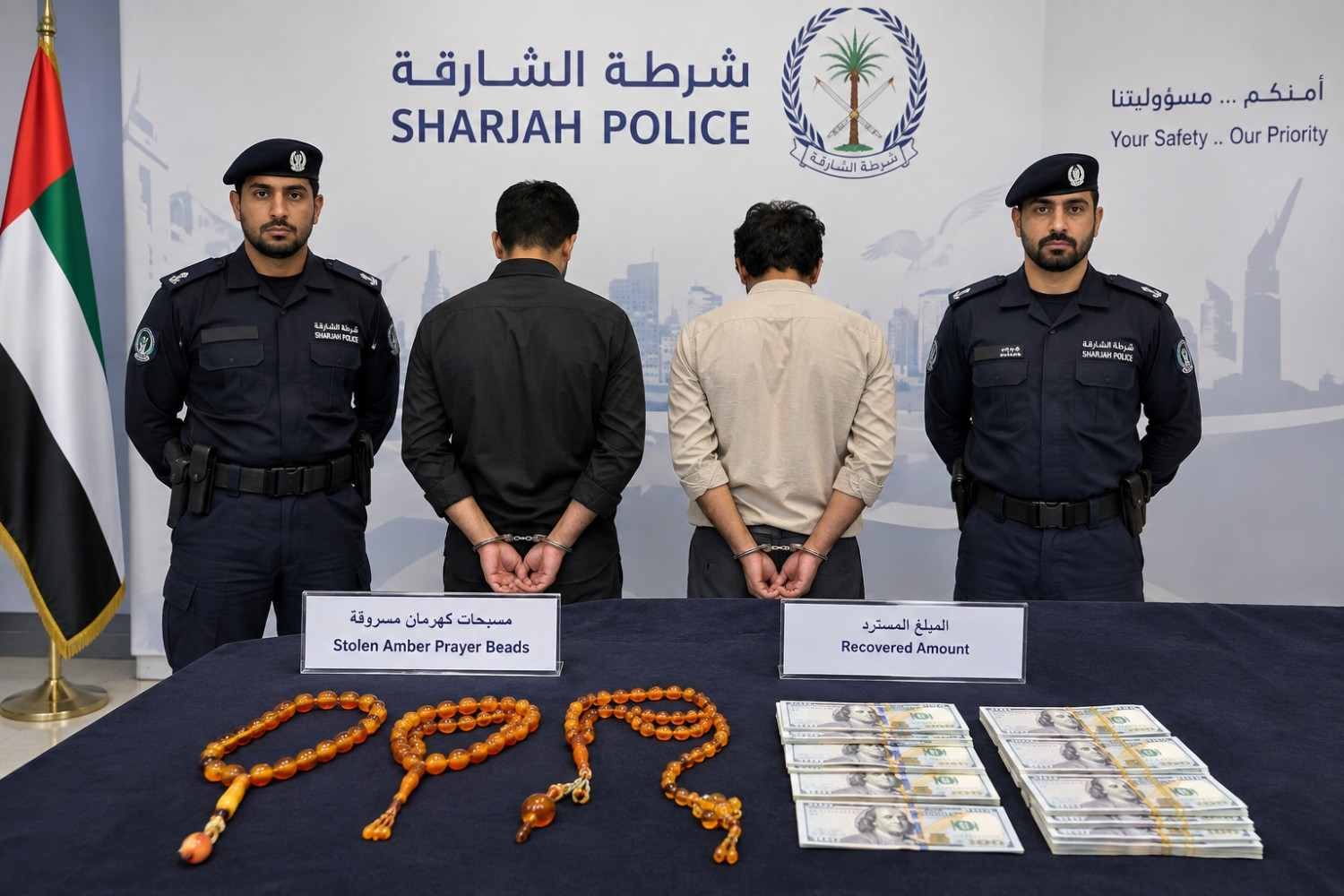
Sharjah Police have demonstrated the speed and precision of their investigative capabilities this week, arresting two suspects and recovering more than $100,000 worth of stolen amber prayer beads within just 24 hours of a theft being reported, in a case that highlights the growing risks residents face when trading valuable items through social media.
The case began when a Chinese national living in the emirate advertised a collection of amber prayer beads for sale online. According to police, two individuals responded to the listing, expressing strong interest in purchasing the entire collection and arranging an in-person inspection. Rather than completing a legitimate transaction, however, the pair allegedly lured the victim to a location within Sharjah, took possession of the goods through deception, and fled the scene.
A rapid police response
Brigadier Dr Khalifa Belhaj, director of the Criminal Investigations Directorate at Sharjah Police, said specialised investigative teams launched search operations immediately after the theft was reported. Officers moved quickly to collect physical evidence at the scene, examine forensic material and analyse available data in an effort to reconstruct the circumstances of the crime and identify those responsible.
The investigation moved rapidly. Police say their teams were able to clarify exactly how the theft unfolded, identify the suspects involved, and track their movements, ultimately locating both individuals in a neighbouring emirate. Working in close coordination with local security authorities there, Sharjah Police teams arrested the suspects and recovered the full value of the stolen goods, all within less than 24 hours of the initial report.
Brig Belhaj said the swift resolution of the case reflects the readiness and operational efficiency of Sharjah’s security teams, as well as their growing reliance on modern technology and data analysis techniques to solve crimes quickly. The case is being held up internally as an example of how forensic evidence, cross-emirate coordination and digital investigative tools can combine to deliver rapid results, even when suspects attempt to flee across jurisdictional lines within the UAE.
A warning for online sellers
Beyond the successful resolution of the case, Sharjah Police used the incident as an opportunity to issue a broader public safety message. The force is urging residents across the emirate to exercise greater caution when buying or selling valuable items through social media platforms, particularly when dealing with individuals they do not know personally.
Officers specifically recommended that residents verify the identity of buyers or sellers before agreeing to meet, and that they use safe, official or well-monitored locations for any transaction involving high-value goods, rather than agreeing to meet at private or unfamiliar addresses. The advice reflects a wider pattern seen across the UAE and internationally, where online marketplaces and social media selling groups have become an increasingly common vector for opportunistic theft and fraud, as sellers often reveal valuable items to strangers with limited ability to verify their intentions in advance.
Part of a broader public safety push
The case comes amid a series of recent public safety initiatives across the UAE’s police forces. In the days before this incident, Abu Dhabi Police highlighted a road safety campaign after a crash video circulated widely online, while Dubai Police reported impounding more than 13,000 e-scooters this year as part of an ongoing crackdown on reckless riding. Together, these efforts point to a broader emphasis across UAE law enforcement agencies on combining rapid response capabilities with proactive public education, aiming not just to solve crimes after the fact but to reduce the opportunities for them to occur in the first place.
For residents active on social media marketplaces, the amber prayer beads case serves as a timely reminder that even seemingly straightforward private sales can carry real risk, and that a few simple precautions, verifying identities and choosing safe meeting locations, can make the difference between a smooth transaction and a costly loss.


Comments 1