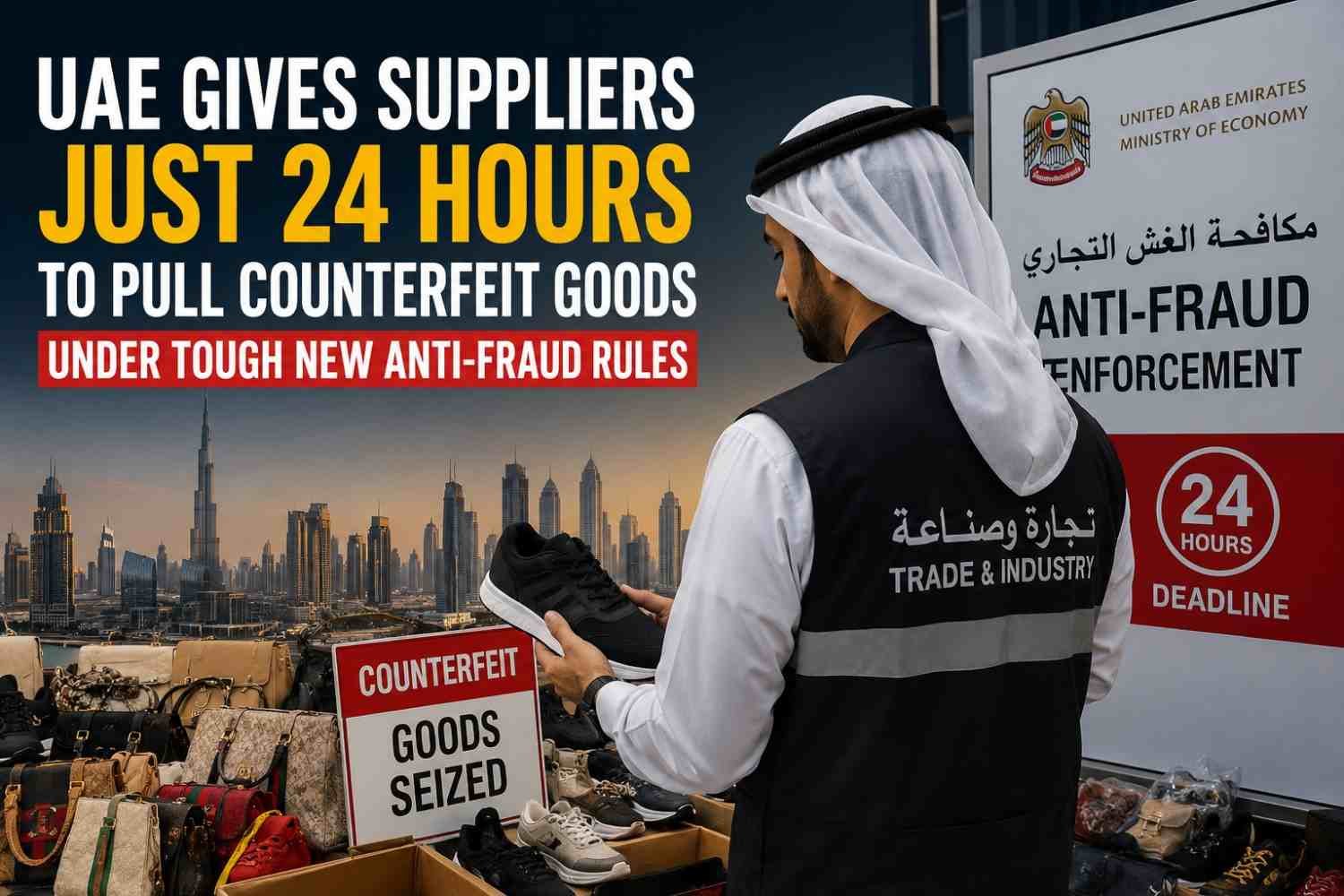
A Tight New Timeline for Businesses Selling Fake or Unsafe Products
Businesses operating across the UAE now face a strict new compliance deadline when it comes to counterfeit, adulterated or otherwise unsafe products: 24 hours. Under newly detailed executive regulations issued by the Ministry of Economy and Tourism, suppliers found to be selling non-compliant goods must immediately halt sales and remove the products from shelves and warehouses within a single day of being officially notified by authorities.
The regulations, which give practical shape to the UAE’s Anti-Commercial Fraud Law, were outlined in detail during a ministry briefing this week, even though the underlying rules technically came into force several weeks earlier. Officials say the timing of the briefing was intended to ensure businesses across all affected sectors fully understand their obligations under the tightened framework.
What the Rules Require
Under the regulations, once a supplier is formally notified that a product has been found to be counterfeit, adulterated, spoiled or otherwise unsafe, they face a cascading set of obligations. First, the business must immediately stop selling or displaying the flagged item. Second, within 24 hours, the goods must be physically withdrawn from all markets and warehouses under the supplier’s control. Suppliers are also required to notify every point of sale and every business entity that received the affected goods, instructing them to pull the products from their own shelves within that same 24-hour window.
Beyond the physical withdrawal, businesses must also provide the ministry with documented evidence confirming the recall has actually been carried out — a measure designed to prevent quiet, unverified compliance. On top of the product withdrawal itself, a public announcement about the recall must be issued within 48 hours of notification, published in both Arabic and English, ensuring consumers who may have already purchased the affected goods are alerted promptly.
In cases where a product is found to pose a serious health or environmental risk, authorities have the discretion to impose an even shorter compliance deadline than the standard 24-hour window, reflecting a risk-based approach to enforcement.
Who the Regulations Cover
Crucially, the new rules are not limited to traditional brick-and-mortar retail. The regulations explicitly extend across supermarkets, pharmacies and online marketplaces, a scope that reflects the rapid growth of e-commerce in the UAE and the corresponding rise in opportunities for counterfeit or substandard goods to reach consumers through digital sales channels. Authorities say this broadened scope was a deliberate design choice, aimed at closing potential loopholes that might otherwise allow non-compliant products to continue circulating through online platforms even after being pulled from physical stores.
The regulations also grant authorities expanded powers to seize suspected counterfeit or unsafe goods and hold them in designated storage at the violating business’s own expense while further examination and testing take place. Products ultimately confirmed as counterfeit, adulterated or imitation goods must be destroyed within a defined period following a formal ruling, unless alternate disposal arrangements are specified by the relevant authority.
The Scale of the Problem
The push for tighter enforcement comes against a backdrop of persistent counterfeit activity across the UAE market. Ministry data shows that in just the first three months of this year, authorities carried out more than 10,000 inspections across the country, uncovering nearly 190 separate breaches of commercial fraud regulations. Officials describe these figures as evidence of both the scale of ongoing enforcement efforts and the continued prevalence of counterfeit and non-compliant goods in circulation, despite years of crackdowns targeting smuggling and fake product distribution networks.
A senior ministry official overseeing commercial control and governance said the broader goal of the regulations extends beyond simply penalising offending businesses. Officials frame the rules as part of a wider effort to strengthen traceability and accountability across supply chains, while protecting consumers and, importantly, safeguarding legitimate businesses that already comply with the rules from being undercut by counterfeit competitors.
What It Means for Businesses and Shoppers
For businesses operating in the UAE, the message from regulators is unambiguous: compliance now needs to be fast, documented and verifiable, not just eventual. Companies that fail to meet the tightened deadlines risk not only financial penalties but also the seizure and destruction of affected inventory at their own cost.
For shoppers, the practical upside is a market designed to respond and self-correct far more quickly when a fraudulent or unsafe product surfaces. With clear timelines now in place for both withdrawal and public disclosure, consumers can expect to be informed of relevant recalls swiftly — an assurance regulators hope will further strengthen trust in the UAE’s retail and e-commerce sectors going forward. Next Article


