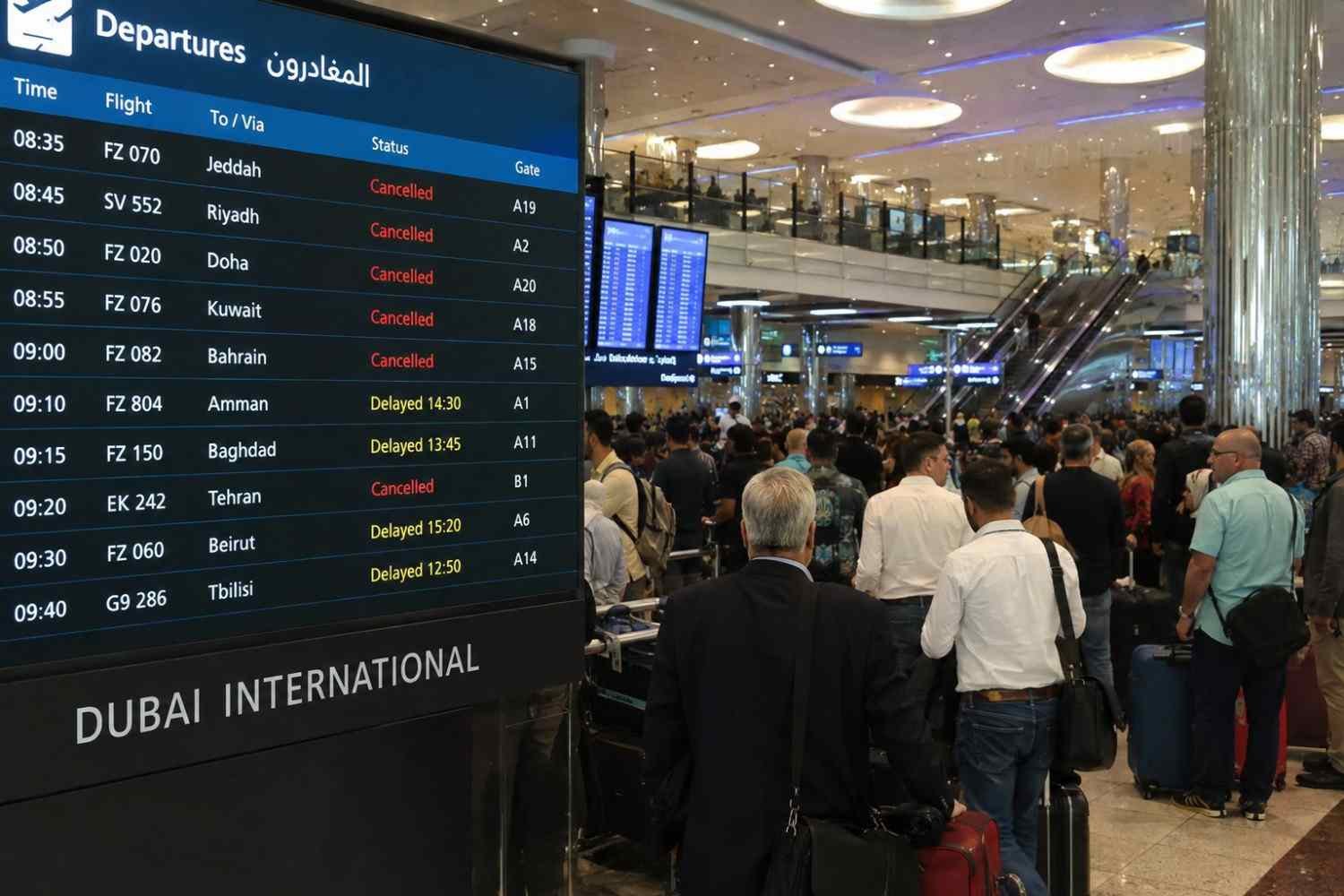
A Mixed Picture for Travellers
UAE-based airlines are continuing to operate the bulk of their networks this week, but passengers are being urged to check individual flight statuses closely as scattered delays and cancellations persist across the region following a fresh escalation in tensions between the United States and Iran.
Emirates, Etihad Airways, flydubai and Air Arabia have all issued updated travel advisories in recent days, with the four carriers broadly continuing to operate their core schedules while adjusting or suspending a smaller number of routes into destinations most directly affected by the volatile security situation. Airlines have stressed that schedules can change at short notice, and passengers travelling in the coming days should check directly with their carrier before heading to the airport.
What Triggered the Latest Disruption
The current round of disruption follows a rapid escalation that began when American forces struck Iranian military targets on September 1, reportedly in response to attempted Iranian attacks on commercial shipping in the Strait of Hormuz. Iran responded with missile and drone strikes targeting American interests and Gulf neighbours including Bahrain, Kuwait and Jordan, with Iranian officials also reporting casualties from the earlier US strikes on its own territory.
That exchange has kept airspace across large parts of the Gulf under a cloud of uncertainty, prompting airlines both regionally and internationally to reassess routes on a near-daily basis. The situation remains fluid, with airlines’ operational teams monitoring developments in real time and adjusting flight plans accordingly.
Regulatory Warnings Extended
Adding to the sense of prolonged disruption, the European Union Aviation Safety Agency (EASA) has extended its conflict-zone information bulletin covering the Gulf region through the end of September, warning of continued risk linked to the wider US-Iran conflict. While such bulletins are advisory rather than binding, they carry significant weight with international carriers, many of which have used them as the basis for extending route suspensions well beyond the immediate days following any individual incident.
A number of major international airlines have adjusted their UAE schedules as a result. Some carriers, including Turkish Airlines and Air France, have already resumed services to Dubai and Abu Dhabi after earlier suspensions, signalling a degree of returning confidence. Others have taken a more cautious approach: several European carriers have extended their suspension of Dubai or Abu Dhabi services into September and, in some cases, October, while select Asian and North American carriers have pushed affected routes even further out on the calendar. Notably, UAE-based carriers themselves have generally taken a less restrictive stance than many of their international counterparts, continuing to operate substantial portions of their networks even as foreign airlines apply their own, often more conservative, safety assessments.
What Passengers Should Expect
For most travellers passing through Dubai International Airport (DXB), Zayed International Airport in Abu Dhabi, or Sharjah International Airport, the practical experience for now is one of occasional delays and a handful of route-specific cancellations rather than blanket disruption. Airlines have cancelled selected services to destinations such as Bahrain and Kuwait, while other routes have seen minor timing adjustments rather than outright cancellations.
flydubai has advised passengers to allow at least four hours before their scheduled departure, and to complete online check-in wherever possible to reduce time spent at the airport. All four major UAE carriers are encouraging passengers to keep their contact details updated so they can be reached quickly with disruption alerts, and to monitor official airline and airport communication channels rather than relying on secondhand information.
Airports Bracing for Busier Skies
Adding a further layer of complexity, Dubai’s airports are simultaneously preparing for a seasonal surge in passenger traffic as residents and visitors return from summer travel, meaning airport teams are managing both a spike in volume and an unusually fluid security situation at the same time. Officials have not signalled any expectation of a broader shutdown of UAE airspace or a nationwide suspension of commercial flights, but have been candid that the situation could shift quickly depending on how the wider regional conflict develops in the days ahead.
The Bigger Picture
For an economy as reliant on aviation and connectivity as the UAE’s, sustained airspace uncertainty carries real stakes — from tourism and business travel to the broader logistics and trade networks that flow through Dubai and Abu Dhabi’s airports. Aviation analysts note that the resilience shown by UAE carriers so far, continuing to operate the vast majority of their networks even as some foreign airlines pull back, reflects both operational confidence and the strategic importance the government places on keeping the country’s aviation hubs running as close to normally as possible.
Until the underlying regional tensions ease, however, passengers flying to, from or through the UAE should expect the current pattern of rolling, route-specific disruption to continue — and should treat every flight status check as essential rather than optional in the days ahead. Next Article


Comments 1